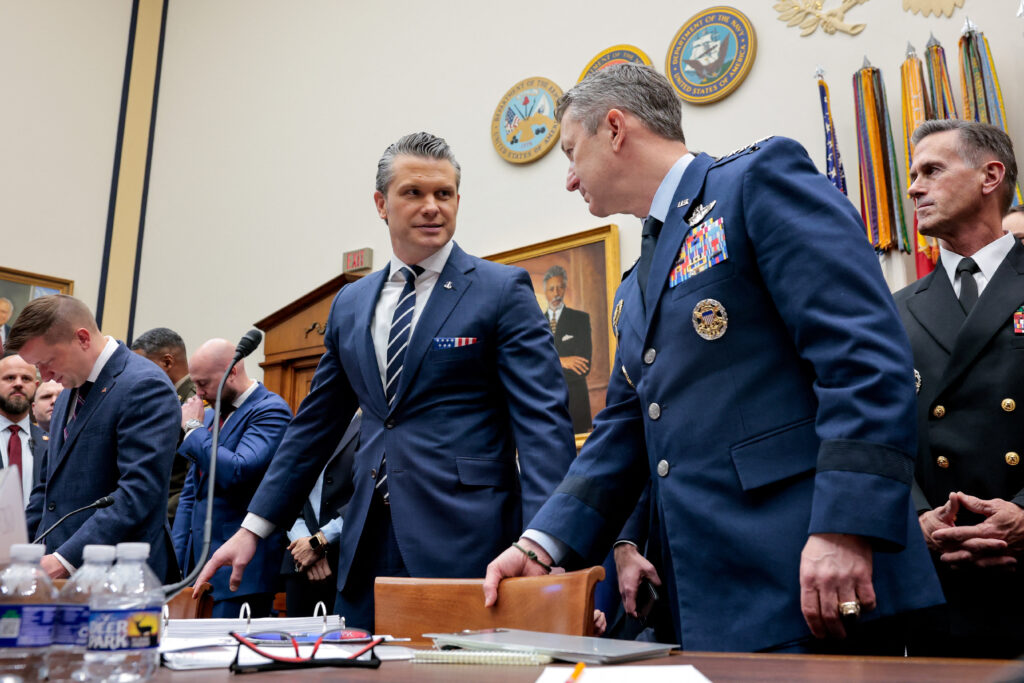
Defense Secretary Pete Hegseth deflected questions from Congress Wednesday on the future of the Iran war and attacked lawmakers who questioned the conflict’s purpose and goals, calling them “reckless, feckless and defeatist.”
A hearing on the Pentagon’s $1.45 trillion budget request for fiscal 2027 became a hotly contested debate on Iran, with House Armed Services Committee members asking how long the secretary expected the operation to last and Hegseth bristling at those who questioned the administration’s decision to go to war.
Committee members praised the work of the U.S. service members currently deployed to the Middle East, but they also wanted Hegseth to address the ultimate outcome.
Ranking committee member Rep. Adam Smith, D-Wash., asked Hegseth where the war was going. Rep. John Garamendi, D-Calif., said the military had executed the war with “tactical success” but called the administration’s strategy an example of “incompetence.”
The comments struck a nerve with Hegseth, who argued that President Donald Trump is the only U.S. leader to decide to physically stop Iran from developing a nuclear weapon.
“The biggest adversary we face at this point are the reckless, feckless and defeatist words of congressional Democrats and some Republicans,” Hegseth said, addressing Garamendi and others who have opposed the operation.
“Shame on you calling this a quagmire two months in the effort,” Hegseth added.
When the U.S. and Israel launched combat operations in Iran on Feb. 28, Trump said the goals were three-fold: destroy Iran’s missile capability; “annihilate” their navy; and ensure that the country would never have nuclear weapons.
The operation killed Iran’s supreme leader, Ayatollah Ali Khamenei, and several key leaders, destroyed Iran’s navy and wiped out key military installations. In retaliation, Iran launched missiles and air assaults on U.S. military facilities, killing 13 and damaging U.S. bases across the region, as well as civilian targets in Meddle East countries.
Hegseth noted that the Iranian navy has been destroyed, but Iran continues to have nuclear ambitions despite losing capabilities as a result of Operation Midnight Hammer last summer that Hegseth said “obliterated” facilities.
“You have to stare down this kind of enemy who’s hell bent on getting a nuclear weapon and get them to a point where they’re at the table giving it up,” Hegseth said.
The questions over the war’s future come as a 60-day deadline approaches Thursday under the War Powers Act. The legislation requires the president to seek congressional authorization to continue the operation or withdraw troops.
The law allows Trump to request an extension if the time is needed to safely withdraw U.S. troops.
According to testimony, the Iran war has cost $25 billion to date, with the highest costs coming at the beginning of the conflict as a result of the use of thousands of bombs and missiles.
Iran war has cost $25 billion so far, Pentagon official says
The Defense Department’s $1.45 trillion budget request for fiscal 2027 is 44% higher than the Pentagon’s current budget — the highest in modern history. It would fund an increase in military end-strength of 44,000 service members, provide a 5% to 7% pay raise to troops depending on rank and boost procurement funding by 76%.
“Under the leadership of President Trump our builder-in-chief, we are reversing … systemic decay and putting our defense industrial base back on a war-time footing,” Hegseth said.
During the hearing, lawmakers raised concerns about the firing of former Army Chief of Staff Randy George and the decision to remove general officers from promotion lists, with several praising the former’s 40-years of service and dedication to soldiers.
“Let’s talk about a guy who is a patriot. Someone who everyone on this dais has huge admiration for,” said Rep. Chrissy Houlahan, D-Penn., an Air Force veteran, referring to George.
In his response to Houlahan, Hegseth hinted that he fired George as part of a war on “woke” — Hegseth’s efforts to eliminate diversity or equity initiatives in the services.
“Out of respect for these officers, we never talk about the nature of their removal, but every one of them, including myself, knows that they serve at the pleasure of the president,” Hegseth said.
But, he added, “it’s very difficult to change the culture of a department that has been destroyed by the wrong perspective.”
During testimony, Chairman of the Joint Chiefs of Staff Gen. Dan Caine remained above the political fray, declining to answer questions he perceived as political.
“My duty is to ensure our civilian leadership has a comprehensive range of military options and the associated risks that to those leaders who make the nation’s hardest decisions and offer my military advice privately,” Caine said.
“My blueprint for this role is Gen. George C. Marshall. His commitment to civilian control of the military and nonpartisan military remains a constant standard, and something I borrow from often,” he added.