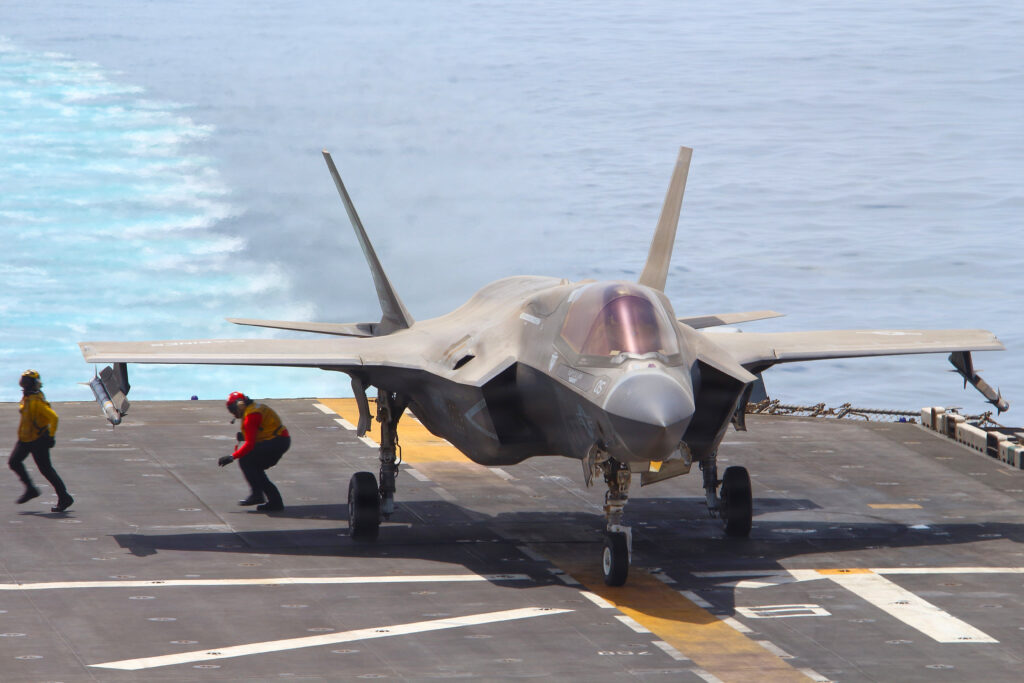
The Pentagon’s fiscal 2027 budget request seeks 85 F-35 Lightning II fighters across the joint force, up from 47 in fiscal 2026.
The increase would mark the largest single-year F-35 buy from the Pentagon since fiscal 2022 and a sharp reversal from last year’s reduced procurement.
The headline number depends on Congress passing a separate funding bill. Only 32 of the 85 requested aircraft are funded through the base discretionary budget. The remaining 53 are tied to a $350 billion mandatory funding request that the administration plans to pursue through a second reconciliation bill, alongside the $1.15 trillion base topline.
That bill has not yet been introduced.
House Speaker Mike Johnson has acknowledged that a second reconciliation bill could be a tough sell, and some House Republicans have pushed back on the idea after the One Big Beautiful Bill Act cleared Congress last year.
If the bill fails, the F-35 buy could plummet to 32 aircraft, below even the fiscal 2026 baseline of 47.
As proposed, the 85-aircraft buy breaks down to 38 F-35As for the Air Force, 37 F-35Cs for the Navy and Marine Corps, and 10 F-35Bs for the Marine Corps, according to the Department of War’s FY2027 Procurement Programs (P-1) book. The total program cost runs to roughly $21.4 billion across all three variants, according to budget justification documents.
The request also targets long-running problems with the program. A $324 million line inside the mandatory funding request would accelerate procurement of 200 Block 4 modification kits, advancing the first fleet delivery from fiscal 2031 to fiscal 2030.
Block 4, the upgrade package that adds new sensors, weapons integration, and electronic warfare capability, has slipped roughly five years from the original schedule. Much of the delay traces to hardware problems with the Technology Refresh 3 processor, the brains behind the Block 4 software.
The budget also targets the readiness problems that have plagued the aircraft. The F-35 fleet averaged a roughly 50% mission-capable rate in fiscal 2024, meaning that fewer than half of the aircraft were ready for combat at any given time. That figure falls well short of the program’s 65% availability target.
Acting Pentagon Comptroller Jules Hurst last week told reporters that the F-35 had been “underfunded in the past as part of the budget” and said the fiscal 2027 request is structured to drive that rate higher.
Service-by-service, the Air Force absorbs the largest share of the joint buy. The 38 F-35As requested by the Air Force are 14 more than the 24 funded in fiscal 2026. Combined with 24 F-15EXs sought in the same budget request, the Air Force’s total fighter buy reaches 62, still 10 shy of the 72-aircraft annual minimum National Guard generals told Congress this month is the floor for stopping the fleet from “actively shrinking.”
The Department of the Navy’s request doubles last year’s F-35 buy: 37 carrier-variant F-35Cs for Navy and Marine Corps squadrons, and 10 short takeoff and vertical landing F-35Bs for the Marine Corps. The increase comes after years of slower naval F-35 buys.
The maritime buy aligns with a 2025 Marine Corps aviation plan that cut the service’s planned F-35B fleet from 353 to 280 aircraft while raising its F-35C objective from 67 to 140. The shift moves the Marine F-35 force toward squadrons aboard Navy aircraft carriers rather than amphibious assault ships.
The proposed joint force F-35 budget request has not silenced critics of the procurement rate, with one taking direct aim at the Air Force.
Retired Lt. Gen. David A. Deptula, dean of the Mitchell Institute for Aerospace Studies, told Air & Space Forces Magazine the 38 F-35A figure represents “budget triage” rather than a serious recapitalization rate.
He argued the Air Force needs to buy even more F-35As to modernize its fleet.