The city has long been a beacon of opportunity, where folks flock to make it big. But metropolises the world over are wasting a major opportunity — many, many square feet of it: Flat rooftops are painted white, when really they should be green.
Not, mind you, shades of mint green, forest green, or lime green, but with the lushness of actual plants. Adding vegetation to roofs — even if it’s just a coating of grass, moss, and succulents — bestows many overlapping, reinforcing benefits not only on a building’s occupants and owner, but on the surrounding community. Like parks on the ground, gardens in the sky reduce local temperatures and help prevent flooding, all while improving urban biodiversity and feeding pollinators like bees.
According to a recent report prepared for the European Commission, the executive body of the European Union, if cities accelerated the transformation of these unused spaces into oases — and converted empty walls into vertical yet verdant surfaces — they’d make themselves more comfortable for urbanites as temperatures climb. Burgs might even start growing crops under solar panels, a burgeoning field known as rooftop agrivoltaics, simultaneously generating food and electricity. The technique could be especially powerful as urban populations continue to balloon: According to the United Nations, another 2 billion people could be living in cities by 2050. At the same time, a phenomenon called the urban heat island effect, in which the built environment warms much more than surrounding rural areas, is driving temperatures to increasingly dangerous levels.
“Our goal is to get our cities more dense, but keep them livable and climate-safe,” said Vera Enzi-Zechner, co-lead author of the report and a vice president at the European Federation of Green Roof and Living Wall Associations, based in Vienna, Austria. “Of course, also water comes in, energy comes in, multi-functionality, social cohesion, engagement, and biodiversity.”
Courtesy Over Easy Solar
The green roof is a surprisingly old technology. Consider the Moos Water Filtration Plant, near Zurich, whose rooftops have hosted nine acres of meadows for over a century. Less of a planned amenity and more of a serendipitous colonization of plant life, the rooftops have nevertheless transformed into refuges for native species.
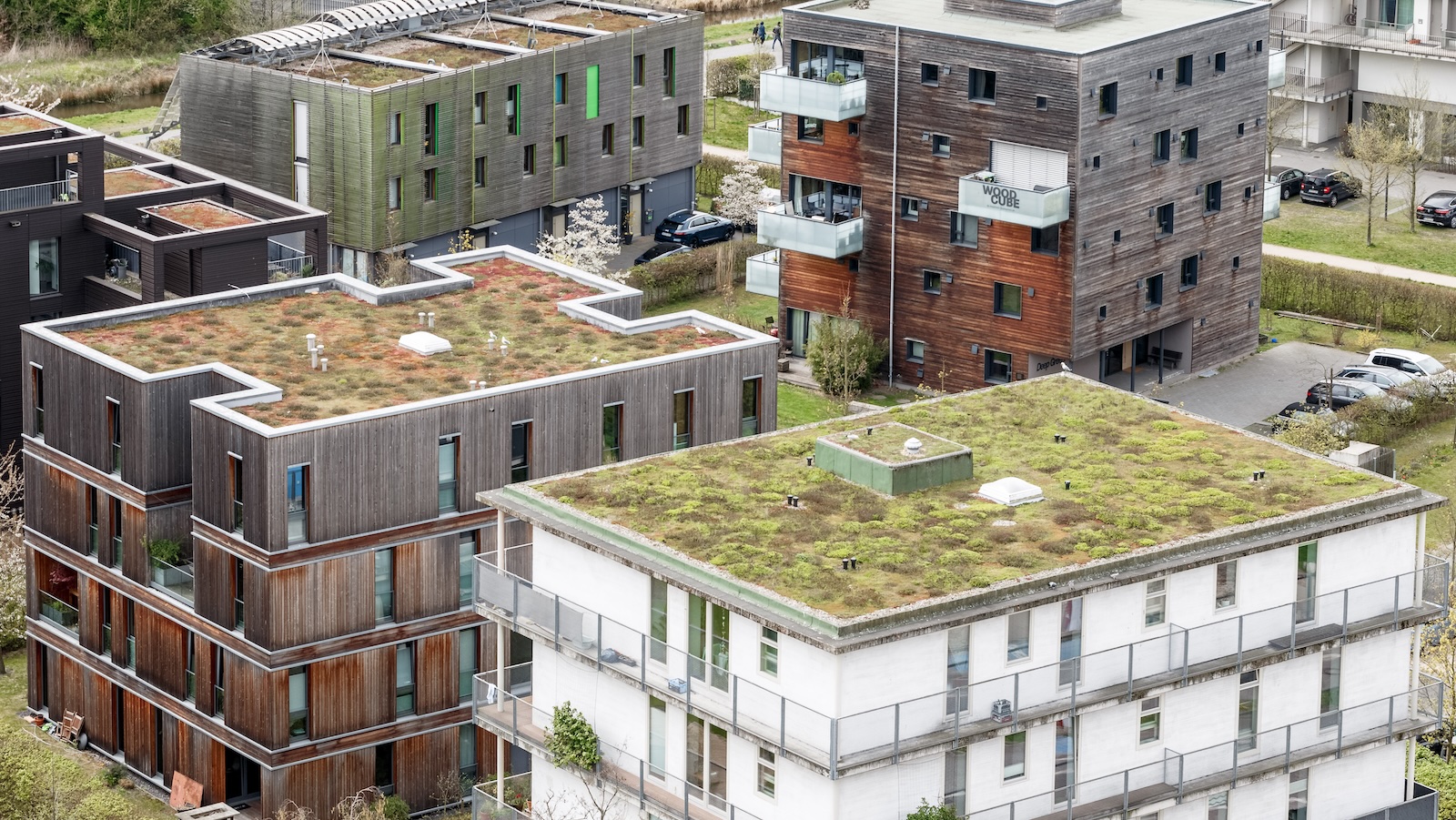
These days, architects would rather not have their buildings bloom by accident. Instead, they’re incorporating the requisite infrastructure into the design. To keep the garden from leaking into the top floor, for instance, they add waterproofing and barriers to contain roots. Designers also must consider the additional weight of the plants and water that soaks into the substrate. How much weight, exactly, will depend on what they want to grow: It might be simple grasses and mosses, like at the Moos Water Filtration Plant, or shrubs, or even trees, whose roots require a thicker layer. And it’s never too late to do this. An owner can add a green roof after construction is finished, though it might require reinforcement.
The investment, though, could pay serious dividends over time. Whereas a traditional roof absorbs the sun’s energy, a green one sweats like a human, as its plants release water vapor during photosynthesis and shade the surface. This cools the air, and the substrate and waterproofing insulate the top floor. Beyond reducing cooling and heating costs, the greenery can extend the life of a roof, the report notes, because relentless sunlight, and extreme heat waves and hail, aren’t aging shingles and paint and such. (Traditional roofs are constantly stressed by expanding and shrinking, as the sun heats them during the day and the night cools them off.) Down at street level, building owners can cover walls with vegetation, protecting them from the elements and providing habitat for birds and bats.
Cities, too, could save money by embracing gardening in the sky. As the planet heats up and rainfall gets more intense, gutters and sewers — designed for the climate of yesteryear — are struggling to keep up. Green roofs soak up some of that deluge, and slow the flow of water into these systems, preventing costly flooding. Some designers are even going a step further with blue-green roofs, which incorporate systems that store rainwater to flush the toilets inside.
Markus Scholz / Picture Alliance via Getty Images
So instead of all that precipitation flowing into sewers and out to sea, some of it goes instead to plants and people. “That is the basic principle for improved resiliency for many cities around the world,” said Steven Peck, founder and president of the nonprofit industry association Green Roofs for Healthy Cities. “We’ve got to capture that water and use it to support plants, because plants will do good things for us, like clean the air. They’re good for our mental health. They’ll cool the city.”
Beyond reducing temperatures and flooding, all this additional greenery creates much-needed habitat for local plants and animals. It’s all well and good to have parks and gardens dotting a city, but this creates better pathways for species. Ideally, green roofs and walls would form a citywide network of stepping stones for flying creatures to move around safely, settle down in shelter, and tap reliable supplies of food. Indeed, the report notes that study after study has shown that this not only boosts biodiversity, it provides havens for endangered and rare species of flora and fauna. “We cannot just integrate green roofs or green walls into the urban environment,” said Maria Manso, co-lead author of the report and an assistant professor of engineering at Lusófona University in Lisbon, Portugal. “They have to be connected with other nature-based solutions in order to have this urban connectivity.”
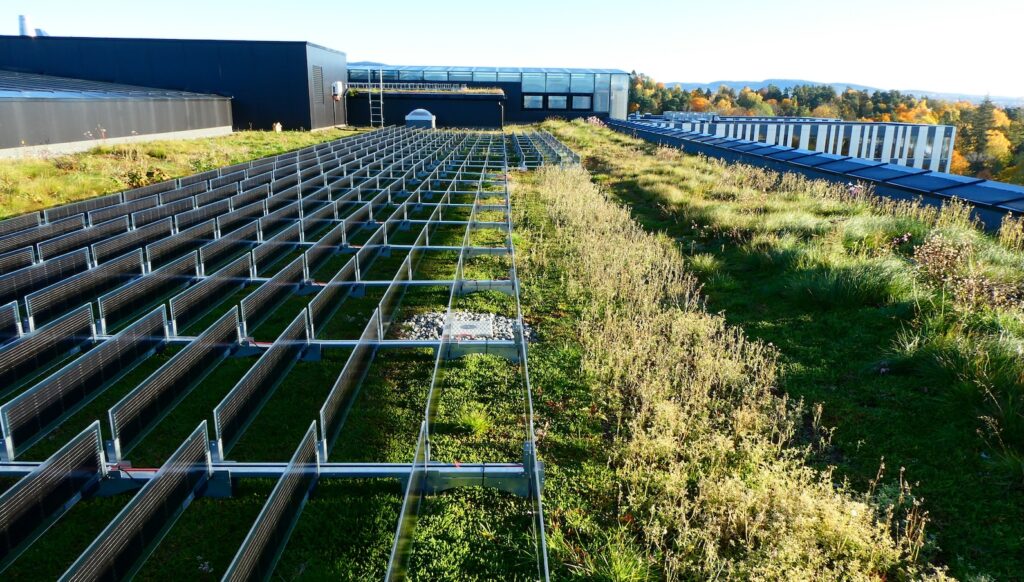
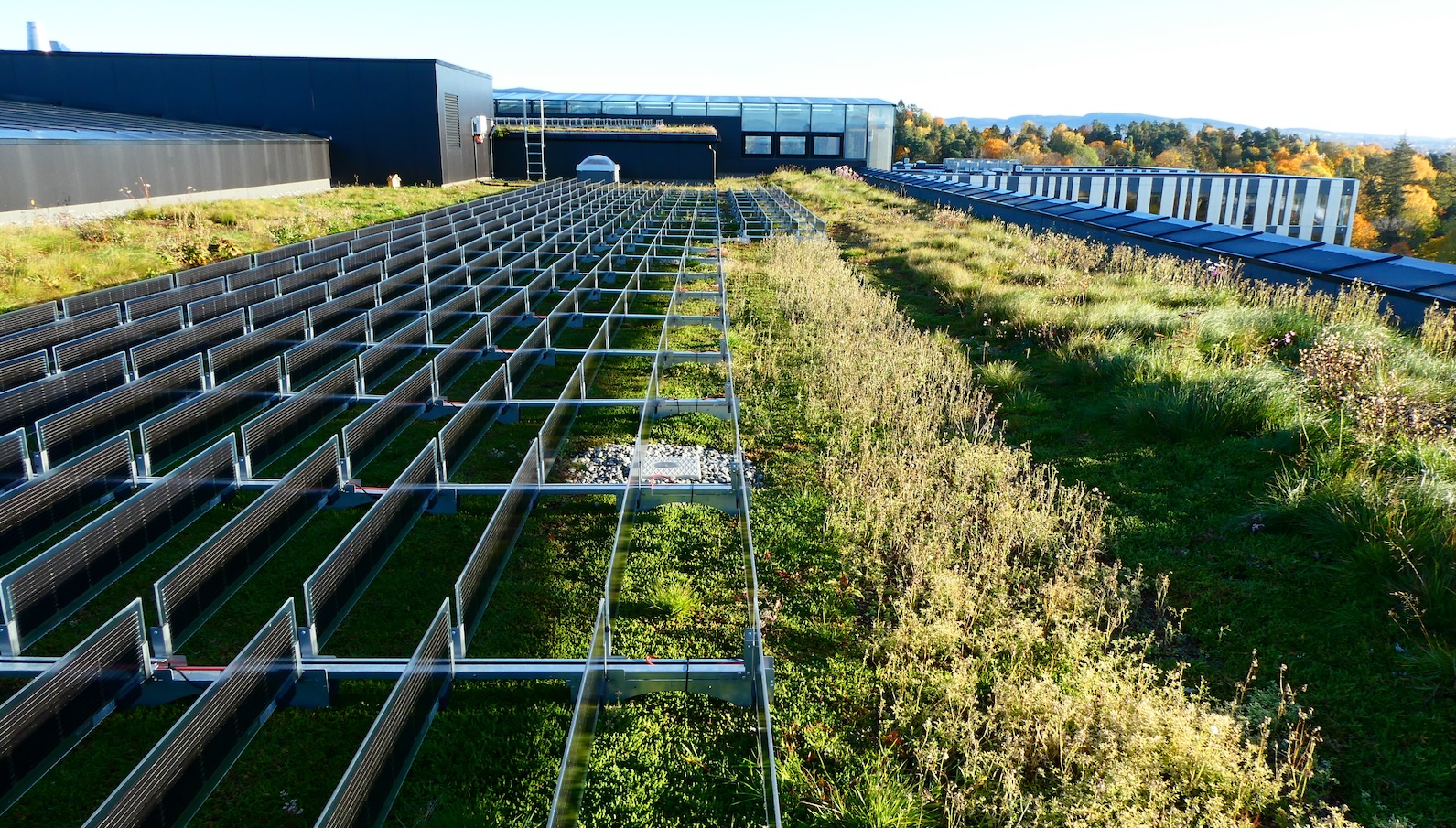
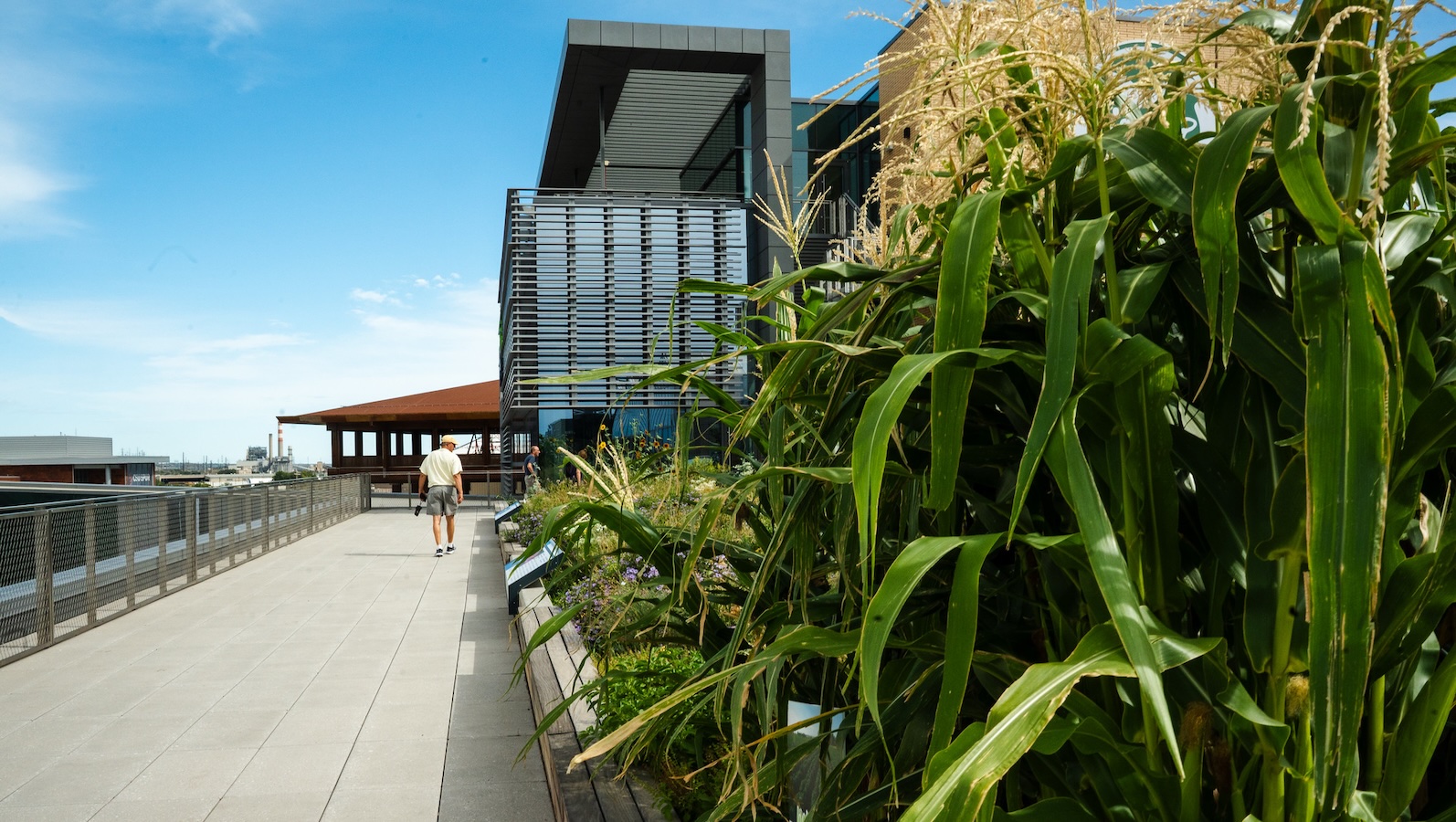
Free-roaming insects and birds will support the next frontier of green roofs: Scientists are now trying to figure out what crops might grow well up there, under the shade of solar panels. These rooftop agrivoltaic systems shelter the plants from fierce winds and excessive sunlight, and in turn the vegetation releases water vapor, cooling the panels above and increasing their efficiency, meaning they can generate more electricity. Early research is finding that warm-season crops in particular, like watermelon, do astonishingly well high in the sky, with cucumbers growing as big as baseball bats. The fliers visiting these plants may well travel to nearby urban gardens on the ground and pollinate crops there, or even head to traditional agricultural fields abutting the city.
Courtesy Kevin Samuelson, CSU Spur
The early results with rooftop agrivoltaics are so promising, in fact, that projects are popping up around the world. In Italy, for instance, the Florence airport’s roof will soon host solar panels and a vineyard. “They couldn’t decide between renewable energy generation or their cultural heritage of growing grapes,” said horticulturist Jennifer Bousselot, who studies rooftop agrivoltaics at Colorado State University but wasn’t involved in the report. “So they decided to actually combine the two.”
While photovoltaic panels increase the upfront cost, they too can pay dividends, and not just with the energy they provide. Because their shade reduces evaporation, rooftop gardeners need to apply less water. That could also mean that a designer might not need as thick a layer of soil to retain water, if less of it is evaporating away. “So in theory, you can actually have a shallower green roof if you’ve got shade integrated, and still have high diversity and high plant success,” Bousselot said.
Given all these benefits, how can cities encourage the proliferation of verdant roofs and walls? The report points out that starting decades ago, Basel, Switzerland provided subsidies for greening the city’s roofs, then changed its building codes to mandate that all new and retrofitted flat roofs get the treatment. By 2010, the city had increased its green roof surface area from 10 to 100 hectares (247 acres). “This tenfold increase,” the report notes, “positioned Basel as a leading example of how coordinated policy, financial support, and ecological standards can effectively accelerate the adoption of biodiversity-friendly green roofs in urban environments.”
In the United States, cities set their own building codes, so they could do much the same. A growing number of municipalities in the U.S. are also starting to charge property owners for the rainfall runoff they produce: The more impervious surfaces you have, the more you pay. Rip out more concrete, though, and install gardens high and low, and you can reduce those fees.
This being American real estate, developers will want to know that even in the absence of subsidies, the things can make money over time, whereas traditional roofs lose it because they have to be replaced within decades. Buildings can even rent out their verdant rooftops for private events.
Cities the world over stand at an inflection point: Invest now in as much green space wherever they can get it, or risk withering as the world warms. “They’re going to be healthier places to live in the face of ongoing climate change impacts,” Peck said. “And that’s where the money is going to be. That’s where the creativity is going to be.”
This story was originally published by Grist with the headline The huge, untapped potential of planting rooftop gardens in cities on Apr 27, 2026.