Two years ago today, an intense heat wave engulfed much of Brazil. For five days at the end of April 2024, temperatures in the central and southern regions climbed to sweltering heights. Many affected were still reeling from another extreme heat wave that had walloped southern Brazil. Just the month before the heat index in Rio de Janeiro reached a staggering 144.1 degrees Fahrenheit, the highest in a decade.
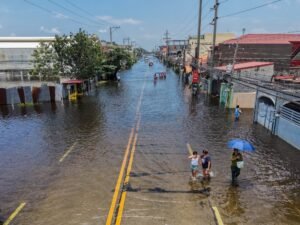
The two events were part of a cycle of prolonged and severe periods of heat that hit one of the world’s largest agricultural powerhouses over several years. Yields of soy and corn, two of Brazil’s biggest commodities, fell in southeastern states like São Paulo. Peanuts, potatoes, sugarcane, and arabica coffee also suffered widespread losses. Droves of livestock pigs in the central-western region were afflicted with severe heat stress for the better part of a year. And when an atmospheric cold front was blocked by the prevailing heat dome and triggered devastating rainfall and flooding throughout the southernmost state of Rio Grande do Sul, the supply chain and markets for pink shrimp were disrupted throughout Brazil.
Much of this data is documented in a new joint report released last Wednesday by the World Meteorological Organization and the Food and Agriculture Organization of the United Nations. Merging weather datasets with agricultural ones, the report traces the compounding effects of extreme heat on the global agricultural system and outlines how to produce food in a world where extreme heat is becoming a baseline.
In the report, Brazil is the sole country-level case study explored in detail; the country’s exports face outsize pressure from warming temperatures and the oscillating extremes of natural weather cycles El Niño and La Niña. But a few dozen other nations are mentioned in the 94-page document, too.
The authors cite how, in Chile, warming seas in 2016 prompted massive algae blooms that killed off an estimated 100,000 metric tons of farmed salmon and trout, creating the largest aquaculture mortality event in history. In the U.S.’s Pacific Northwest, when one of the strongest heat waves ever recorded struck in 2021, entire raspberry and blackberry harvests were lost, Christmas tree farms saw 70 percent timber volume declines, and the intersection of extreme heat, vegetative drying, and wildfires led to an increase of between 21 and 24 percent of forest area burned in North America that year. After a record heatwave hit India in 2022, wheat in over a third of Indian states fell anywhere between 9 and 34 percent, dairy animals afflicted with heat stress produced up to 15 percent less milk, and some cabbage and cauliflower yields were halved. And last spring in Kyrgyzstan’s Fergana mountain range, a region known for its year-round snow, spring temperatures rose 50 degrees Fahrenheit higher than the seasonal average — a bout of weather so unusual that it contributed to a locust outbreak and dramatic declines in cereal harvests.
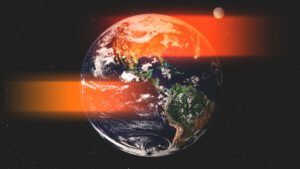
Human-caused warming has already been increasing at an unprecedented rate. The past 11 years are also the 11 warmest years on record. “We’re not moving at a speed that is good enough,” said Martial Bernoux, senior natural resources officer at the FAO’s Office of Climate Change, Biodiversity, and Environment. “And we have, really, a residual risk that is increasing.”
On a high-emissions trajectory, much of South Asia, tropical Sub-Saharan Africa, and parts of Central and South America could experience as many as 250 days a year that are simply too hot to work outside by the close of the century, according to the report.
Dangerous exposure to heat is already an occupational crisis for much of the world’s agricultural workforce. A 2024 report by the International Labour Organization found that extreme temperatures had put more than 70 percent of the global workforce, or some 2.4 billion people, at high risk. Those findings spurred a call to action on extreme heat by António Guterres, the Secretary-General of the United Nations, in the summer of 2024. He urged governments and the international community to prioritize four areas: caring for the most vulnerable; stepping up protections for workers exposed to excessive heat; boosting resilience using data and science; and quickly and equitably phasing out fossil fuels.

“Heat is estimated to kill almost half a million people a year,” said Guterres at the time. “That’s about 30 times more than tropical cyclones. We know what is driving it: fossil fuel-charged, human-induced climate change. And we know it’s going to get worse.”
According to Bernoux, the joint FAO-WMO analysis is a direct response to the UN Secretary-General’s call to action. “The UN said, ‘We have a problem,’” said Bernoux. “So FAO and WMO, we decided to work together to be able to reply to that.”
Naia Ormaza Zulueta, a postdoctoral researcher at the University of British Columbia studying extreme heat and the agricultural workforce, questions whether their report focuses enough on the people who grow, harvest, and raise the world’s food.
“The diagnosis in this report is sharper than anything we’ve had before, and that matters,” said Zulueta, who calls it a breakthrough in perspective — one that underscores how climate change and food systems can no longer be studied in isolation. “The prescription is where the system hasn’t caught up.”
First, the worker exposure calculations omit both hourly and nighttime wet-bulb exposure; Zulueta argues that these finer-grained metrics capture the severity of heat exposure for outdoor workers better than daily averages — meaning that she thinks the number of days of dangerous heat identified in the report is likely an undercount.
The report’s recommendations on how the sector can best adapt also center entirely on crops, livestock, and ecosystems — such as planting earlier or later in the season, developing heat-tolerant breeds, and investing in large-scale irrigation systems. Direct recommendations for agricultural laborers, though, only appear in passing references to existing international agreements on worker safety and health adopted more than a decade ago. For instance, the FAO and WMO call for dramatically increasing global climate-related development finance for food systems and increasing early-warning systems to lessen extreme heat’s compounding risks, but no concrete roadmap is provided for how best to adapt food production in order to protect the billions of outdoor workers exposed to intensifying heat.
Perhaps the oversight, says Zulueta, is because UN agencies tasked with worker rights — like the International Labour Organization — weren’t involved in the report. Even so, she finds it hard to justify, given the UN Secretary-General’s own emphasis on protecting the workforce from escalating temperatures.
“The workers are present in the diagnosis, but they’re largely absent in the prescription,” Zulueta said. “It’s a little sad, to be honest with you. It almost feels like the human dimension is missing, and everything that comes with it.”
This story was originally published by Grist with the headline The world is getting too hot to feed itself on Apr 27, 2026.