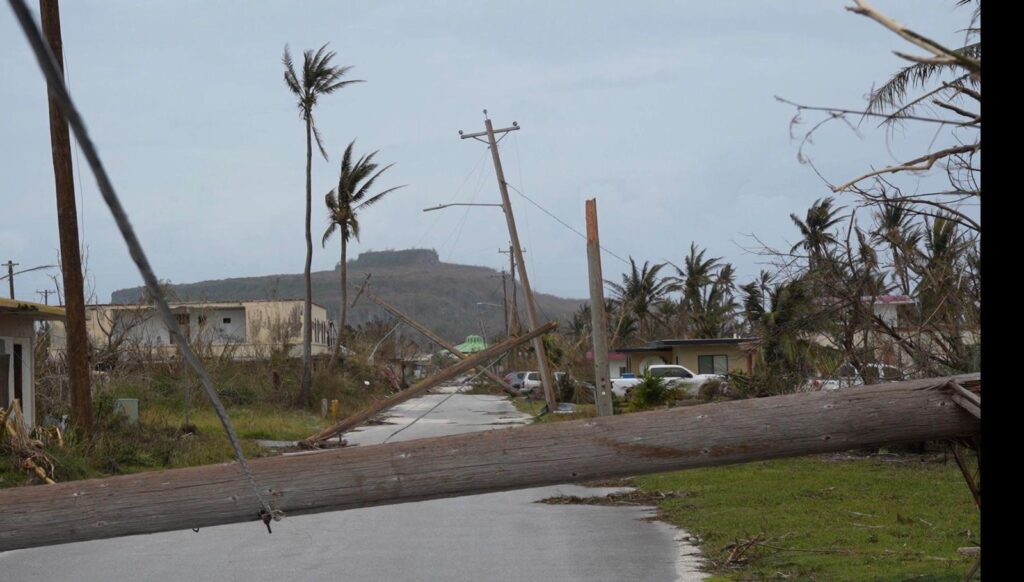
When a 150-mph cyclone hit the Mariana Islands in mid-April, federal officials handed out more than 1,400 tents and 1,100 temporary roofs to help families with damaged or destroyed homes. Last week, local officials urged residents to take the tents down and find safer shelter as another super typhoon approached.
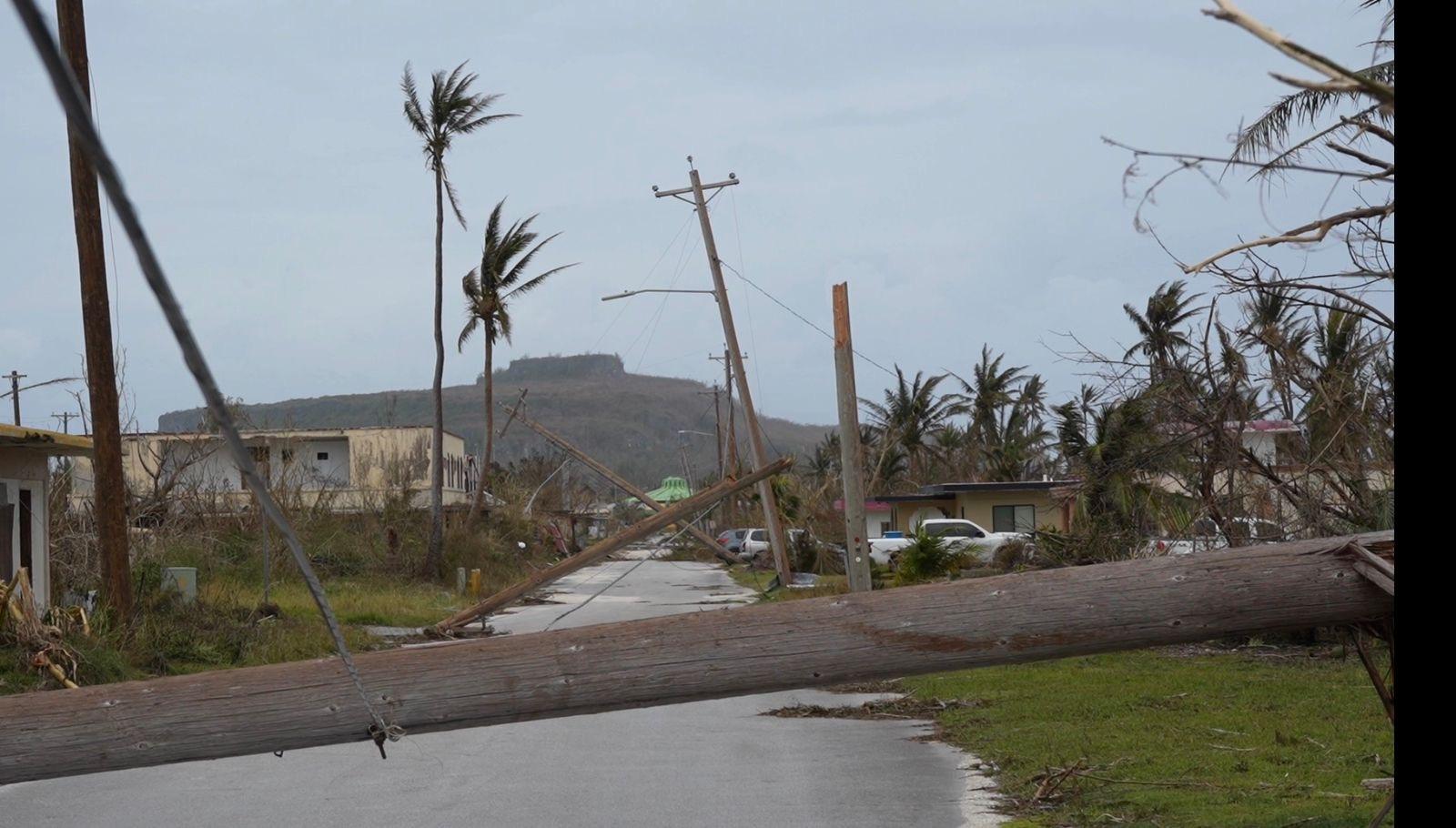
“Those tents are not rated to withstand anything stronger than a weak tropical storm,” Miguel Dandan, a public information officer for the Commonwealth of the Northern Mariana Islands, told NMI News Service. Days later, Super Typhoon Bavi hit the island of Rota with 180 mph winds; the neighboring islands of Guam and Saipan saw winds over 100 mph. “Our washer flew, our dryer, even our freezers flew. Everything, even the trees in the back broke down and fell on our cars,” Rota resident Peter James Meskin told the Marianas Press.
It’s the second massive typhoon to pummel the Marianas in less than three months, and the archipelago is only a week into its typical typhoon season. The islands are home to Indigenous Chamorro and Carolinian peoples who are accustomed to frequent storms, but scientists say climate change is making them more intense. It’s part of a broader pattern of Indigenous Pacific peoples bearing the brunt of climate impacts while contributing relatively little to the burning of fossil fuels that cause the atmosphere to warm.
Kristina Dahl, a climate scientist who leads the science division at the nonprofit Climate Central, said abnormally hot ocean waters due to that warming atmosphere intensified both Bavi and Sinlaku, another super typhoon that struck Chuuk with 185 mph winds then weakened to 150 before hitting the Marianas on April 14. “In both of these cases we can see the fingerprint of climate change on the storms and that has really devastating consequences for the people who are repeatedly in their paths,” she said.
Federal emergency officials were still processing disaster aid applications for Sinlaku when Bavi hit on Monday, and many families were still without power. A June 26 update from the commonwealth government estimated 29 percent of utility customers — more than 4,000 — lacked electricity more than two months after the April storm. Zeno Camacho Deleon Guerrero Jr., an Indigenous Chamorro resident of northern Saipan, considered himself lucky that his outage lasted only a little over a month after Sinlaku. But now his family is out of water and power again. Deleon Guerrero had been in Japan on a work trip when Sinlaku hit and was shocked to see the islandwide destruction on Saipan when he returned. “We were all just jaw-dropped flying in from Guam, being able to just see the whole south to north landscape, and it was just brown, dry and toasted bare,” he said. “We got the house cleaned up to a standard where it was livable but to where things were actually clean it was impossible because there was just a lack of running water.” He saw his neighbors lining up as early as 3 a.m. to buy water.
Bavi didn’t hit his village as hard as Sinlaku did, but he still spent the storm mopping up water coming in through the windows. “It was honestly really chilling and terrifying to hear the rattling of the windows and just wondering, is it going to cave in or burst in at any moment?”
Courtesy of Marianas Press
Deleon Guerrero’s experience might be repeated yet again before the year ends. The National Oceanic and Atmospheric Administration estimated last month that U.S.-affiliated Pacific island nations and territories would experience more frequent tropical cyclones due to El Niño, a weather pattern that shifts warm waters in the Pacific Ocean east toward South America. Chuuk is expected to see four to six cyclones this year, with Saipan and Guam potentially experiencing as many as seven tropical storms and typhoons.
Dahl noted that while El Niño may be fostering the formation of those storms, climate change is making them more intense. “Our data shows that the temperatures that (Bavi) is encountering along its path are 10 to 40 times more likely to be as hot as they are because of climate change,” she said.
The fact that storms are growing more intense has major implications for Pacific peoples’ homes, health, economies, and lives. There are no confirmed deaths from Bavi so far, but Sinlaku was the deadliest storm to strike the Micronesian region in more than two decades, with the death toll reaching 17 across the Federated States of Micronesia, Guam and the Northern Marianas.
Deleon Guerrero, who works as solidarity director at the nonprofit Right to Democracy that advocates on behalf of U.S. territories, said the commonwealth’s inability to meaningfully participate in the federal government — including its lack of a vote in Congress or for president — makes it hard for the community to have any say in critical moments like this, when the commonwealth relies so heavily on federal disaster response.
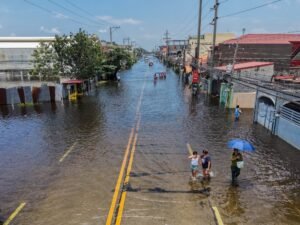
The day after Bavi swept through the Marianas, Deleon Guerrero woke up to another landscape of destruction, with his neighbors’ temporary roofing installed post-Sinlaku now part of typhoon debris.
“We understand that it was meant to be temporary but it just goes to show that in this region, especially with the climate changing the way that it is, these temporary fixes aren’t cutting it,” he said. “A lot of people are just back to square one when some people thought we were making some meaningful progress.”
Grist reporter Joseph Lee contributed to this story.
This story was originally published by Grist with the headline Another super typhoon just pummeled the Pacific on Jul 8, 2026.