The U.S. needs to ramp up focus on building a variety of cheaper weapons systems at scale to ensure sufficient supply for future fights, according to Anduril’s president and chief strategy officer.
U.S. industry became complacent and got “ambushed by the future,” said Christian Brose, who was on hand last week at the Washington Post’s inaugural Building America Summit to discuss defense industry developments.
“There was just no way of thinking that this formidable capability institution could be disrupted, and I think that there was a failure of imagination,” Brose said.
Brose added that the nation has been “systematically failing” at making necessary changes to project a stronger footing in the U.S.-China competition. He pointed to lessons from the Ukraine war and Operation Epic Fury, adding that Tehran has been evolving technologically and ramping up asymmetric capabilities.
“We’re struggling right now with a regional power of Iran that isn’t even close to what China would present to us,” Brose said. “And we’re struggling to some extent because we haven’t necessarily learned our own lessons of Ukraine and other recent events.”
Anduril recently opened a new 5-million-square-foot facility in Columbus, Ohio, where the company produces a range of munitions destined for the U.S. military.
Brose pointed to the new facility as evidence of Anduril meeting the military’s demands — under one roof — for mass produced, quickly built weapons that cost a fraction of a munition like a PAC-3 interceptor or Tomahawk missile.
“The point is not that the government should stop buying the exquisite weapons and instead just buy ours,” Brose said. “It’s that if all you have in a fight is a Tomahawk, that’s all you’re going to use, which is why in the first opening weeks of Epic Fury, we shot eight to 10 years of Tomahawk production in a few weeks.”
Brose added that once the military puts significant dents in stockpiles of munitions that are “artisanally built and incredibly expensive,” it can take years to replenish that production capacity.
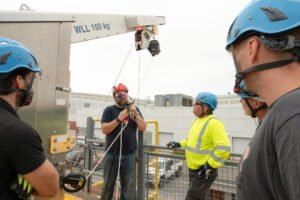
He said that Anduril is instead building systems that can be completed by workers with minimal training and simple tools, much like how the country built weapons during World War II.
“It was Rosie the Riveter, not like Martha, the master welder, who took 14 years to become proficient at every craft,” Brose said, noting that to quickly build at scale, the nation has to take advantage of the country’s industrial workforce.
“It’s a whole different approach to the manufacturing philosophy, and it enables you to scale 10x [or] 20x to get to that order of magnitude … that I think we’re going to need to be able to be relevant in these protracted conflicts,” Brose said.
America, Brose added, has been too concerned with creating perfect technology, making the process long and failures unacceptable.
He highlighted the belief of how certain older systems, like the Tomahawk and Patriot, have given the country military advantage for a generation, but the nation needs to be constantly producing, testing and learning from mistakes.
With the Ukraine war, Brose said that there’s no piece of technology that jumps out at him. Instead, it is the cycle of innovation and rebuilding at scale.
“When you look at the opening days of Epic Fury, obviously the United States and Israel have inflicted an enormous amount of damage on Iranian leadership, government, military, industrial base, but Iran’s still in the fight,” Brose said.
“They’re still in the fight because they’re using a lot of these asymmetric capabilities, low-cost drones, different types of systems.”