For more than 15 years, the Office of Naval Research has explored how video games can affect human cognition. While researchers often found evidence that they can improve cognitive performance, the concept has had limited application into real-world programs.
That may be changing.
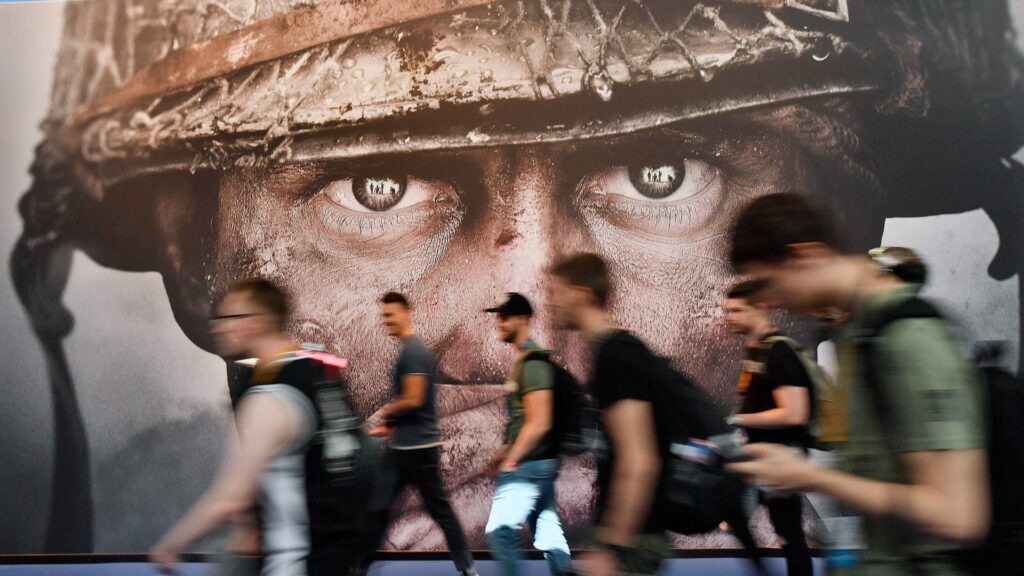
In January, Marine Corps University began using a modified version of Call of Duty: Modern Warfare 7 at its sergeant’s course in Quantico, Virginia, to help strengthen leadership, communication, critical thinking and decision making under pressure.
The program, called Research into Competency Acquisition with Novel E-gaming, or R-CANE, was developed through a partnership with Virginia Tech and the University of Memphis with funding from the Office of Naval Research.
Brig. Gen. Matthew Tracy, commanding general of Marine Corps Education Command and president of Marine Corps University, described R-CANE as enhancing “natural intelligence” rather than traditional training. Although the game has Marines playing avatars that use weapons and fight enemy combatants, he said the purpose is improving cognitive performance.
“What the game allows us to do is manipulate that cognitive load on the Marines’ actual brain and their ability to take in information, process that information, observe, create a plan on the fly, articulate that plan amongst their team, reassess that plan, create another one, rearticulate that, all as they’re being loaded with information coming in,” he told Military Times.
Tracy said that he will “pounce” on the word “training” when it comes to describing the program because he thinks it would benefit anyone in any profession or job set, ranging from a sniper to NFL player to cocktail party host and even to a writer.
“Who would not benefit from enhanced brain performance?” he inquired.
Inside the program
Louis Hickman, an assistant professor of industrial-organizational psychology at Virginia Tech and principal investigator of the project, said Marines are grouped into teams of six, with one Marine assigned to lead the other five. Wearing gaming headsets and sitting behind monitors, they work together as a fireteam to complete missions.
Hickman said the 14 custom-designed levels vary in difficulty and mission. Easier scenarios help Marines familiarize themselves with the game, while more difficult levels challenge them to collaborate and adapt under pressure.
“The goal is not to train the Marines on military protocol,” Hickman said. “It’s to help concretize some of the lessons that are already taught in the sergeant school around leadership, communication and collaboration.”
Gameplay footage shared with Military Times shows Marines clearing an office building before facing a sudden shift in mission: enemy combatants surround the building, forcing the team to move to an extraction point.
The increased pressure quickly creates chaos. Players are killed and respawned to continue the mission, forcing rapid communication and adaptation under stress.
Throughout the exercise, observers monitor player reactions, positioning and communication. Once the level is complete, a large language model, or LLM, trained with military policy, generates prompts for an after-action review.
“The goal is to get the Marines to engage in reflection and metacognition to help concretize potential learnings from the gameplay scenario,” Hickman said.
He added that players may not fully benefit from the experience unless they take time to reflect on what happened and consider how it would translate to a real-world engagement.
A review from the classroom
Master Sgt. Christine Monroig, the staff noncommissioned officer in charge at the sergeant school, said in an email to Military Times that she was initially skeptical of the program but came to see how it could benefit participants after experiencing it firsthand.
“I quickly recognized its value as an innovative training tool that complements traditional instruction by enhancing communication, decision-making, adaptability, and cognitive performance in a dynamic and engaging environment,” she wrote. “Rather than replacing existing methods, it serves as an additional capability that can further prepare Marines for the demands of future conflict.”
Monroig said she had very little experience with video games — mostly classic titles like Super Mario Bros and Sonic the Hedgehog — and limited familiarity with the concept of neuroplasticity, or the nervous system’s ability to adapt, but found that the scenarios closely aligned with warfighting principles taught at the school.
“While I cannot compare it directly to the commercial game, I can attest that the mission-focused design of the training supports the development of skills that are relevant to warfighting and small-unit leadership,” she said.
She added that the program cannot fully replicate the physical demands of live exercises, but it does create cognitive stressors that force Marines to work together and think quickly.
“One of the most valuable lessons I gained was a greater appreciation for the cognitive aspects of learning and performance,” she said. “As Marines, we are often focused on mission accomplishment and operational effectiveness, but this experience encouraged me to think more deeply about how Marines learn, adapt, and develop decision-making skills.”
Up next for the program
Currently, R-CANE is only available at the sergeant school in Quantico, where the school is equipped with 75 systems but has a capacity for 25 students.
Tracy said the deliberate rollout is tied to the program’s research goals. Each student undergoes cognitive testing before attending the course to establish a baseline and measure changes over time.
While the Marine Corps plans to expand the program to sergeant courses at other bases, such as Twentynine Palms and Camp Lejeune, Tracy said expansion will remain limited for now.
“We want to get more data before we start thinking big and asking for resources,” he said. “We have to ensure that we have a body of evidence that is rich enough and convincing enough before we make larger investments into other facets.”
Hickman said he believes video game-based learning could eventually evolve into direct military training applications, particularly for drone operations.
Rather than training on actual equipment, operators could use game-based systems that mirror real-world interfaces and physics without risking damage to costly hardware, he said.
Hickman also said expanding the program’s LLM capabilities could have applications beyond classroom gaming, particularly in after-action reviews.
He said traditional after-action reviews require a human facilitator and are usually conducted in group settings, making them difficult to scale. An LLM could provide a more flexible alternative when facilitators are unavailable.
“They have these large-language-model girlfriends. They have large-language-model tutors. They have large-language-model coaches,” Hickman said. “Here, we made a large language model after-action review facilitator.”
The long-term goal, he said, is to build an LLM capable of monitoring exercises and conducting after-action reviews not only for teams but for individual Marines as well.
“The long-term goal is to take those automated assessments from the scenario and use those as inputs in that large language model after-action review,” he said. “That way it has information about what went on so it can help guide that conversation in a more meaningful way.”