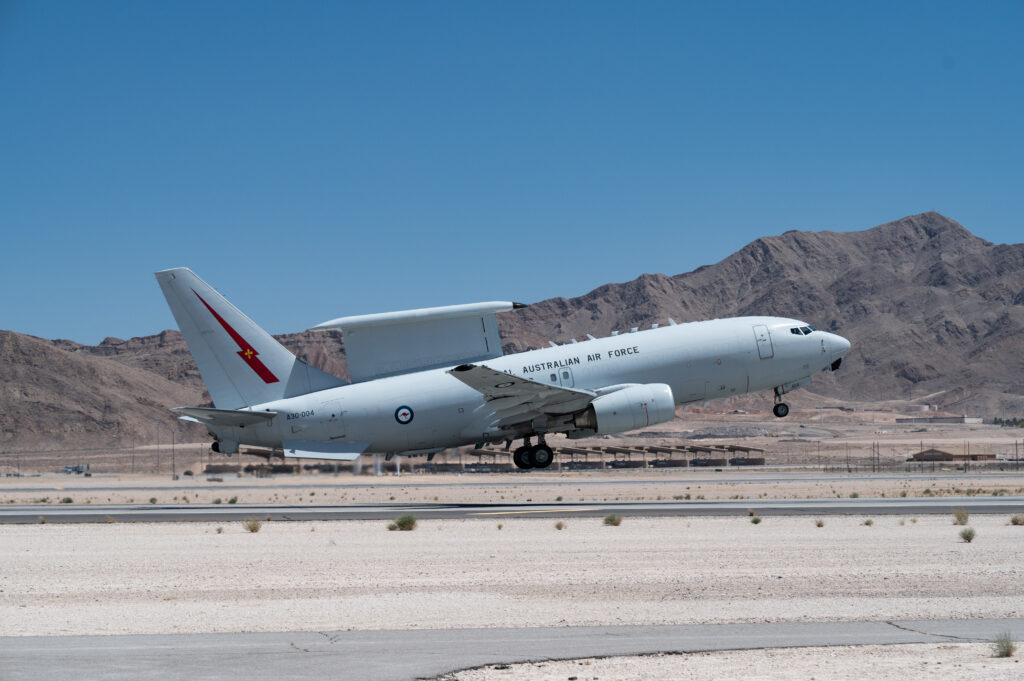
The White House budget office wants to raid a Navy radar-plane account and a classified Air Force line to pull the E-7 Wedgetail back from the dead.
The maneuver surfaced in a Wednesday report accompanying the House Appropriations Committee’s fiscal 2027 defense bill, and it runs on money the White House went looking for a week earlier.
In a June 17 budget amendment to House Speaker Mike Johnson, R-La., the Office of Management and Budget asked Congress to steer more than $1.55 billion into the Air Force’s research and development account to keep the airborne battle management jet alive — money the service had left out of its original request after the Pentagon moved to cancel the program just a year ago.
Getting there required two cuts and one deposit.
OMB carved about $651 million from the Navy account that buys the E-2D Hawkeye and $899 million from the Air Force’s other procurement account. It funneled the combined sum into Air Force research, development, test and evaluation.
The House report pins the Air Force half on the Special Update Program, one of the service’s classified procurement lines.
The justification ran identically across all three amendments: The money would “deliver two E-7 Wedgetail prototype aircraft and continue Engineering Manufacturing and Development activities for a program of record.”
The Air Force already has seven E-7s on contract, including two rapid prototypes and five more added under a March modification. However, all are developmental jets meant to prove out the U.S. design before any production decision, which is why the money lands in research and development rather than procurement.
The committee pointed to the war in Iran to make its case.
“The conflict in Iran has reinforced the need for the Air Force to maintain a credible airborne battle management capability, currently being met with the Air Force’s E–3 Airborne Warning and Control System and the Navy’s E–2D Hawkeye programs,” the committee wrote. “As the E–3 is set to retire, the E–7 Wedgetail will serve as modern replacement for lost battle management capability.”
Panel pushes back on taking Hawkeye money
The Hawkeye money, though, was not OMB’s to spend. The House panel backed the E-7 realignment but rejected the Navy offset, restoring the $651 million the White House had taken from the Hawkeye program.
“While the committee wholly supports the E–7 program and funding realignment, the Committee also restored the E–2D program to six aircraft for fiscal year 2027,” the report states. “The committee understands the operational necessity of the E–2D platform; the complementary nature of the E–2D and E–7; and believes that more aircraft, not fewer, are necessary to support our warfighters now and in the future.”
For all the money in motion, it buys prototypes and development work, not a Wedgetail fleet. Lawmakers want to know what comes next.
The report orders the Air Force secretary to brief the House and Senate defense appropriations subcommittees, alongside the 2028 request, on “the full E–7 acquisition strategy, to include required quantity; funding requirements across the future years defense program; and schedules for development and production.”
Prior to the war in Iran, the Air Force wanted to scrap the E-7 program, a platform already flying with Australia, the U.K. and other allies, after an Air Force official said its per-aircraft cost had climbed from $588 million to $724 million, and amid doubts about whether it could survive in contested airspace.
The previous plan was to lean on extra E-2Ds and a future of space-based sensors instead.
The war with Iran undercut that case, exposing a near-term battle management gap that satellites cannot yet fill, compelling the Pentagon to reverse course this spring.