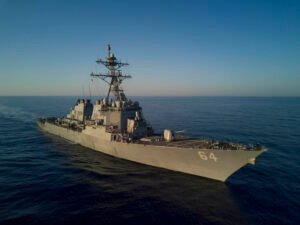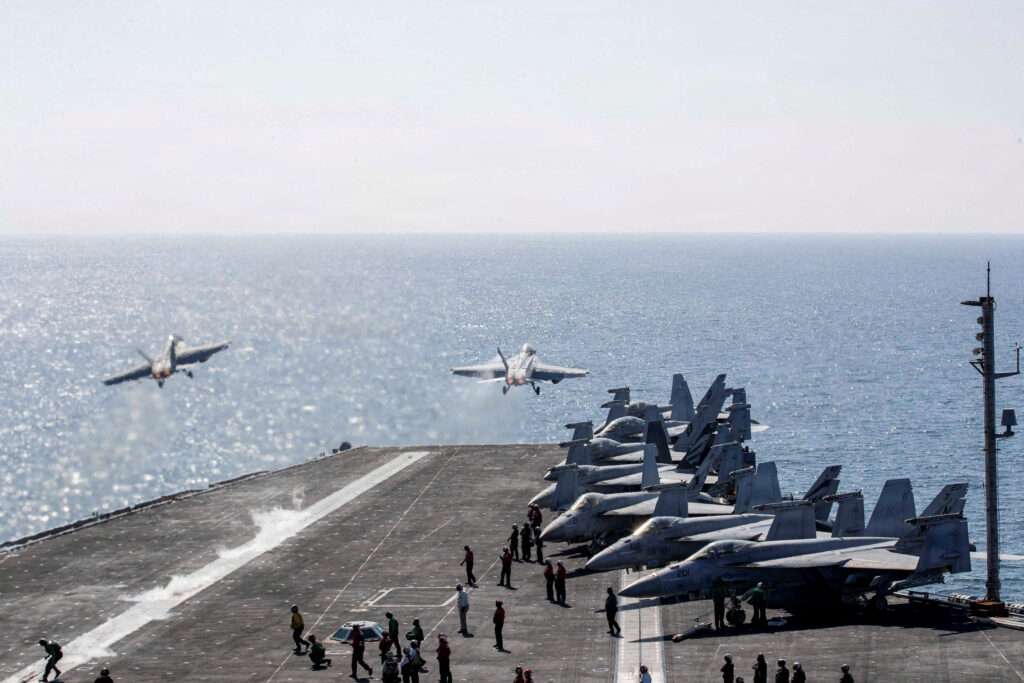
As the U.S. Navy continues to increase its presence and block passage in the Strait of Hormuz during the Iran war, experts have published a report calling into question the country’s current shipbuilding strategy and recommending ways to improve its maritime industrial base.
A Center for Maritime Strategy report, released Friday, argues that amid an “atrophy” of the maritime industrial base, the U.S. should utilize its partnerships with naval allies to boost its shipbuilding, technological and strategic capabilities.
This assessment comes while the Navy is in the spotlight for playing a large part in the war in Iran, a conflict that puts strain on the Navy’s already diminished assets and does not indicate signs of slowing down.
The Center for Maritime Strategy, a nonprofit and nonpartisan think tank that focuses on U.S. maritime issues and their broader national security implications, highlighted in its report that the Navy has yet to reach its shipbuilding goal.
“The U.S. [maritime industrial base] must be reconstituted quickly, utilizing the most modern equipment and procedures to meet the growing threats to the United States and its allies and partners,” the report reads.
President Donald Trump’s fiscal 2027 budget request allots $65.8 billion for shipbuilding to produce 18 battle force ships and 16 nonbattle force ships, doubling the amount of ships produced in fiscal 2026.
This increase is an effort to improve the maritime industrial base by manufacturing ships that are simpler to construct than battle ships, given their lack of radar systems and nuclear propulsion systems.
At a WEST Conference in February 2026, Commandant of the Marine Corps Gen. Eric Smith said that the industrial base is less about items and more about ensuring people are incentivized to remain in the service.
“Everything costs what it costs,” Smith said at the conference. “I don’t want to pay $4 billion for a ship, neither does my shipmate [Chief of Naval Operations Adm.] Daryl Caudle. But that’s what it costs to have pipefitters, steamfitters, welders, electricians build the ship.”
Currently, the Navy consists of approximately 295 ships with that number expected to decrease as the service retires more ships than it plans to commission. Last year, the force noted its goal to retain a fleet of 381 over the next 30 years to counter global threats.
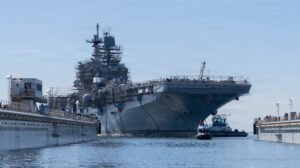
Meanwhile, the U.S. has sent more troops to the Middle East to support the ongoing war in Iran, including the Tripoli Amphibious Ready Group and connected Maritime Expeditionary Unit. The forces include 5,000 personnel and many warships, such as the USS Tripoli, USS New Orleans and USS San Diego.
The amphibious ready group’s deployment follows a 2025 Military Times report that showcased a drop in the Navy’s amphibious assault ships’ readiness rate to 41% as a result of the Trump administration’s endeavor to combat drug cartels in Latin America and the Caribbean.
The Center for Maritime Strategy recommended seven objectives in its report to improve the maritime industrial base, including reforming the design process, embracing new technologies and relying more on allies.
Out of all the recommendations, the report emphasizes the involvement of U.S. allies the most, specifically the Republic of Korea, Italy, Canada, Sweden and the United Kingdom, to model existing frameworks, use allied ports and supplement the domestic shipbuilding labor pool with migrants from the allied countries.
“For the Navy to meet the challenges it faces in the coming decades, the United States must take advantage of its strong partnerships with naval allies to support a collective revitalization of the allied maritime industrial base,” Kenneth Braithwaite, the 77th Navy secretary, said in the report’s foreword.