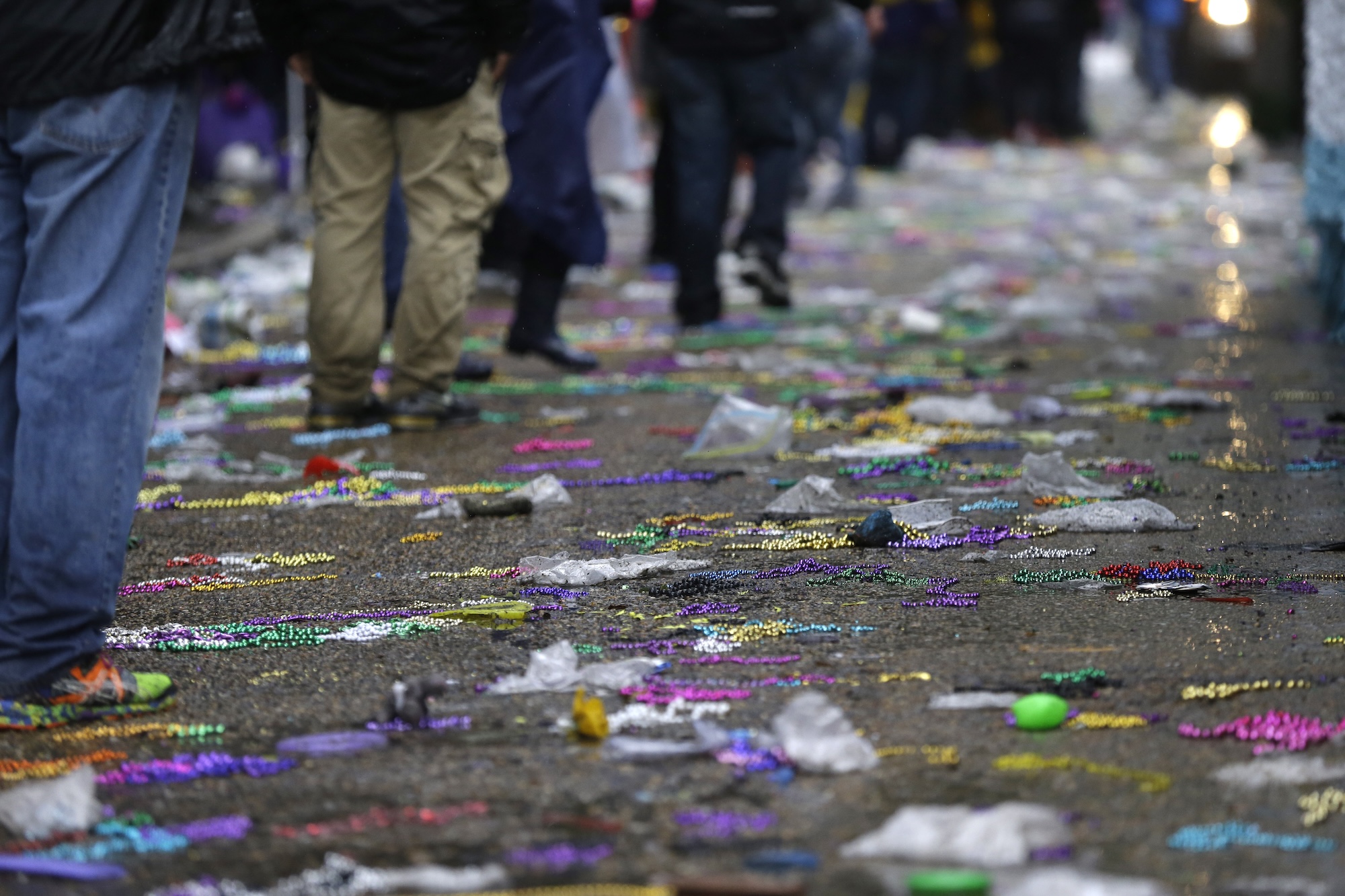
When cleaning crews dug deep into New Orleans’ clogged drains in 2018, they pulled up leaves, mud — and 46 tons of Mardi Gras beads.
The sheer magnitude of waste accumulated over decades of Carnivals — and its impact on the flood-prone city’s drainage system — shocked many residents and city officials.
“Once you hear a number like that, there’s no going back,” then-Public Works director Dani Galloway said at the time. “So we’ve got to do better.”
But nearly a decade later, New Orleans is generating more Mardi Gras garbage than ever. During the roughly five weeks of this year’s Carnival season, crews collected 1,363 tons of beaded necklaces, beer cans, plastic cups, and other refuse along the city’s parade routes — a 24 percent increase from the year before and the highest total on record. The trash tonnage is the equivalent of 741 cars. In New Orleans terms, it’s roughly the weight of the Steamboat Natchez or more than 1 million king cakes.
Mardi Gras revelers are leaving behind more trash than ever
Tons of trash collected from New Orleans parade routes, 2011–2026
“To see the waste go up that much, it’s just absurd,” said Brett Davis, founder of Grounds Krewe, a nonprofit group trying to make Mardi Gras more sustainable through recycling and waste reduction efforts.
It’s a century-old tradition for riders on parade floats to shower crowds with beaded necklaces, toys, and other items — collectively known as “throws.” Most are cheap plastic trinkets. The beads are often laden with toxic chemicals, including unsafe levels of lead. Many throws are dropped moments after they’re caught, then crushed under feet and eventually swept up and hauled to landfills.
City officials initially blamed the rise in rubbish on the popularity of this year’s festivities, which ran from January 6 to February 17 and included more than 30 float parades. An estimated 2.2 million people visited downtown New Orleans during the Carnival season, about 10 percent more than in 2025, according to the Downtown Development District, which drew on data from location analytics company Placer.ai.
“The increase from last year was directly associated with the larger crowds,” Matt Torri, the city’s sanitation director, told the City Council in March. “Anybody who was out at this year’s parades definitely took note that there seemed to be more people enjoying the Carnival season, which is great for the city.”
But a Verite News analysis of annual attendance and city cleanup records shows no clear relationship between crowds and trash levels. Overall, Mardi Gras waste tonnage has trended upward over the past decade, regardless of the year-to-year changes in attendance. The Mardi Gras season in 2020, for instance, drew more people — about 2.4 million — but produced roughly 241 fewer tons of garbage than in 2026.
In the early 2010s, trash tonnage hovered around 880 tons. It spiked in 2017, surpassing 1,320 tons, and has not fallen below 1,000 tons since. The only exception was 2021, when no trash was recorded because the city canceled parades and most Carnival festivities due to the COVID-19 pandemic.
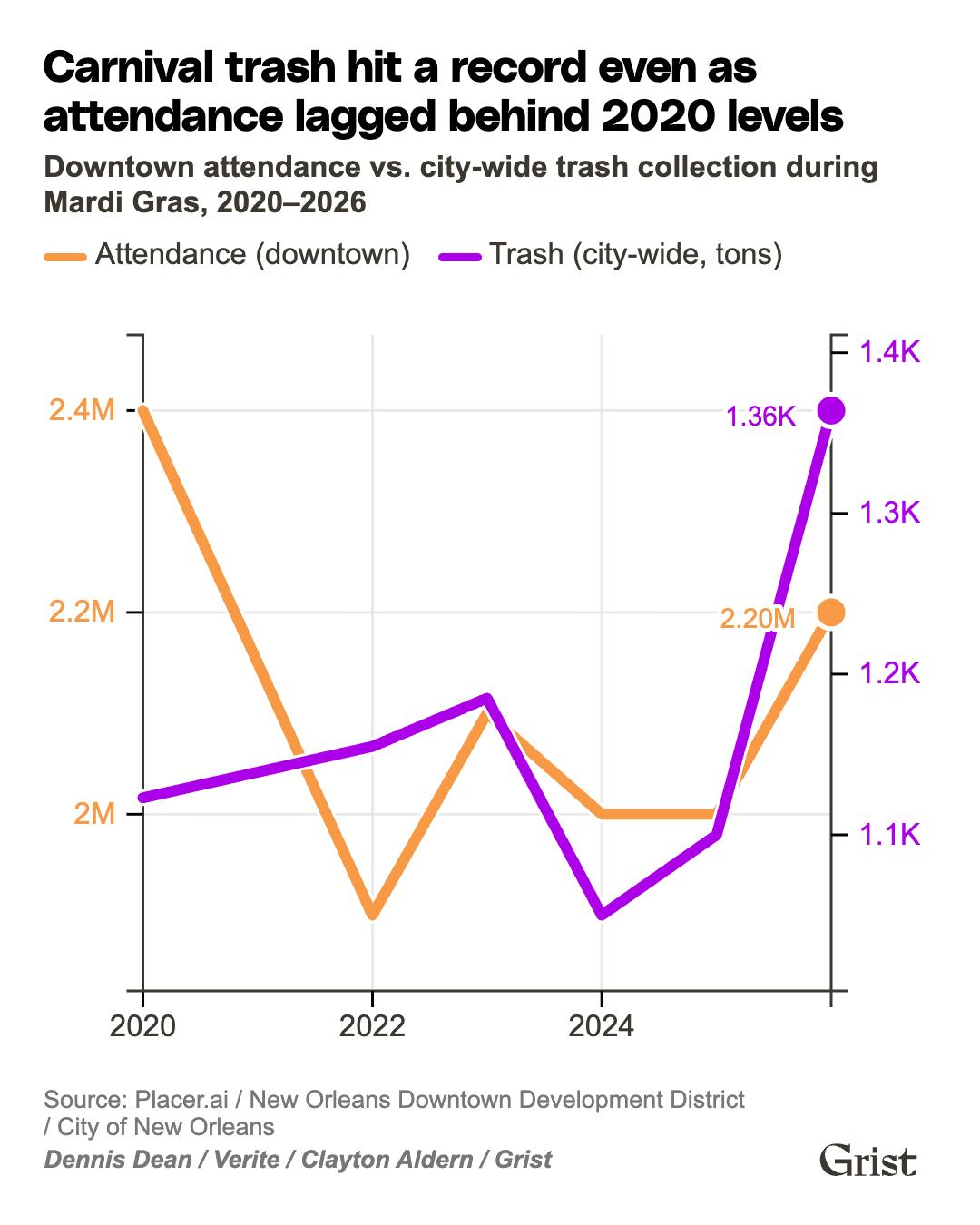
Carnival trash hit a record even as attendance lagged behind 2020 levels
Downtown attendance vs. city-wide trash collection during Mardi Gras, 2020–2026
Attendance (downtown)
Trash (city-wide, tons)
Since 2020, when the Downtown Development District began tracking visits in the Central Business and Warehouse districts, annual attendance has stayed within a relatively tight range, between 1.9 million and 2.4 million. Still, the trash tally has swung wildly, indicating that other factors are at play. The development district doesn’t track citywide visits, but its annual downtown tally is considered the most accurate indication of Carnival attendance.
The office of Mayor Helena Moreno and the city’s sanitation department did not respond to requests for comment.
Parade trash remains a problem for the city’s drainage system. After the infamous bead blockage of 2018, the city began installing temporary filter contraptions, known as “gutter buddies,” at catch basins along parade routes, but conservation groups say the outfalls still spew more litter into canals and Lake Pontchartrain during the Carnival season.
The upswing in trash is occurring alongside a seemingly contradictory trend of waste reduction. In recent years, many parade organizations, called krewes, have cut back on plastic beads and other “junk” throws. They’ve opted for higher-value items like socks, baseball caps, wooden cooking spoons, and metal drinking cups.
Grounds Krewe and other groups have also expanded their recycling efforts. They set set up stations to collect bottles, cans, and reusable throws, and some volunteers even pick through the parade debris for recyclable items. This year, the groups diverted about 28 tons from landfills. That’s despite the city pulling back its support for recycling this year because of budget concerns. Even if the city government spent the $200,000 it initially earmarked for recycling, “it’s not going to reverse the 24 percent gain” in waste, Davis said.
There was some hope that the volume of throws would be curbed by rising prices for beads and other trinkets, a result of higher inflation and President Donald Trump’s steep tariffs on imports from China, where most beads are made. Some parade-goers said they noticed the change, taking to social media to complain about stingier krewes.
“We are really perplexed,” Davis said. “All that is happening, with people throwing fewer beads and a lot of krewes switching to higher-quality throws, but waste is still going upward.”
The swelling tonnage may have less to do with the throwers and more with the catchers. Davis and some city leaders say parade-goers are setting up earlier, staying longer, and bringing even more of the comforts of home: folding chairs, canopy tents, coolers, grills, and wagonloads of food. They’re also chaining together walls of ladders, erecting scaffolding, installing portable toilets, and plunking down generators and old sofas. As the season ends, many of these items are broken, dirty, or too much of a hassle to haul home.
These abandoned items, which can range in weight from 5 pounds for a folding chair to 300 pounds for a couch, are an increasingly heavy lift for cleanup crews, City Council President JP Morrell said.
“The reality is that they get their use out of this stuff, and then it becomes a tremendous amount of debris that our workers have to deal with because these people had no intention of ever picking this stuff up,” he said. “It goes towards a sense of abject entitlement — that our entire city exists to serve other people’s whims.”
Gerald Herbert / AP Photo
Many of these gear-laden revelers are territorial, roping off patches of sidewalk or spreading tarps across grassy street medians, known locally as neutral grounds. These public-space appropriators have come to be known as the “Krewe of Chad,” after the name, spraypainted across a large patch of grass, went viral in 2013.
These “Chadders,” as Morrell calls them, appear emboldened by the recent ebb in the enforcement of the city’s parade rules. Officially, early birds aren’t supposed to set up until four hours before a parade starts, but this rule is regularly flaunted. In 2024, the list of banned items grew to include many of the things that have become commonplace — tents, tarps, and viewing platforms among them. A crackdown that year, which included the seizure of truckloads of encampment gear, appeared to briefly change behavior, Davis said.
But last year, the city announced it would scale back enforcement and prioritize security after a terror attack on New Year’s Day killed 14 people on Bourbon Street.
Enforcement was further scaled back by the city’s current budget crisis. Amid layoffs and other cutbacks aimed at reducing a $220 million deficit, Morrell admitted that efforts to clear Carnival encampments would be “spotty.”
“How are they going to enforce it? Well, to be honest, we’re hard up for cash,” Morrell said on an Instagram post in early February. He stressed that police and other city departments would “do their best,” but enforcement wouldn’t be as “robust as it could be.”
Torri, the sanitation director, said the city had the capacity to clear large items on just one day before the final cleanup on Fat Tuesday. “Mardi Gras Day was a major undertaking,” he told the council in March. Crews started working at 8 a.m. and didn’t finish until 1 a.m. “It’s a full day of cleaning because of everything that people have brought. Tarps, ladders, tents, coolers, grills are left because they’re disposable things that were only intended to last the weeks of Mardi Gras.”
Davis predicted the trend toward fewer but better throws will continue, and his organization will keep pushing for more reuse and recycling. But, he added, the policies meant to curb parade encampments — and the waste they leave behind — are only as effective as their enforcement.
“Having the krewes throw less is great, but what’s really heavy is a couch and all the stuff people brought out in wheelbarrows,” Davis said. “Unless we have police out there and the trucks to haul it away, this kind of behavior creeps back. And that’s what we’re seeing now.”
This story was originally published by Grist with the headline New Orleans wants to fix its Mardi Gras mess. So why is the trash pile still growing? on May 11, 2026.