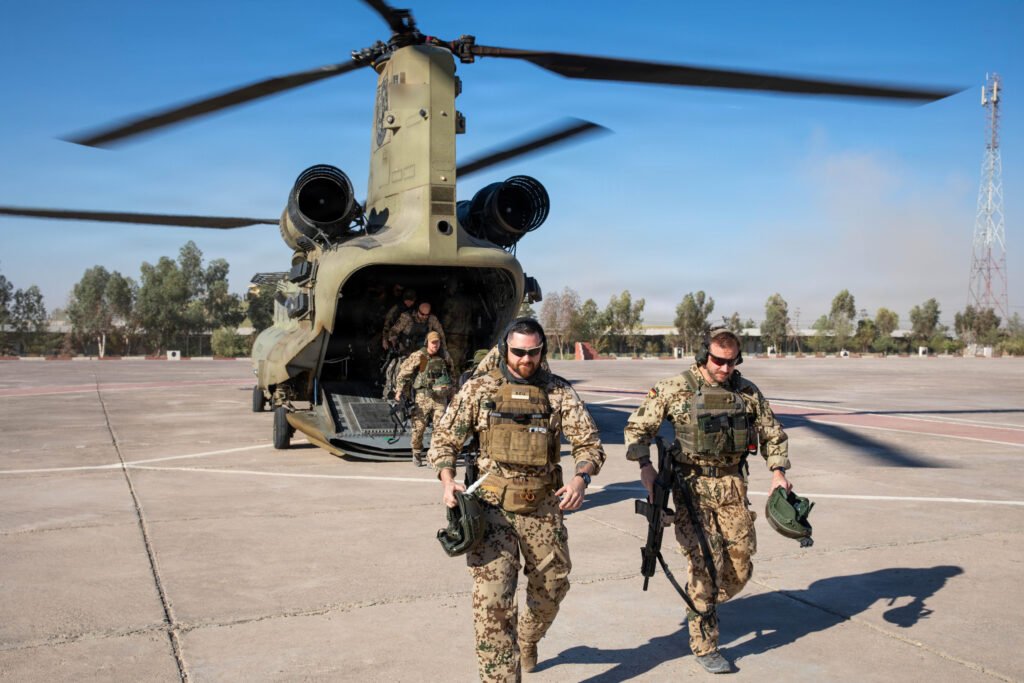
A U.S. Army flight simulator at a barracks in Germany stands as a center of critical training for NATO’s aviation community.
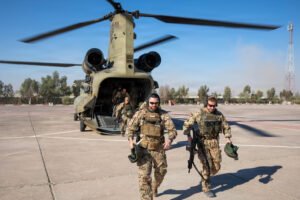
The U.S. Army Garrison Ansbach’s Stock Barracks in Illesheim houses the Illesheim Flight Simulator Complex, or IFSC, providing one-of-a-kind training opportunities ahead of the German Armed Forces preparing to field CH‑47F Block II Chinook helicopters next fall, according to an Army release.
The IFSC, which is operated by U.S. Army Europe and Africa, provides the necessary training needed to prepare German forces to receive 60 of the heavy-lift, tandem-rotor helicopters, the release says.
Two German Air Force pilots who will be part of the first cohort to fly the new aircraft once they arrive in fall 2027 recently trained at the IFSC.
“In the simulator you can train all the scenarios you do not want to experience while flying a real aircraft,” said Lt. Col. L, a visiting pilot whose name was withheld, as is standard in the German Air Force, or Bundeswehr Luftwaffe. “Emergency procedures, challenging landings and extreme weather operations can all be practiced safely.”
“Everything you can do in a real flight, you can also do in a simulator,” the other visiting pilot, Maj. H, said.
The fleet will be stationed at two Bundeswehr installations and is meant to boost Germany’s heavy-lift and transport abilities, per the statement.

The two German pilots also trained in the U.S. Army Aviation Center of Excellence at Fort Rucker, Alabama.
Fort Rucker is the Army’s largest helicopter training institution and trains more than 1,300 U.S. soldiers every year. Beginning in 2028, German Air Force aviators will also trek to Fort Rucker annually for initial helicopter training and complete “track training,” including the CH‑47 qualification.
The Army did not say how many German aviators are expected to train at Fort Rucker each year, but the release noted that the German Air Force plans to staff more than 200 trained pilots to operate its future fleet.
Germany has already begun sending helicopter pilots for conversion training to the CH‑47 platform, according to the release.
Since the IFSC simulator software is tailored to U.S. Army aircraft configurations and not the Bundeswehr’s, the German pilots will need additional learning to transition to their Air Force’s aircraft.
Instead of German Air Force pilots needing to travel across the Atlantic for advanced simulator training, the IFSC allows them to drive just three to five hours from their home station.
By using the existing U.S. Army facilities in Europe, NATO partners reduce costs by not needing to build their own simulator complex, the announcement says. Even though the IFSC schedule prioritizes U.S. Army soldiers, the complex routinely supports at least five NATO partners’ pilots.
“For NATO partners requiring up-to-date, quality aircraft simulation training, USAG Ansbach’s Storck Barracks continues to prove its value: a small installation delivering strategic impact through world‑class training,” the release reads.