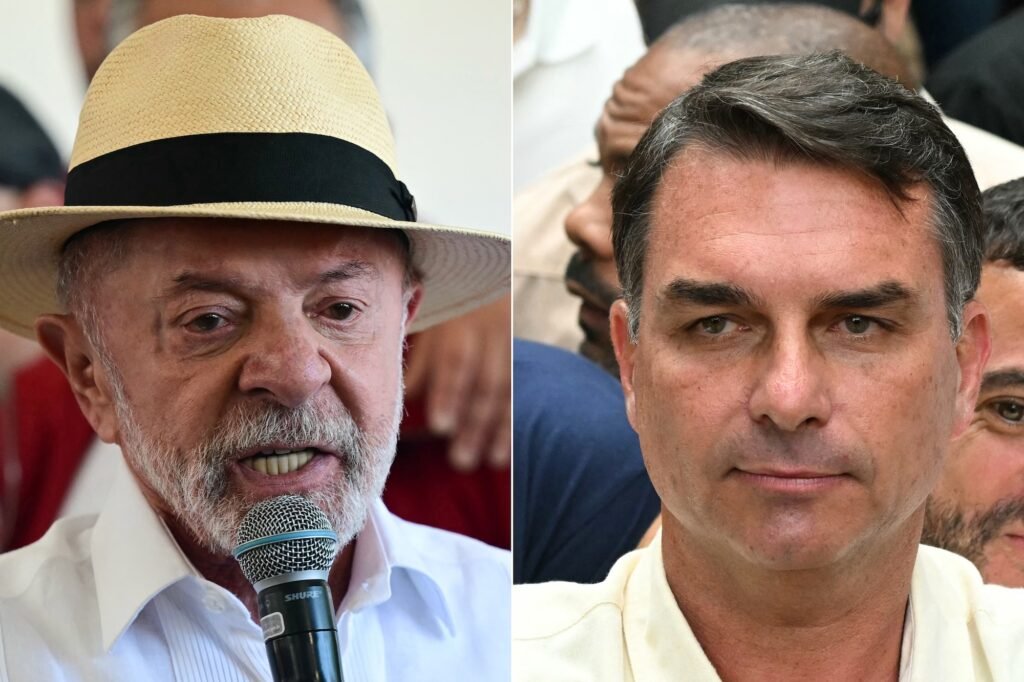
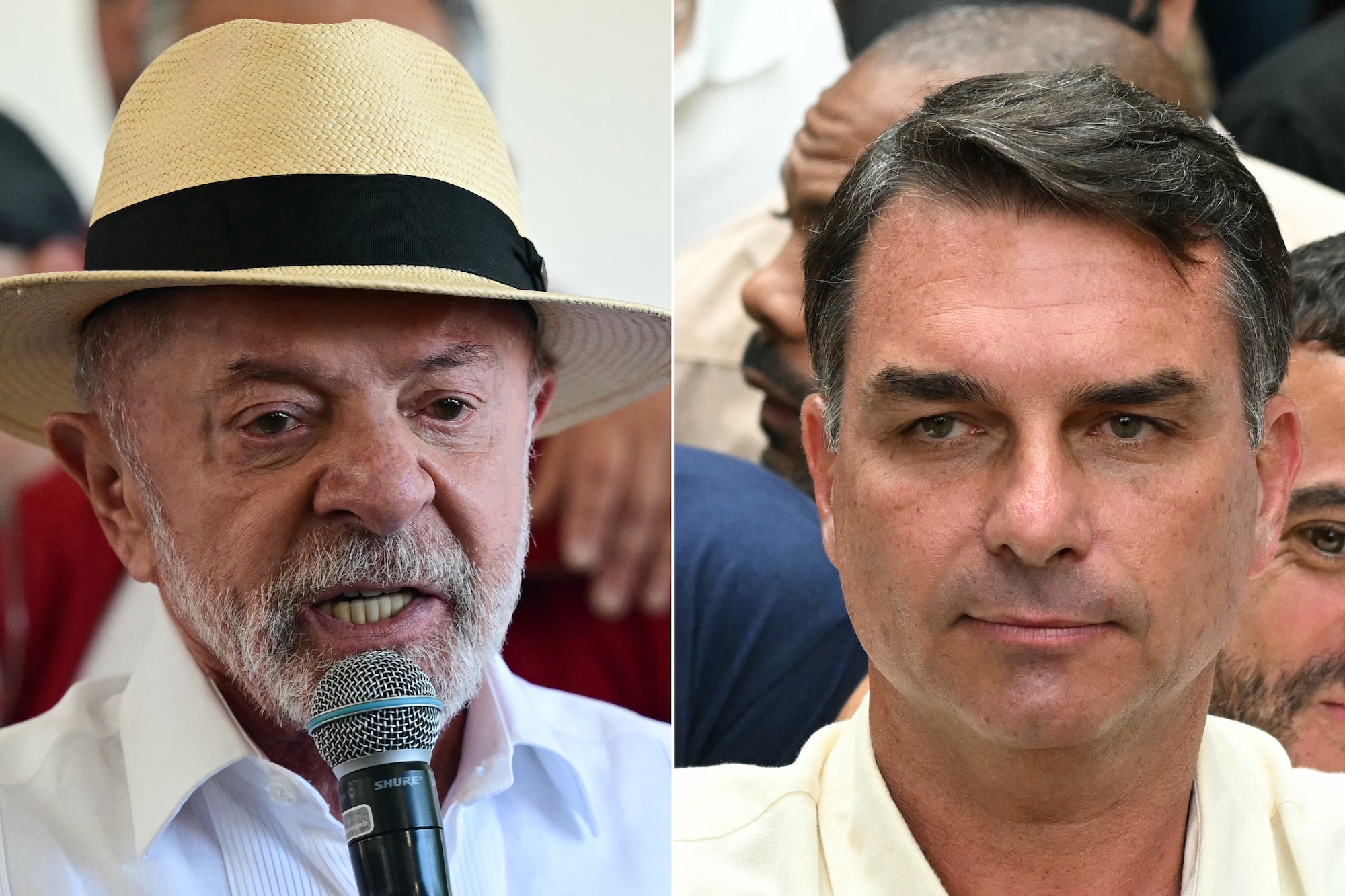
Brazilians filling out presidential ballots earlier this month saw three-term incumbent Luiz Inácio Lula da Silva pitted against Senator Flávio Bolsonaro. Environmental observers saw something else: a referendum on the future of the Amazon rainforest.
“We are very serious about the risks for the Amazon if Flávio wins the election, because he is a climate denier,” said Carlos Nobre, a climate scientist currently at the University of São Paulo’s Institute for Advanced Studies. “If this candidate is elected, certainly deforestation in the Amazon will increase. We are in a very serious situation.”
Flávio Bolsonaro, son of imprisoned former president Jair Bolsonaro, is campaigning on an agribusiness-friendly, deregulatory agenda. In the first round of voting, he finished 2.2 million votes ahead of Lula. With neither candidate securing the requisite 50 percent needed to be declared the winner outright, the two will head to a runoff on October 25.
Pablo Porciuncula / Mauro Pimentel / AFP vai Getty Images
Taken at face value, Bolsonaro and Lula would appear to have similar rainforest policies. Lula promises net-zero deforestation by 2030; Bolsonaro promises zero illegal deforestation by 2029. Legal is the operative term. Bolsonaro’s platform argues for an “agile, modern” environmental licensing process that “will no longer serve as a way to block those seeking to invest and create jobs.”
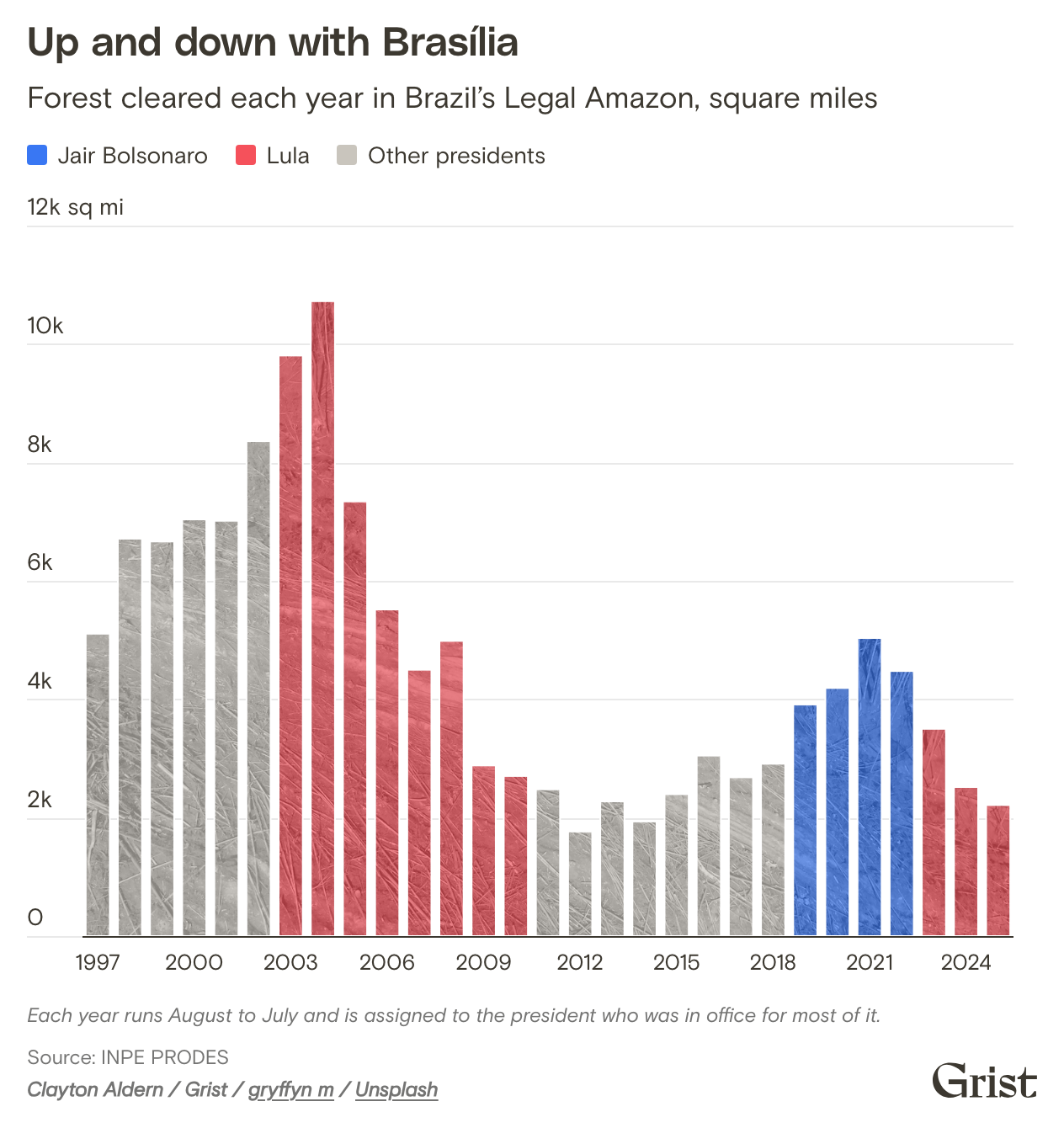
Monica de Bolle, an economist at the Peterson Institute for International Economics, argues a Bolsonaro win would amount to a repeat of his father’s term, which saw an increase in clearing, a plummeting of environmental infraction notices, and a near doubling of carbon emissions in Amazonia in 2019 and 2020, compared to the average levels between 2010 and 2018.
Jair Bolsonaro “basically dismantled the enforcement structure,” de Bolle said. “Which is, I think, what would likely happen again.”
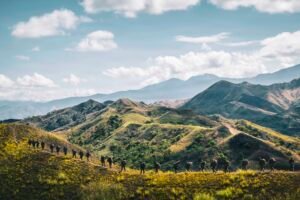
Omnipresent but non-voting in the coming election is the Amazon itself, which stands at the edge of farm country and stores something on the order of 175 billion metric tons of carbon, equivalent to roughly 15 years of global carbon dioxide emissions. The planet’s largest tropical rainforest, the Amazon is big enough to make its own weather: Water drawn up by its trees ultimately accounts for up to half of the region’s rainfall.
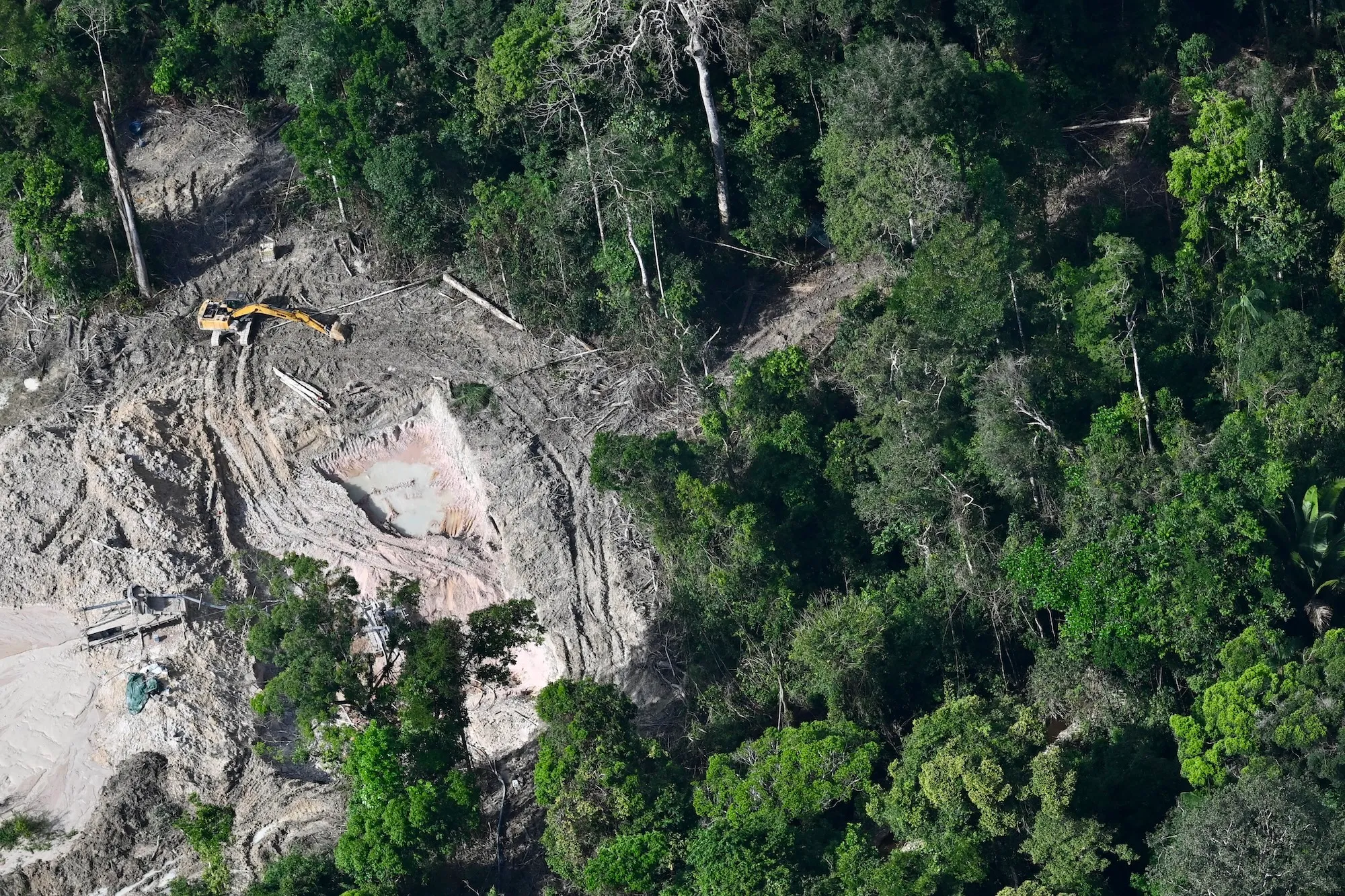
Affronting the forest is a menagerie of harms, from drought to fire and logging to clear-cuts. And while the Brazilian Forest Code permits landowners to cut up to 20 percent of their Amazon properties, the monitoring network MapBiomas recently estimated that 97 percent of Amazon land clearing in 2025 showed signs of illegality.
Evaristo Sa / AFP via Getty Images
Under Lula’s current term, clearing rates in the Amazon have fallen every year. If Brazil returned to the elder Bolsonaro’s deforestation pace, the rainforest would lose about 17,600 square miles over the next four years, versus about 8,900 square miles at the 2025 rate: a difference in landmass approximately the size of Belize.
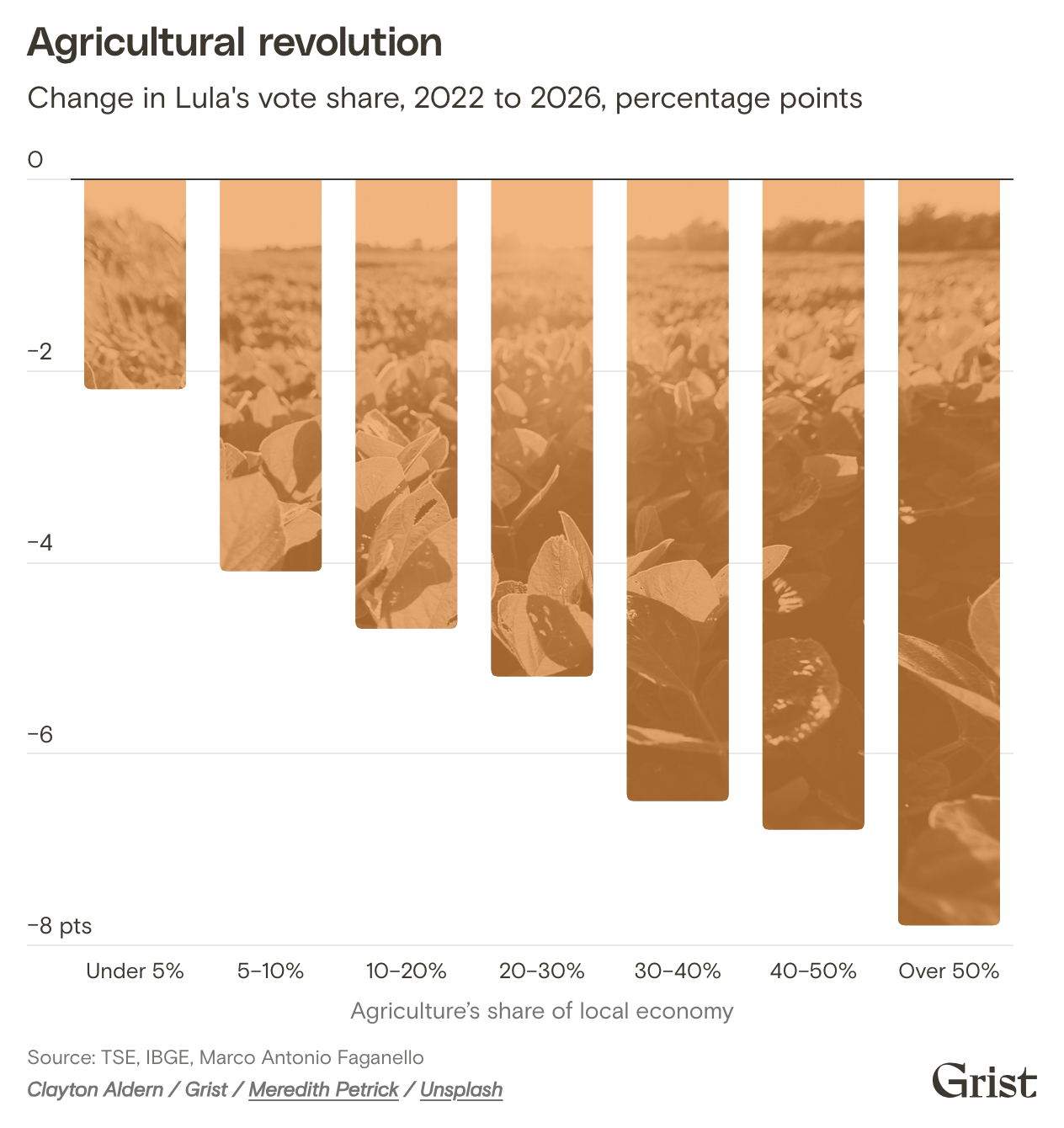
The first-round election results suggest agricultural interests likely played a role in Bolsonaro’s strong performance. Lula lost vote share in almost every municipality in the country relative to his 2022 results. But in municipalities where agriculture accounts for more than half of the local economy, his vote share fell by nearly 8 points: triple his loss in non-agricultural areas.
If Brazil’s next administration accelerates clearing, the effects could be devastating for the rainforest, the people who call it home, and the industries on which its continued health depends. For decades, forest and climate scientists have warned of a brutal tipping point: Cut enough of the forest down and the water cycle won’t be strong enough to sustain a rainforest ecosystem. Instead, the area would morph into savanna and degraded forest — causing a net release of planet-warming carbon and depriving nearby soybean farms of rain.
The actual tipping point in question is multi-causal and difficult to estimate, but the most frequently quoted deforestation threshold is 20 to 25 percent clearing across Amazonia, a range first suggested in 2018 by Nobre and U.S. conservation biologist Thomas Lovejoy. The duo argued that “negative synergies between deforestation, climate change, and widespread use of fire” would send the forest into a feedback loop once this threshold is passed. A Nature study published in May of this year estimated the tipping-point range to be closer to 22 to 28 percent clearing when paired with the 1.5 to 1.9 degrees Celsius (2.7 to 3.4 degrees Fahrenheit) of global warming the world is likely to experience by mid-century.
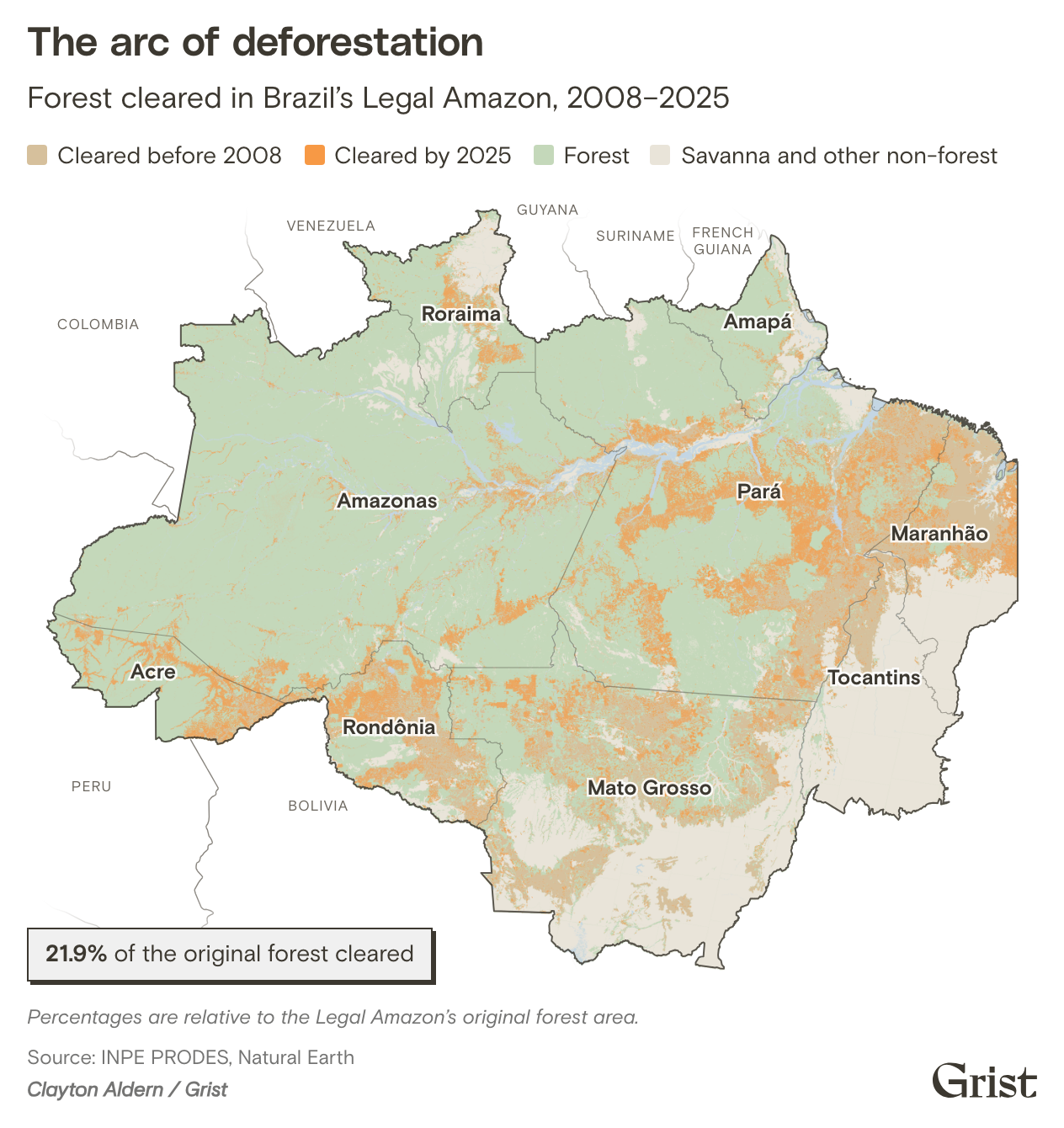
About 18 percent of the Amazon — which spans nine countries — and 22 percent of the Brazilian Amazon have already been cleared.
Nico Wunderling, a climate scientist at Goethe University Frankfurt who led May’s Nature study, estimated a return to Jair Bolsonaro-era practices would clear about 1 percent of the Amazon basin’s rainforest over the next presidential term. At this rate, “we would reach the danger zone by the middle or end of the 2030s,” he told Grist.
Conversely, if Lula delivered on his pledge of net-zero deforestation by the early 2030s, Wunderling argues runaway feedback might yet be avoided. While climate change is a global process requiring global coordination, deforestation is “the lever that can be pulled back more easily,” he said.
The late 2030s is beyond the term covered by this election cycle, and the exact science of the tipping point remains uncertain. But the result of this election could still set the Amazon rainforest on its ultimate path. Ronaldo Christofoletti, an oceanographer at the Federal University of São Paulo, likened the situation to insuring a vehicle. “Why do I pay the insurance? Because an accident can happen. When? I don’t know.”
For Christofoletti, the electoral stakes are all about managing this uncertainty. “Do not expect magic from scientists,” he said. “Do trust that the tipping point is getting closer.”
The Bolsonaro campaign did not respond to a request for comment.
In the meantime, organized agribusiness is pushing for Bolsonaro in the runoff election. The Parliamentary Agricultural Front, Brazil’s primary agribusiness lobby, recently endorsed Flávio Bolsonaro, who has promised that the caucus will choose his minister of agriculture.
Even if Bolsonaro doesn’t win the October 25 runoff, agribusiness may already have done so. On October 4, Bolsonaro’s party won 121 House seats, the most any party has held since the Brazilian Constitution was promulgated in 1988. An analysis by the Brazilian Amazon-based news platform Sumaúma suggests that half of the incoming House has voted to loosen environmental licensing and limit Indigenous land claims.
For agribusiness, that means the currently off-limits may soon be in play. “Even if Lula gets reelected,” said de Bolle, “he’s going to be very weak.”
This story was originally published by Grist with the headline Brazil’s election could determine the fate of the Amazon on Oct 15, 2026.