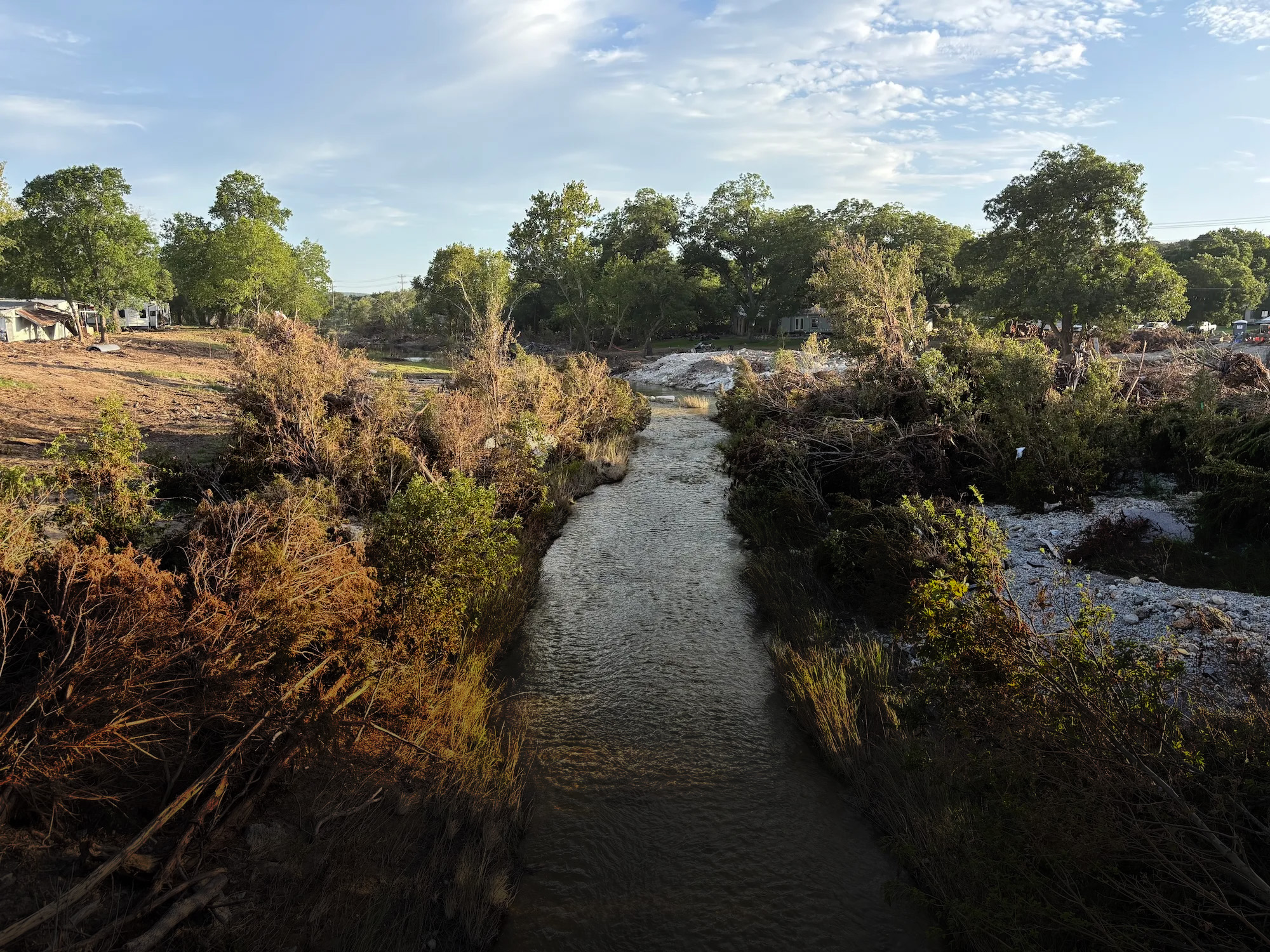
When rain falls on the RVs that line Big Sandy Creek, it sounds like gunfire. The harder it pours, the louder it gets. But what bothers Ashlee Willis most is how the wind makes them sway. It is so unsettling that she cowers in her camper’s narrow hallway with her two frightened cats, a Taylor Swift blanket stuffed into their carrier in case they have to flee.
It always reminds her of that terrible night in July, when the creek ran so high and so fast that the mobile home Willis lived in actually bobbed after the water tore part of it from the foundation. Within hours, the flood would kill 10 people and destroy 74 homes in Sandy Creek, a small community in central Texas.
It was supposed to be a joyful evening. Willis and her parents, Brandy and Gregg Gerstner, had bought “a bajillion” glow sticks to illuminate the above-ground pool, and had a stockpile of fireworks to celebrate Independence Day. Rain dashed that plan, so everyone, including eight guests, went to bed. Some slept in tents pitched outside.
By 2:30 a.m. the storm was so violent it shook Brandy and Gregg awake. The creek was rising quickly as they scrambled to round up the goats, but there was no saving them. Gregg loaded two pigs into a guest’s Jeep as Brandy dashed back inside to grab her diabetes medication and Gregg’s laptop. By the time Gregg returned to the house, water was rushing in and limbs were crashing through the windows.
Gregg led Brandy to higher ground, then waded through the torrent to save two dogs and a cat in the house. Before he reached the back door, he heard screams and watched the flood sweep the Jeep away, tossing its two occupants out. Gregg rushed to save them. One grabbed a floating tire he shoved toward her, while the other latched onto a plastic drum. He heard a third guest cry out for help from the branches of a partially submerged tree and convinced him to stay put. But he couldn’t reach Willis, who had climbed onto a pool table with the five other guests, two dogs, and a pair of cats as water filled her mobile home. She called her mother to say goodbye. “There was no way to comprehend how we were going to survive,” Willis said.
Suddenly the water receded. It retreated far enough for everyone to gather in Ashlee’s wrecked house. They used glow sticks to spell “Help” in the windows, then sang “the sun will come out tomorrow” while waiting for it to arrive. When dawn came, they found their world remade. “It’s all gone,” Ashlee said at the time. “Everything’s gone.”
One year later, the family is still waiting to rebuild. So is the rest of the community.
Laura Mallonee
The Gerstner-Willis family spent seven weeks in a hotel. Everyone had made it through the storm, even Brandy’s sister Donna Wright, who had been swept 2 miles downstream before being caught by a light pole. Each morning they returned to Sandy Creek to sift through the confetti the flood had made of their lives. Sometimes they found pieces of the world that once was. Brandy unearthed someone’s crystal bowl, perfectly intact, from what had been her goat pen. Not all discoveries were joyful. Workers found three human body parts. “I was there when they dug up somebody’s hip,” Brandy said.
The family eventually moved into donated RVs. They sit no more than 30 feet from Big Sandy Creek — closer than before the flood. Gregg monitors the water level with security cameras, and sometimes shows Brandy the feed to calm her.
A few months after the flood, Brandy attended a permitting clinic the county held to help people navigate the reconstruction process. “They informed us all, ‘Any of you thinking of staying, there are new permit rules, and we are watching you all now,’” she said. “They watch us like hawks.”
The rules weren’t new — just new to Sandy Creek.
The Gerstner-Willis family is among hundreds of survivors struggling to recover from the July 2025 floods that killed 139 people in central Texas and caused $1.1 billion in property damage. For many, the months since the disaster have revealed the complexities of recovery, a long, hard process that goes beyond repairing what the water destroyed.
Residents of Sandy Creek face permitting requirements, limited aid, insurance gaps, and construction costs they did not anticipate. Travis County is requiring them to meet standards locals say it rarely enforced before the flood, but the poverty that put many of the community’s 600 or so people in or near the floodplain leaves some of them unable to comply. Dozens of families remain in RVs, damaged homes, or temporary housing, caught between the need to rebuild and the cost of doing so.
For many homeowners, the problems started with a federal standard known as “substantial damage.” Anyone with damage equivalent to at least 50 percent of the home’s pre-flood market value must bring the entire structure up to code. In Travis County, houses that sit in a floodplain must be elevated at least 2 feet above the expected height of a 100-year flood. For the Gerstner-Willis family, that means building 12 feet in the air and installing a lift to reach the door. Meeting these requirements can increase costs by more than $100,000, on top of the thousands needed for engineering and surveys. For some, the burden is simply too great.
“I would say 98 percent of the people out here are not going to be able to afford their houses to be raised,” Brandy Gerstner said.
Disaster survivors who cannot afford to rebuild depend upon a patchwork of insurance, loans, government assistance, nonprofits, and churches for help. But those in floodplains often find that this system isn’t designed for them.
“The storm’s not over,” Brandy Gertner said in May, standing on ground still studded with shards of glass and debris 10 months after the inundation. “Surviving after the storm has been much harder. We’ve had to fight for everything.”
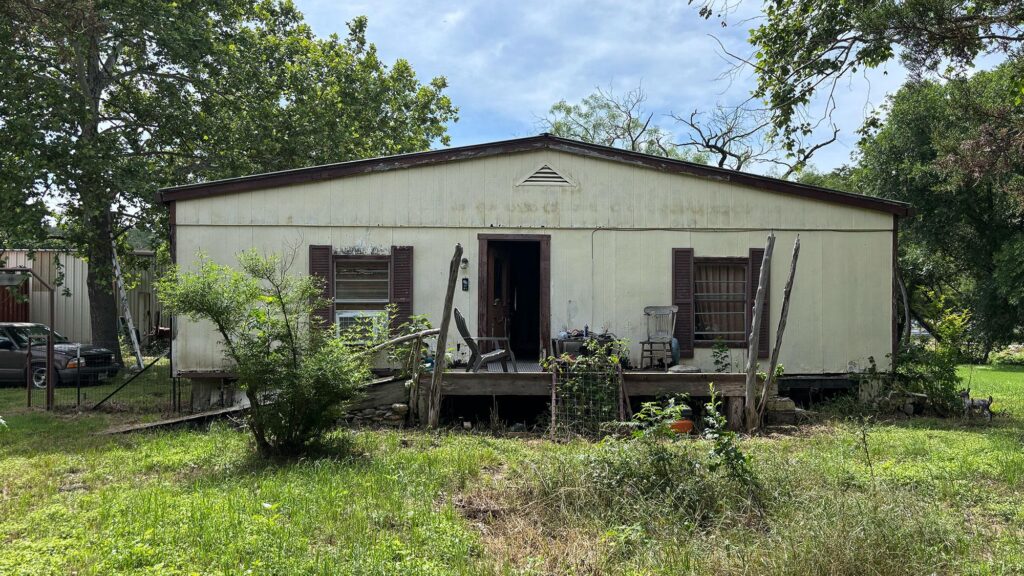
Two years before the flood, Ashlee Willis moved into a 1,500-square-foot double-wide manufactured home on her parents’ land. Family compounds like that are common in Sandy Creek, an arrangement that has made it difficult for some to get help rebuilding. Willis isn’t on the deed, and because her home is a second structure, few organizations could assist her. Some treated her as if she didn’t own the home. Others saw her situation as a duplicate claim.
“A lot of these groups out here helping don’t come across multigenerational plots of earth,” Willis said. “It looked like double-dipping.”
By early December, when the nonprofit organization Rebuild Sandy Creek encouraged her to apply for its home-rebuilding program, Willis had recovered just 3 percent of her losses — $1,000 from a church and $5,000 from Samaritan’s Purse, an evangelical Christian relief organization. Rebuild Sandy Creek board members selected Willis from among 17 or so applicants. The organization has struggled to raise money, but said it remains committed to helping Willis with construction costs.
Her predicament exposed some limits of the recovery system. FEMA has registered 1,212 flood-affected households in Travis County and distributed $4.3 million in assistance. That aid, capped at $43,600 per household, is meant to stabilize people, not make them whole. Rebuilding can take anywhere from a few months for those with good insurance to a few years for those without it.
Most don’t have it. Just 2.4 percent of affected households in Travis County had flood insurance, which typically pays only enough for policyholders to rebuild what they already had. For everyone else, help ranged from federal loans to small payouts of up to $2,000 from various ministries to a county donation fund that distributed $7.85 million to 264 families, or about $30,000 each. A concert by country singer George Strait raised enough to give more than 60 families $25,000 apiece. Governor Greg Abbott handed out the checks.
Austin Disaster Relief Network, which the county deployed to coordinate volunteers, offers help including funds for construction; it is still working through roughly 80 applications. Samaritan’s Purse is installing eight manufactured homes — Wright got one — and letting homeowners choose from a furniture package that includes appliances.
Navigating this web of nonprofits is exhausting, and residents complain of “form fatigue.” The Travis County Recovery Alliance, which coordinates with 16 nonprofits to help 155 families, hopes to make the process easier by, among other things, creating a unified intake form so survivors fill out just one application. But things are still getting off the ground. “We’re building the plane while we’re flying,” said executive director Janis Bookout.
The county has tried to make permitting easy — it waived fees, expedited paperwork, and for several months staffed a mobile office to walk people through the process. But residents have sought just 24 permits for work in the Sandy Creek Ranches subdivision since the flood, though not all were for flood-related work. Only eight were for new homes.
Simply preparing a lot for a manufactured home requires leveling and grading the land, laying a foundation, and installing utility hookups. Jason Hefner found the prospect of applying for the permit to do that overwhelming. “I know I’m gonna need one, but I have no idea where my home’s gonna go,” he said. “Even though you might have the money to build back, it’s just like, ‘Oh my gosh, here we go.’”
He received just $20,000 from his insurer and is betting Samaritan’s Purse will replace his home. “That’s one reason,” he said, “why a lot of us aren’t looking yet to rebuild.”
This isn’t Brandy Gerstner’s first time starting over. After tumbling through California’s foster care system, she set out on her own at 15 and made her way to Texas, where she found work in nursing. Ashlee came along in 1987. Four years later, Gerstner walked into a real estate office looking for a place to build a home. She couldn’t afford any of the properties she saw until a realtor showed her a parcel with rent-to-own terms.
It sat on the banks of Big Sandy Creek, which had flooded a decade before. Weeds loomed over Gerstner, who is 5 feet tall, and a narrow path led to a mobile home built in 1975. It was overgrown with vines and infested with tarantulas, bats, and other vermin. Rattlesnakes bred in the flower bed. She squashed 75 scorpions within weeks of moving in. “It was horrific,” she said.
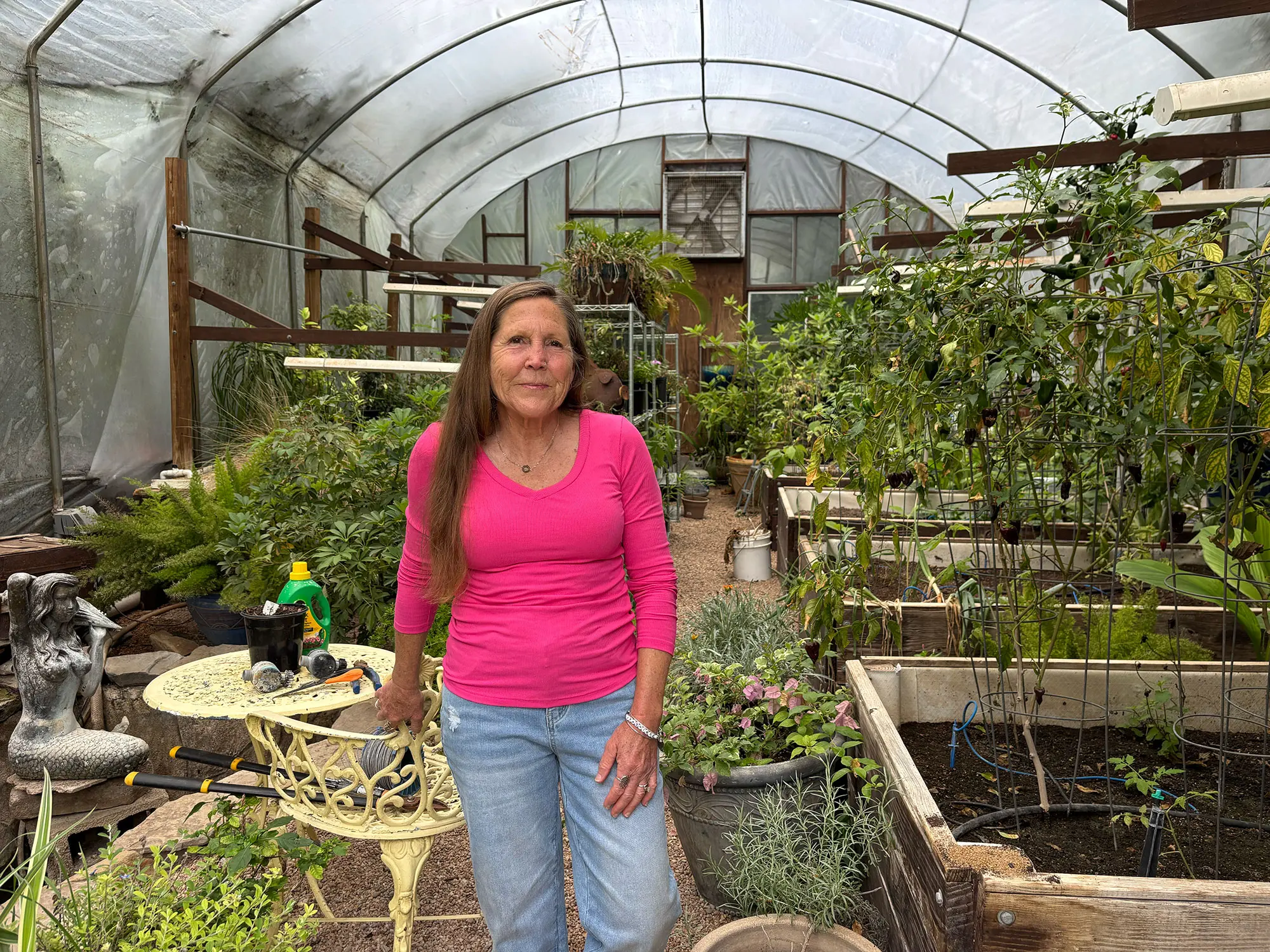
Gerstner rolled up her sleeves and set to work. She fixed the plumbing, tamed the yard, and built a deck. She planted apple, plum, and pear trees, established a garden, and later put up a greenhouse. Over the years she added chickens, pigs, and goats. In 2002, she bought a double-wide, which she eventually refinanced to add more buildings, including a garage for brewing beer, bottling honey, milling spices, canning fruit, and making cheese and wine. Her home was open to all, a place where 16 people frequently crowded around a dining room table meant for six. “This was where everybody came,” she said. “They called it their garden of Eden.”
Inexpensive land and scant oversight attracted others to Sandy Creek. Texas is a strong property-rights state where counties have limited power to regulate what is built and how. Some have little or no permitting, especially for manufactured homes and RVs. Enforcement is often complaint-driven, and few complain in places where people move specifically to avoid municipal meddling and taxes.
Travis County began regulating floodplain development in 1982, but many structures in Sandy Creek received exemptions because the community was laid out in the 1970s. Gerstner rarely bothered with permits unless a contractor required one. Few in Sandy Creek did. “This was kind of a free-for-all out here,” she said. “The county doesn’t care about the area.”
In many ways, the Gerstner-Willis family is a best-case scenario, even as it illustrates where disaster assistance breaks down. The resourcefulness that allowed Brandy Gerstner to transform her property into a thriving hobby farm has helped her navigate recovery better than most. The family also had flood insurance, documentation, and the patience to negotiate with nonprofits.
Yet they still live in RVs that are closer to the creek than the house it destroyed. They also pay $4,000 a year for construction insurance on a project that hasn’t started and continue fighting the insurance company for $200,000 they believe they’re owed. Willis isn’t surprised. “I just had it in my brain, ‘We’re going to be in these things for probably two years,’” she said. “Everyone thought I was crazy.”
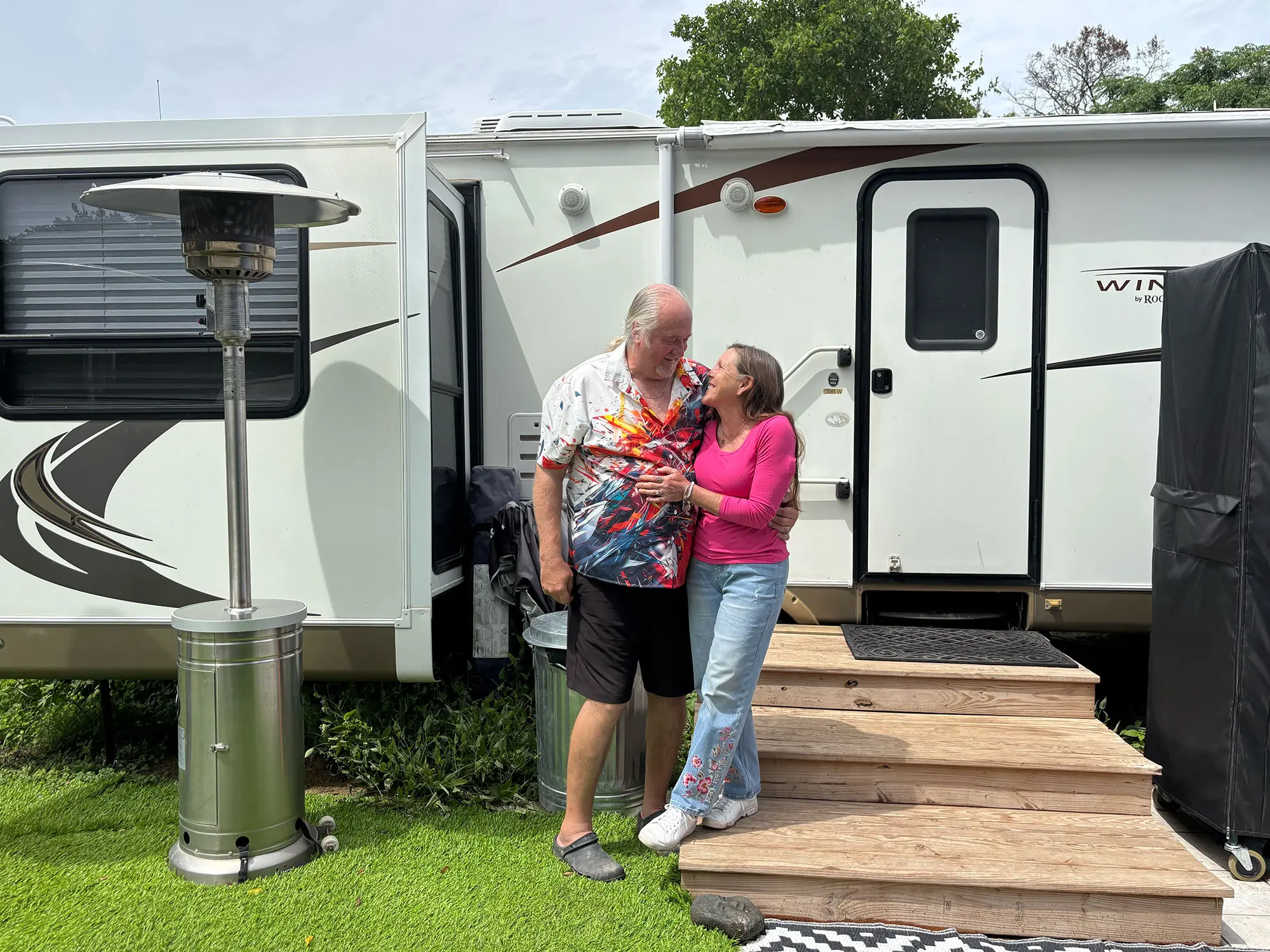
She and her parents plan to build two houses connected by a breezeway so Willis can help them as they age. It will cost about $1 million. They’ve already spent $15,000 on the design, engineering, and land surveys.
For many others, rebuilding doesn’t feel like an option.
In December, Sara, a British nurse who has volunteered in Sandy Creek since the flood, visited an elderly woman whose floors were rotten. Rodents and cockroaches scurried about. The woman had been hesitant to let her inside, and had not sought help because she had been in and out of the hospital. Sara, who asked to be identified by her first name only amid concerns about her immigration status, recalled telling the woman, “You need to get out of this house tonight, this is dangerous.’” A social worker arranged a hotel, then a six-month Airbnb stay. Willis joined other volunteers in emptying the place and knocking it down.
Many remain in damaged homes, unable to afford repairs, afraid of invoking the substantial damage clause, or unwilling to leave their land and livestock. In some cases, FEMA did not classify their houses as a total loss after the flood, but they later grew rotten or moldy enough to be condemned after the assistance application period had ended.
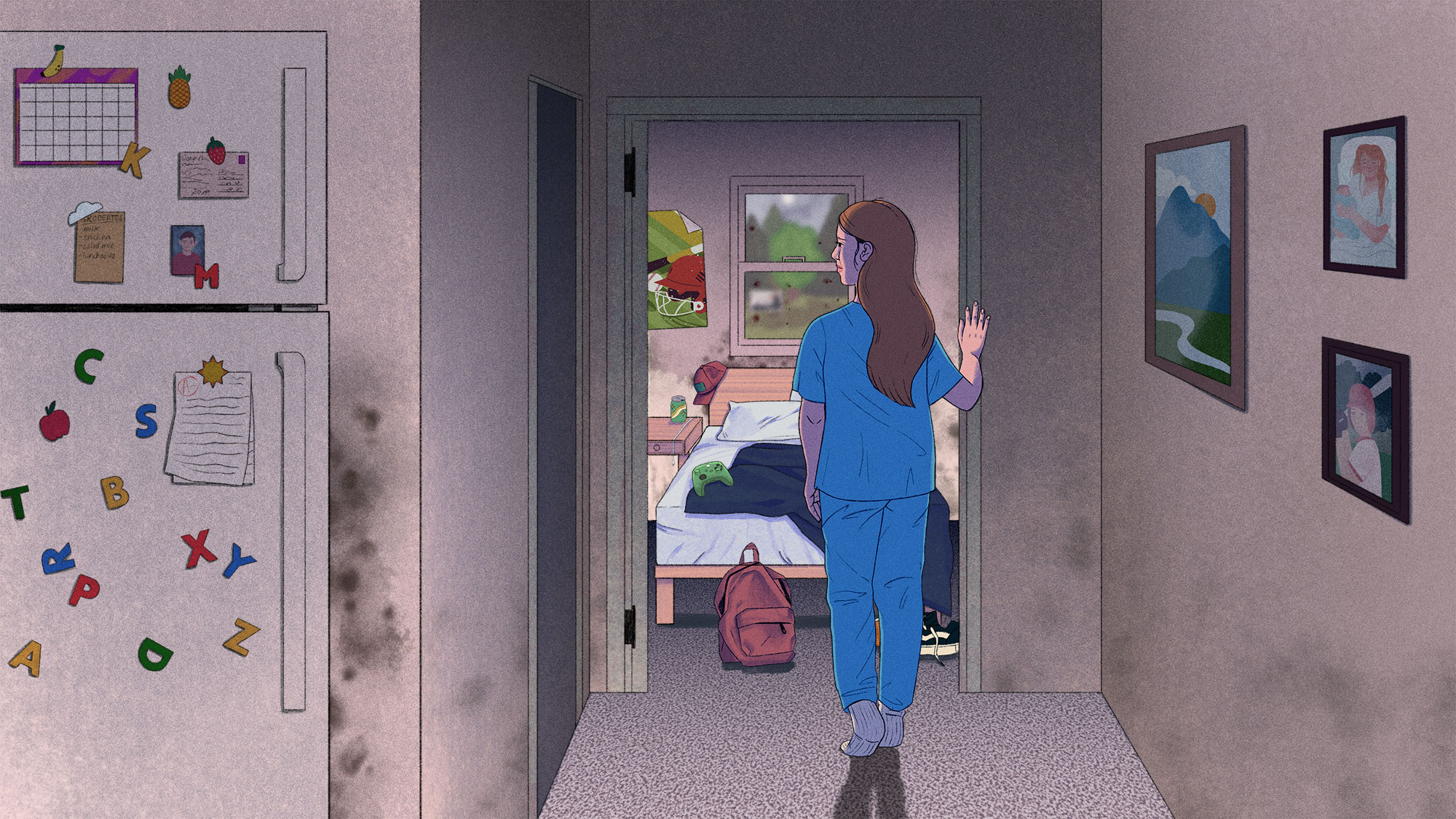
Landlords do not qualify for a lot of nonprofit aid, leaving many renters — who comprise 48 percent of Travis County households affected by the flood — in subpar conditions. Michelle Warner, a speech therapist who is recovering from knee surgery, moved to Sandy Creek 20 years ago from southeast Texas after losing everything to Hurricane Rita. She pays $1,175 a month for a three-bedroom mobile home scarred by the flood. “I’m just ready for this to look like it used to look, so I’m not driving up still to a damaged house I can’t fix on my own,” she said.
Noel Hernandez’s insurance agent advised him not to file a claim on the house he rents out, which sits in a flood-risk area, because his rate would go up. It rose anyway. As a landlord, he didn’t qualify for FEMA assistance and received about $3,000 in other aid — yet spent nearly $70,000 rebuilding. A family rented the place in February. An inflatable kiddie pool sits in the yard.
Dozens of families remain in campers. “If you go out there, it’s basically an RV park,” said Michelle Varela, a cofounder of Rebuild Sandy Creek. Last winter, space heaters sparked fires in some of them, Varela said. In mid-June, flooding washed out a portions of the water crossing the Gerstner-Willis family and others use to leave their property. The county bars RVs from remaining on a given site for 180 consecutive days or more. It doesn’t look like anyone is enforcing the rule.
“Who in the hell is monitoring that?” Brandy Gerstner asked. “What are you going to do — kick us all out of here? Make us all homeless?”
The systems that made Sandy Creek residents vulnerable before the flood have kept them that way after it. Poverty, political disengagement, and scant regulation shape how communities are built — and how they recover.
“Low-income people tend to live in low-quality homes in low-lying areas, because that is what the market allows,” said Shannon Van Zandt, a Texas A&M researcher who studies post-disaster housing recovery. In desirable areas like western Travis County, they are even more likely to end up in flood zones. “We need to be doing a better job of making sure that income is not such an important predictor of the harm that someone receives during a disaster,” Van Zandt said.
Texas counties have limited authority to regulate what is built and where it is built in unincorporated areas, and efforts to impose stricter standards often face resistance. Van Zandt said that contributes to poor-quality housing and suffering after disasters.
Counties have no legal obligation to offset these inequities, but Van Zandt believes they have a moral and practical one because resilience requires investing in vulnerable communities before a catastrophe. But residents of such places often lack the resources to make that happen. “People who feel disenfranchised for whatever reason — whether it’s income, race, ethnicity, or even documented status — are not going to get it because they don’t ask for it, or they’re seen as not entitled to it,” Van Zandt said.
Many in Sandy Creek still rely on the generosity of others. Even now, a year after the flood, people still throw community fundraisers. There’s one coming later this month. But relying on nonprofits to fill gaps is “not sustainable,” said Michelle Meyer, Van Zandt’s colleague. As tragedies like the Texas floods grow more common, even substantial contributions will not be enough. Donors are burning out, and inflation has made rebuilding costlier.
County governments sometimes buy vulnerable homes to minimize future risks and losses, but find many residents don’t want to leave. Travis County has purchased hundreds of floodplain properties in the lower Onion Creek area, a largely Latino part of South Austin. An unpublished study by the University of Texas found that, of 176 homeowners who accepted a buyout, nearly all moved beyond the floodplain, though most ended up near it. Van Zandt said buyouts work best when they are voluntary, offer enough to secure safer comparable housing elsewhere, and include efforts to preserve community cohesion. Researcher Kijin Seon, the author of the study, believes “relocation came at the cost of social fabric.”
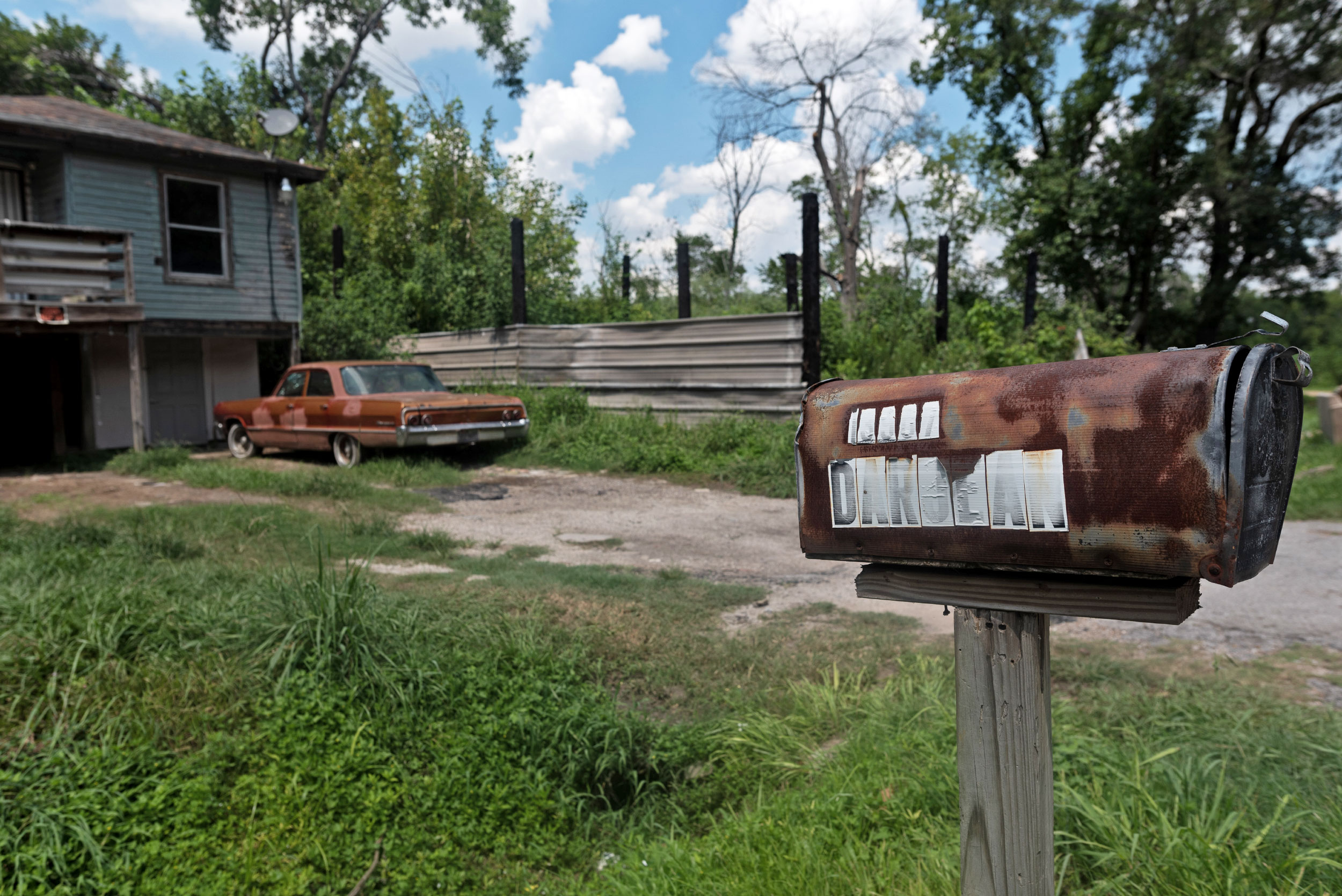
The root of the problem, Van Zandt said, is too little regulation. In a meeting with rural county judges in May, she recommended higher standards for subdivision development, including installing drainage, elevating homes, and ensuring ready access. Travis County regulates these things but lacks broader land-use controls like zoning. “That’s what they need,” Van Zandt said. “They need to be able to limit development in those areas.”
Many counties have long asked the Legislature for greater authority to do that. Travis County has generally supported “legislation giving county governments the necessary tools to manage growth, protect property values, and preserve quality of life.” But counties have found lawmakers reluctant to act.
Disasters create a “window of opportunity” in which political reform is possible, Van Zandt said. But it closes quickly if residents aren’t engaged.
Some in Sandy Creek are trying to hold that window open. Brandy Gerstner and Ashley Willis joined two other women in creating the Sandy Creek Alliance to lobby county and state officials to address the crisis. They visited Washington D.C. to call for strengthening FEMA, and asked the governor to create Fund Texas Forever, a disaster reserve financed by the state’s rainy-day fund to expedite relief. Willis handed him a letter outlining the idea and inviting him to return to Sandy Creek to hear from survivors. He thanked her and read it. “Nothing happened,” she said.
Andrew Mahaleris, the governor’s press secretary, told Grist in a statement, “Governor Abbott and the State of Texas continue to use all necessary resources to help Texans recover and rebuild from last year’s disastrous flooding.” He noted that the state has provided more than $500 million to assist families and communities, and that Abbott signed legislation to better protect people from catastrophic flooding events. “The governor will continue to work with the Legislature to strengthen flood regulations and preparedness,” Mahaleris said.
Meyer supports the idea of a disaster reserve, something academics have suggested with little success. Politicians don’t like setting aside money for future disasters, and cash assistance often gets tangled up with talk of welfare and self-reliance. Survivors, she said, carry more political weight in pushing for such programs.
Willis has made that her focus. She got a part-time job helping build Organizing Resilience, a new national network of disaster survivors that’s advocating for reform. “I’m a Swiftie,” she said, “I always like to joke with county and government officials, ‘Look what you made me do.’”
The community is still rebuilding, but nature has reclaimed land ruined by the flood, just as Tamerra Garcia predicted it would a few weeks after the disaster. Before the summer heat settled in, the fields were ablaze with sunflowers. Prairie verbena, firewheels, and beebalm growing along the road swayed in the breeze.
The trees that once obscured Sandy Creek are gone, leaving the banks barren but for a few saplings. Neighbors who never saw each other before the flood now see into each other’s backyards. They also hear every trash can being rolled to the curb on Wednesday nights.
In a lot that belonged to Garcia’s grandfather, Harold Sherwood, a cardinal perched on a beam. Not much else remains of Sherwood’s home, which was razed after water reached 5 feet up the walls. It was there, amid the muck and the stench, that Garcia made her prediction.
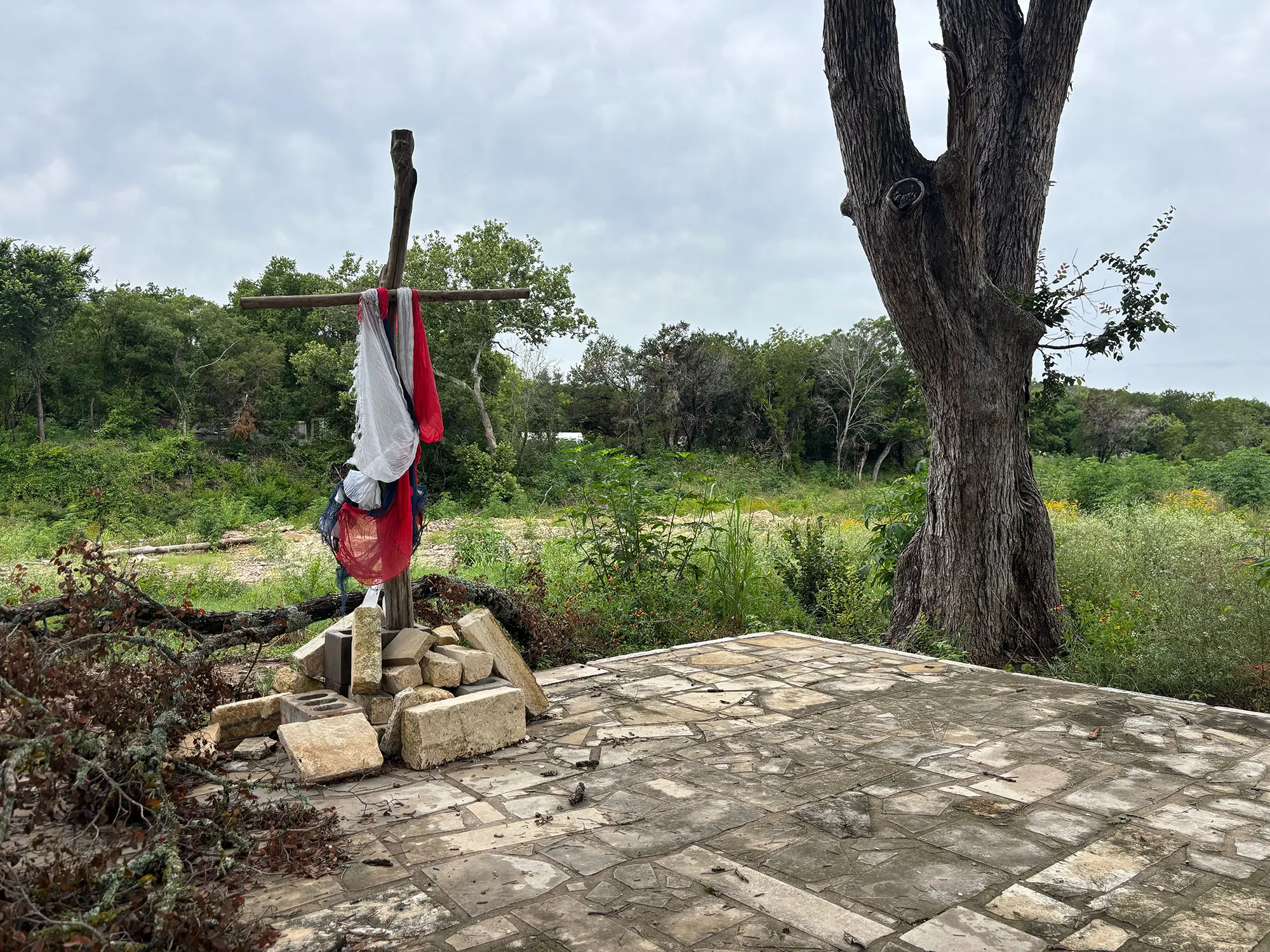
Her grandfather did not live to see it come true. Overwhelmed by the prospect of building a home 12 feet in the air to comply with the building code, he planned to live out his life in an RV. He eventually had a change of heart and decided to rebuild.
He died a short time later, around Christmas, of cancer. His health deteriorated quickly after the flood and “all the stress [of] losing everything you’ve had for all your life,” Brandy Gerstner said.
Friends and neighbors held a poignant memorial in early January on the land where his home once stood. The tattooed minister stood before a cross of branches draped in red, white, and blue fabric to honor Sherwood’s military service. He reminded those gathered around it that Jesus was a carpenter, then invited them to imagine him building Sherwood a heavenly mansion.
This story was originally published by Grist with the headline One year after the Texas floods, home feels further away than ever on Jul 1, 2026.