It’s no secret that U.S. electricity prices have been rising over the last few years: The average residential energy bill in 2025 was roughly 30 percent higher than in 2021. This jump is largely in line with the overall inflation Americans have experienced during this period. As the cost of groceries, gas, and housing has increased, so too has the cost of electricity.
But there are big differences from state to state and region to region. Some places — like California and the Northeast — have seen mammoth price increases that outpaced inflation, while costs have held steady in other parts of the country, or even fallen in relative terms. Nearly everywhere, though, rising electricity costs have strained the budgets of low-income households in particular, since they spend a much larger share of their earnings on energy compared to wealthier Americans.
Higher energy bills have also become a political flashpoint. Over the past year, rising electricity prices have helped push voters to the polls, and politicians have taken note. In Virginia and New Jersey, newly elected governors campaigned heavily on reining in utility bills. In Georgia, incumbent utility regulators were booted out by voters, who elected two Democrats to the positions for the first time in two decades.
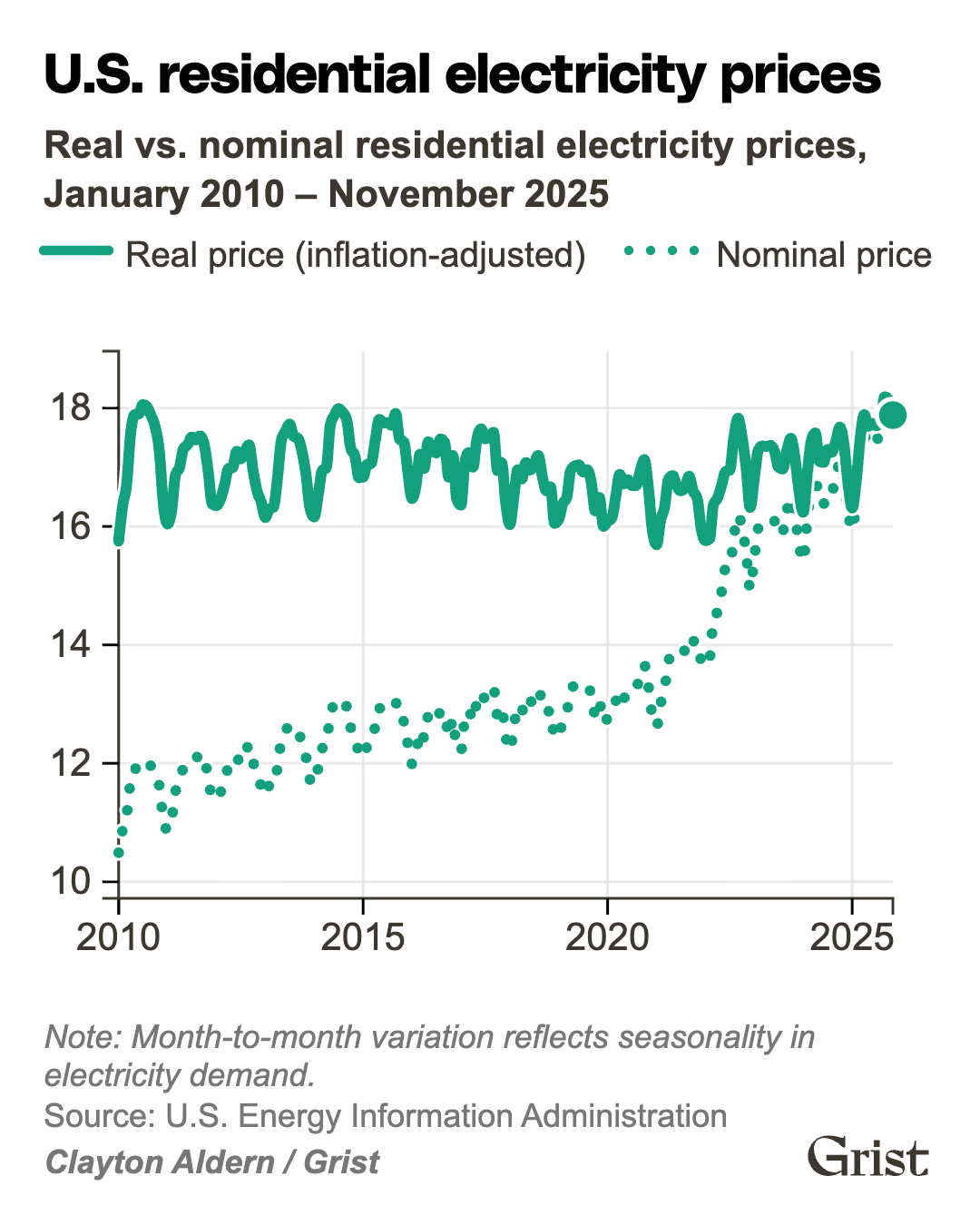
U.S. residential electricity prices
Real vs. nominal residential electricity prices, January 2010 – November 2025
Real price (inflation-adjusted)
Sticker price
A wide range of culprits have been blamed for the surge in electricity prices, with energy-hungry data centers shouldering much of the criticism. Tariffs, aging power plants, and renewable energy mandates have also come under fire. But the reality is far more nuanced, according to recent research from the Lawrence Berkeley National Laboratory and the latest price data from the federal government’s Energy Information Administration. Electricity prices are shaped by a complex mix of factors, including how utilities are structured, how regulators oversee them, regional divergences in fuel prices, and how often the grid is stressed by heat waves or cold snaps. In many states, the biggest driver is the rising cost of maintaining and upgrading grids to survive more extreme weather — the unglamorous work of replacing old poles and wires.
Select your state from the dropdown menu below. (U.S. territories, including Guam and Puerto Rico, do not appear in the menu, since data availability is more limited.)
Compare your state’s electricity prices to the U.S. average
Real and nominal prices, cents per kWh
— Select a state —
All customer classes
Residential
Commercial
Industrial
?
EIA data covers only about 70 to 80 percent of Alaska’s electricity providers.
Many rural communities rely on microgrids that don’t report to EIA.
More comprehensive state data suggests the true statewide average is
roughly five percent lower than shown here, but rates in remote communities
can exceed $1/kWh.
Click to show or hide lines
U.S. (inflation-adjusted)
U.S. (sticker price)