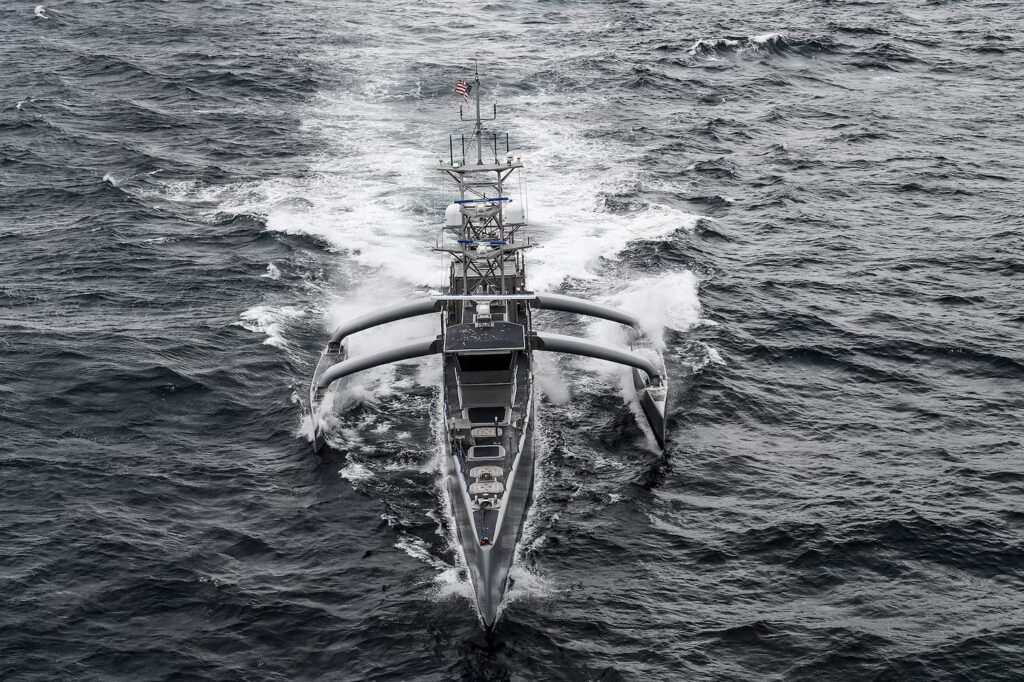
May the best Unmanned Surface Vessel win.
The U.S. Navy announced Friday that it selected seven companies to compete for the service’s Medium Unmanned Surface Vessel contract.
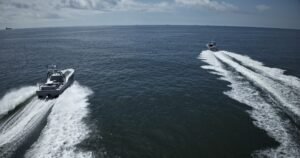
At-sea testing of the vessels is slated to begin next month, with companies whose MUSVs successfully complete the trials set to receive $15 million and be eligible for “follow-on production,” according to the Navy.
Testing is set to wrap up by October of this year.
The companies chosen to for the trials include Sea Machines, Leidos, Saronic Technologies, Galliano Marine Services, PacMar Technologies, Birdon and Huntington Ingalls Industries.
This announcement comes as the Navy seeks to expand its unmanned service vessels fleet, with officials hoping to swell its numbers sevenfold, from four to 30 vessels by 2030 in the Indo-Pacific.
The four USVs that were deployed in the Indo-Pacific for five months in 2024 were the Sea Hunter, Sea Hawk, Mariner and Ranger vessels, and all four are still being used to further develop the Navy’s USV program, according to previous Military Times reporting.
The Navy is utilizing the MUSV marketplace to solicit bids from “smaller, non-traditional shipyards” in the hopes of creating new opportunities to build out the Navy’s unmanned fleet. The initiative, according to the release, “represents a strategic shift in naval acquisition, designed to rapidly field unmanned technologies by leveraging mature, existing commercial solutions.”
In March, the MUSV marketplace — which received roughly $2.1 billion in funding from President Donald Trump’s “One Big Beautiful Bill” — replaced the Modular Attack Surface Craft program, causing some consternation among companies that had spent time developing unmanned vessels for the MASC marketplace.
The latest solicitation, published on March 26, calls for MUSVs that are capable of traveling 2,500 nautical miles at 25 knots while carrying a 25-ton load on the payload deck in moderate conditions. The MUSV must be fully autonomous day and night, capable of operating through different weather conditions in moderate to rough seas and “survivable through sea state 7.” In addition, the vessel must be able to restrict “all Radio Frequency (RF) emissions when commanded while continuing to autonomously operate” and having a “passive mode with no RF emissions.”
The MUSV should also be able to monitor its health and status while “autonomously report[ing] conditions to the offboard C2 station, providing situational awareness of the condition of the vessel to the operator,” according to the solicitation.
After the sea trials, the contractor should be prepared to field five to 10 operation MUSVs in fiscal year 2027 to help rapidly usher in the unmanned era in the U.S. Navy.