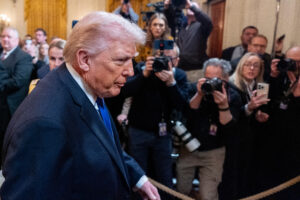
During the year she spent leading the U.S. Department of Homeland Security, or DHS, Kristi Noem faced a torrent of criticism. Lawmakers from both parties assailed her for lying about the shooting of protestors in Minneapolis and spending millions of dollars on television commercials. Government audits concluded that she “systematically obstructed” investigations and created security risks at airports.
Now she has become the first cabinet-level official fired by President Donald Trump during his second term. After a combative hearing this week, during which Noem seemed to mislead Congress about whether Trump approved her ad spending, the president fired her.
As DHS Secretary, Noem also raised eyebrows for the unprecedented degree of control over staffing and spending at the Federal Emergency Management Agency, or FEMA. She paused most FEMA payments, leading to extensive delays for disaster recovery, and sought to slash the agency’s on-call workforce by thousands of employees. She also expressed a desire to downsize or eliminate the agency entirely, shifting the burden of disaster relief onto the states.
A growing number of critics and experts believe that Noem’s interference with FEMA may well have been illegal. This week, two Senate Democrats released a report alleging that Noem’s blanket freeze on FEMA payments violated federal law. At the same time, lawyers for a federal workers’ union argued to a federal judge in California that Noem’s workforce cuts also violated the law. In both cases, critics pointed to legislation passed after Hurricane Katrina, which prohibits DHS from interfering with FEMA.
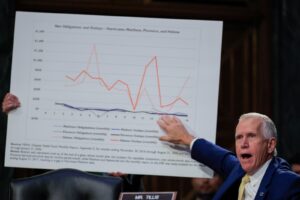
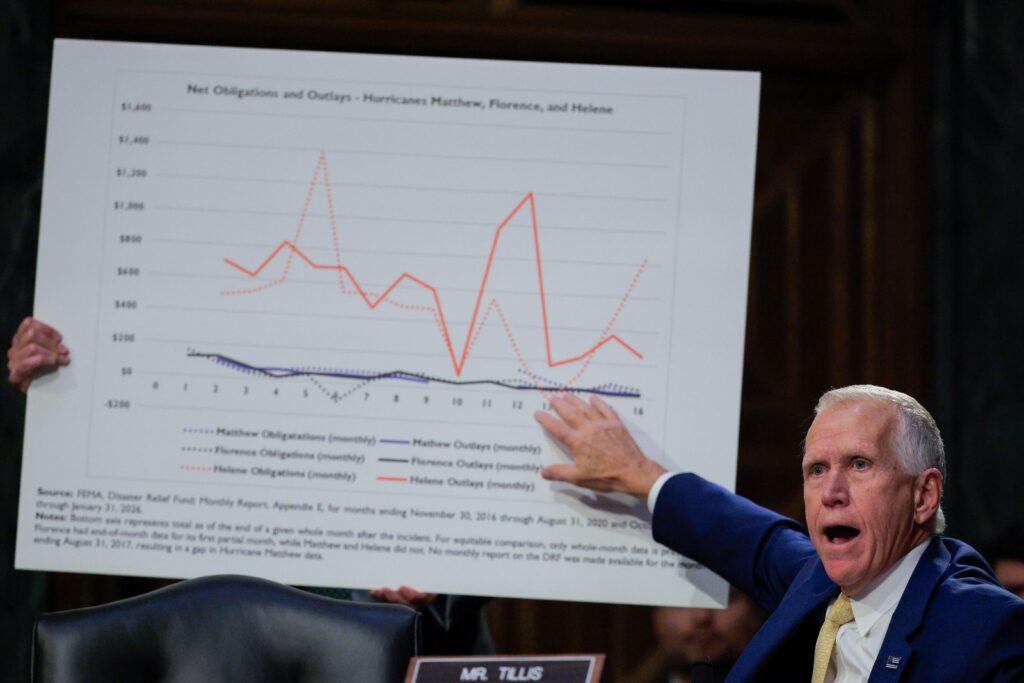
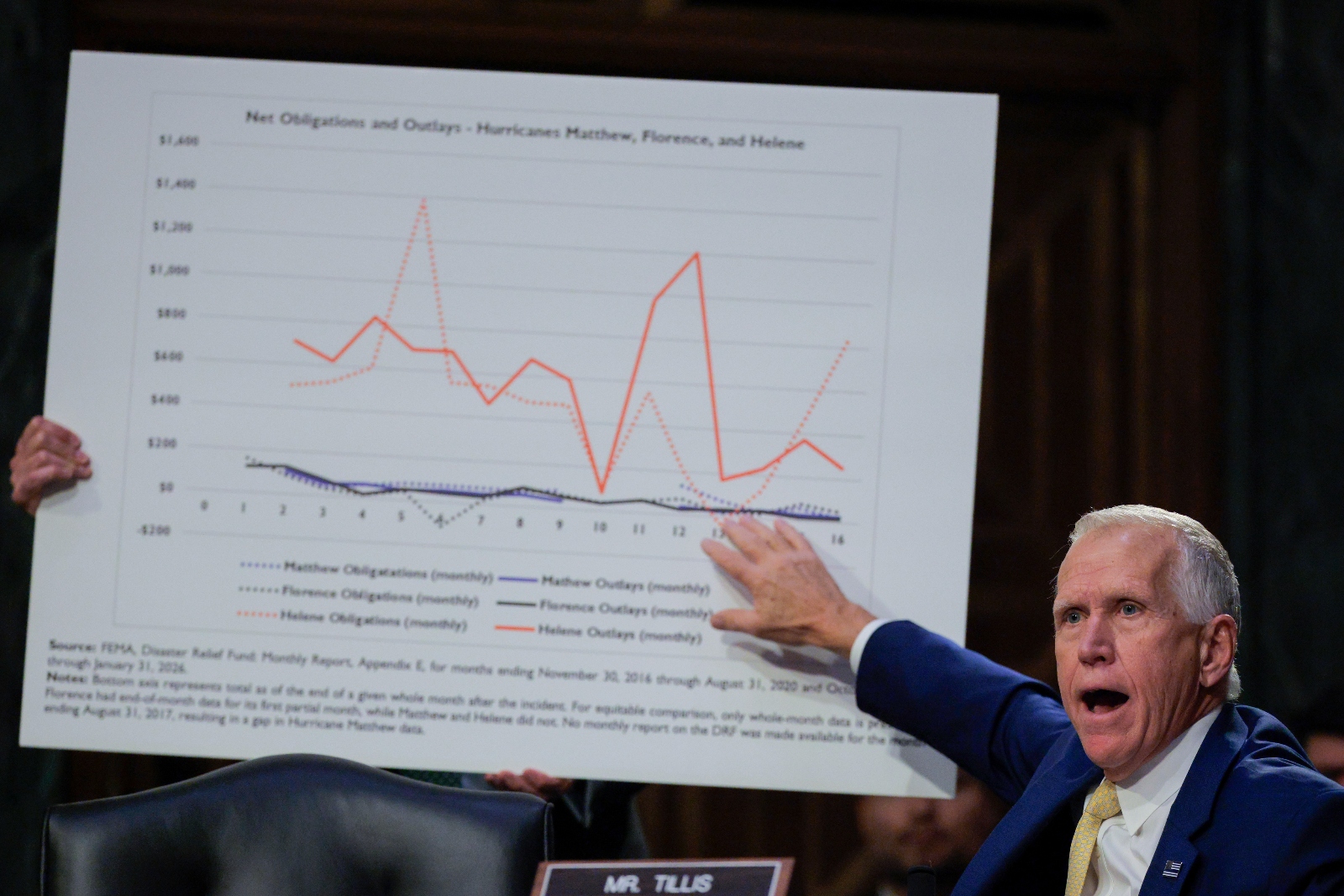
“I have reason to believe that you’re violating the law, either knowingly or unknowingly,” said Senator Thom Tillis, a Republican representing North Carolina, during his questioning of Noem this week.
These accusations will remain relevant if Noem’s apparent successor, Oklahoma Senator Markwayne Mullin, continues her quest to make permanent changes to FEMA’s structure — a goal that the president has frequently suggested he supports. Though President Trump has in many cases been able to make unilateral cuts to federal programs on a rapid timeline — as with the Department of Education and U.S. Agency for International Development — the post-Katrina law may put FEMA on stronger footing for the rest of the president’s term.
“To my knowledge, DHS has never been involved in decision-making about the FEMA workforce,” said MaryAnn Tierney, a former FEMA official who led the agency’s regional office on the eastern seaboard for more than a decade.
The Post-Katrina Emergency Management Reform Act of 2006 emerged from a series of federal investigations into the agency’s failures after the devastating storm, which killed more than 1,400 people and submerged much of New Orleans. A bipartisan select committee in the House of Representatives found that the agency’s leaders had dithered for days before activating key response measures, and that there were numerous breakdowns in the agency’s chain of command.
Congress also found that FEMA had withered after the Bush administration placed it under the newly-created Department of Homeland Security, where leaders were focused on combating terrorism in the wake of 9/11. As a result, they did very little planning for a major natural disaster like Katrina. State emergency managers testified to Congress that FEMA was “emaciated and anemic” and had been “lost in the shuffle” at DHS.
Congress tried to fix this in 2006 with a law requiring that FEMA leadership have experience in emergency management and giving the agency the ability to report directly to the president during disasters. The law also stated that “the Secretary [of DHS] may not substantially or significantly reduce the authorities, responsibilities, or functions … or the capability of the Agency.”
Noem attempted to do just this. Trump has not nominated anyone to lead FEMA since he assumed office last year — the law requires a FEMA administrator with at least five years of emergency management experience — and has instead designated three different acting administrators, avoiding Senate confirmation and the emergency management experience requirement. The most recent, Karen Evans, has been in office since December. It appears that all three of these acting administrators have taken direct orders from DHS, allowing Noem to fill the leadership vacuum.
“I think Congress never anticipated [that] what has happened would happen, or they would have probably put in more clarity,” said W. Craig Fugate, who led FEMA under the Obama administration and earlier served as the head of Florida’s emergency management agency.
In June, Noem asserted direct approval authority over all FEMA spending transactions that exceeded $100,000 — a total that, given the nature of disaster response, includes most of the agency’s payments. The policy led to an immediate freeze in payments to cities that were rebuilding after recent floods and fires and an almost total halt in new infrastructure projects that will protect against future disasters.
A report released this week by Senators Gary Peters of Michigan and Andy Kim of New Jersey found that the spending pause delayed more than 1,000 disaster-related projects. These included the opening of a call center after the July 4 floods that devastated the Texas Hill Country, temporary housing for survivors of Hurricane Helene and the Maui wildfires, and housing inspections for storm victims in places like Missouri. The senators argue that this blanket spending policy violates the post-Katrina law by depriving FEMA of autonomous control over its disaster spending. (After Senator Tillis berated Noem during her Senate appearance, FEMA released around $80 million in Hurricane Helene recovery funding to his state.)
The spending freeze isn’t the only way in which Noem may have violated the 2006 law. In recent months, she also tried to downsize FEMA’s workforce, and in particular its Cadre of On-Call Response and Recovery Employees, or CORE workers, who assist with recovery and response operations during major disasters. These workers tend to have their contracts renewed pro forma, but DHS ordered the non-renewal of around 200 such employees’ terms in January. Noem was reportedly targeting a broad cut of 11,000 workers — half the agency’s workforce.
A union of federal employees sued over the recent firings, arguing that they violate the post-Katrina law. In a hearing on Tuesday, a federal judge at first said she was inclined to let the firings go forward, but she changed her mind after a federal government lawyer failed to provide even basic information about who is making decisions for FEMA. FEMA’s acting administrator herself said in a sworn declaration that “DHS decided” not to renew the core workers, but the lawyer denied that was the case.
If confirmed as the new DHS secretary, Senator Mullin’s approach to FEMA will face extreme scrutiny from judges and lawmakers. A bipartisan group in the House of Representatives is pushing a bill that would extricate the agency from DHS, giving it full cabinet-level status. New leadership at DHS might also increase the pressure on Trump to appoint a permanent FEMA administrator.
If Trump does move to install a permanent leader, that person will have a lot of work to do to prepare the agency for hurricane season, according to Fugate.
“[Noem] has already broken them,” he said of the agency’s leadership, adding that the loss of many senior officials could leave it vulnerable during a big disaster. “There’s still good people at FEMA, but I just don’t know if there are enough of them, and if DHS has the sense to get out of the way.”
This story was originally published by Grist with the headline Kristi Noem all but killed FEMA. Will her departure save it? on Mar 5, 2026.