You are here because of a single, all-important enzyme. But don’t look inward to find ribulose-1,5-bisphosphate carboxylase/oxygenase, known more mercifully among scientists as rubisco. Instead, look to the food you eat and the trees that manufacture oxygen, as this is the protein that makes photosynthesis possible. Without it, life on Earth as we know it would not exist.
For all that heavy lifting, rubisco is remarkably inefficient. The enzyme converts carbon dioxide into sugars that sustain plants. But it is easily confused, and will react with oxygen in a process that creates a toxic byproduct, wastes energy, and limits how quickly plants can grow. (Which is not to fault rubisco: This is a very difficult reaction to pull off, and just look at how many plants have been getting it right for hundreds of millions of years.) That includes the essential crops that feed humanity — grains, vegetables, fruits — that could theoretically grow better if their rubisco worked more efficiently. This problem becomes more urgent as global temperatures rise, because this essential protein gets even less efficient in the heat.
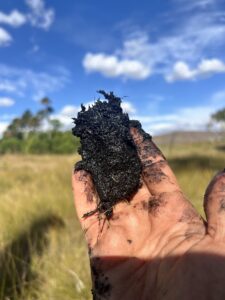
Enter the hornwort. This tiny plant, which is related to mosses, grows as a green sheet on the ground. It’s the only known land plant that’s found a way (evolutionarily speaking) to supercharge rubisco by concentrating CO2 around the enzyme.
Now, an international team of scientists says it has figured out how hornwort does this, and how it may be able to apply that superpower to crops. That could mean massively improved yields, so farmers wouldn’t need to cultivate as much land to grow the same amount of food. “It’s very impressive,” said Robert Wilson, a biochemist who studies rubisco at the Massachusetts Institute of Technology. (Wilson wasn’t involved in the research but does collaborate with one of the scientists.) “It’s interesting, because it’s a completely new and novel mechanism through which an important aspect of rubisco biochemistry occurs.”
Scientists have long known that some species of algae also improve the efficiency of rubisco. Inside their chloroplasts — the structures within cells where photosynthesis hums along — they’ve developed specialized compartments known as pyrenoids. These concentrate CO2 around the enzyme, minimizing its reaction with oxygen. “It prevents rubisco from touching oxygen, because it puts it into a house and then pumps a bunch of CO2 into the house,” said Laura Gunn, a synthetic plant biologist at Cornell University and coauthor of a new paper describing the work. “So the rubisco is completely, completely saturated with CO2, and all the oxygen is outside the house.”
But because algae are so distantly related to the foods we eat, it would be challenging to genetically modify crops to mimic those pyrenoids. On the other hand, the hornwort is more closely related. These researchers discovered that it has a unique way of making these pyrenoid structures, due to a protein they’re calling RbcS-STAR. Rubisco in all plants is made of proteins, but the hornwort’s version has an extra “tail,” which helps tether the enzymes together to create compartments into which CO2 pumps, increasing the efficiency of the process.
To that end, the researchers introduced the RbcS-STAR protein into a closely related hornwort species that doesn’t have pyrenoids, and sure enough its rubisco reorganized to create those compartments. They then did the same with Arabidopsis — a small flowering plant commonly used in lab experiments as a model organism — and it too responded. “They form pyrenoid-like structures, and that will be a very important step toward engineering a better photosynthesis using this type of CO2-concentrating mechanism,” said Fay-Wei Li, a plant biologist at Cornell University and the Boyce Thompson Institute and coauthor of the paper. Now the team is looking to do the same by genetically modifying crops: Gunn said that by adding pyrenoid structures, researchers might boost growth and yields by as much as 60 percent.

At the moment, though, the researchers have so far just built the pyrenoid-like house. “Basically, we’ve built the walls, right, we’ve built the roof,” Gunn said. “But we haven’t got the HVAC system yet. We haven’t got the system in there that’s going to pump the CO2 in, and then going to pump out the sugar products at the end.”
Once the researchers figure that out, it could mean a field day for farmers the world over. Because Rubisco is so inefficient, plants must produce a lot of it. To encourage that, farmers have to apply heaps of synthetic fertilizers. All those chemicals are not only expensive, but also terrible for the environment: It takes an immense amount of energy to produce, then pollutes waterways when it runs off fields.
And speaking of water, the breakthrough could also mean crops use less of it. Plants are dotted with little structures called stomata, which open up so they can “inhale” CO2. Because rubisco is so inefficient, plants need to breathe deeply to get enough of the gas, but that releases more water vapor through the stomata, hence having to constantly irrigate crops. “If a rubisco does not react with oxygen as much, the plants can close their stomata more often,” Li said. “If you can close your stomata, then you will not lose as much water.”
But if algae and the hornwort have figured out how to improve rubisco, why haven’t all plants? Algae live in aquatic environments, where CO2 dissolves poorly, so they’ve had to make the best of what little they’ve got. For the hornworts, the reason isn’t actually clear, especially since related species living in the same environment haven’t evolved pyrenoids. As for all the other land plants lacking a better system, one reason might be that rubisco evolved at a time when there wasn’t much oxygen in the atmosphere, meaning plants didn’t have to worry about the enzyme getting distracted as it tried to process CO2.
All these years later, scientists have cracked the code, and they could soon make rubisco even more of an essential enzyme. “I think it’s very likely that improvements to crop yields through plant synthetic biology will be forthcoming in the next 10 years,” Wilson said. “And that’s very exciting, because that’s where the field has been trying to go for many decades now.”
This story was originally published by Grist with the headline How the humble hornwort could supercharge agriculture on Mar 13, 2026.