The government of French Polynesia plans to challenge an American startup’s proposal to explore the waters just beyond its maritime borders for seabed mining.
“We were approached, but we were not consulted,” Moetai Brotherson, the territory’s president, told Grist. “We are not remaining passive while industrial activities are proposed immediately next to ecosystems that French Polynesia has chosen to protect.”
As Grist reported last week, a Bay Area investor wants the Trump administration’s approval to explore seabed mining in international waters entirely surrounded by the maritime borders of the Cook Islands, Kiribati, and French Polynesia. The company, American Deep Sea Minerals, has a permit application pending before U.S. regulators and hopes to extract minerals essential to the production of batteries and military technologies. It is one of at least a dozen applications under consideration as President Trump races to make the United States a leader in critical mineral mining.
Negotiators from dozens of countries are meeting this month in Jamaica at the headquarters of the International Seabed Authority, where they are debating the minutiae of a regulatory framework that’s been in progress for more than a decade. Last year, the Trump administration invited companies to apply for permits to mine the high seas directly through the U.S. rather than wait for the adoption of those rules. That has prompted global outrage from countries who say it flouts international law.
“The deep seabed belongs to no single country and no corporation; it belongs to all of us,” Letitia Carvalho, the secretary-general of the regulatory body, said in Jamaica last week. “If we lose sight of this, we risk repeating on the ocean floor the same injustices and destruction we still strive to remedy on land.”
French Polynesia doesn’t have a seat at the authority because it remains a French territory whose Indigenous people haven’t been granted political self-determination. And until recently, when environmental nonprofit organizations extended their observer status to Indigenous advocates, the voices of French Polynesians were largely left out of the discussion. Still, Brotherson said he prefers the international regulatory process to recent U.S. actions.
“This case therefore goes beyond one company or one licence application,” Brotherson said. It raises a fundamental question, he said, about whether an individual country can unilaterally authorize a new industry in international waters, particularly those adjacent to Pacific island nations and protected marine areas.
According to Brotherson, American Deep Sea Minerals sent a brief introductory email to a government representative; the government replied asking for more information. “No response was received,” he said. “Thus, no consultation has taken place regarding this proposal, and the government has not been provided with sufficient information to assess the project or its potential environmental implications.” Under international law, Indigenous peoples have the right to free, prior and informed consent — and to withhold such consent — regarding development and extractive projects on their ancestral territories.
Graham Goulet, the CEO of American Metals, told Grist the company intended to consult the governments of the Cook Islands, Kiribati, and French Polynesia “as the exploration program develops.” Those discussions will, he said, occur under U.S. oversight and in accordance with the intentions outlined in its application. The filing notes that it intends to create a benefit sharing agreement with Pacific nations and plans to avoid interfering with fishing.
The National Oceanic and Atmospheric Administration, the U.S. government agency overseeing seabed licenses in international waters, is still considering Goulet’s application. It is available for public comment online until August 3.
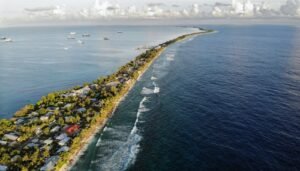
The environmental implications of seabed mining have long concerned French Polynesia, which banned the practice in 2022, followed quickly by France in 2023. Indigenous peoples with longstanding connections to the ocean, such as for traditional navigation, account for 80 percent of the territory’s population. Studies show extraction could harm fisheries, and Indigenous Pasifika leaders from across the region have raised cultural concerns about the significance of disturbing the sea floor.
“As if climate change wasn’t enough, the spectre of deep-sea mining threatens to strip-mine the ocean floor, our sacred place of creation,” said Hinano Murphy, an Indigenous cultural expert from Moorea and Tahiti in a TEDxTalk last year.
Last September, Brotherson added further prohibitions on seabed mining within Tainui Atea, a marine protected area that encompasses nearly all of the islands’ exclusive waters. The preserve sustains 21 species of sharks, 176 species of coral, and more than 1,000 species of fish, according to the United Nations. One survey found more than 92 percent of French Polynesians support Tainui Atea because it honors their traditional cultural practices.
“French Polynesia’s position is therefore not only a political statement. The protection of deep-sea ecosystems is now embedded in our domestic regulatory framework,” Brotherson said.
The waters that American Deep Sea Minerals is eyeing, known as Eastern High Seas Pocket 3, are also a popular tuna fishing spot, as well as a potential conservation area.
In January, the United Nations High Seas Treaty, an international law intended to protect marine ecosystems, took effect, allowing nations to create conservation areas in international waters for the first time. French Polynesia wants to use the law to protect the Eastern High Seas Pocket 3. Doing so could set an important precedent for how effective the treaty is, and how protected the world’s oceans will be in the future, Brotherson said.
If American Deep Sea Minerals’ application proceeds, French Polynesia wants a say in what happens and a thorough environmental review. Recently, U.S. regulators fast tracked the approval process for deep-sea mining applications by halving the number of environmental reviews required for commercial permits. “We expect the interests of neighboring Pacific countries and territories to be fully taken into account through prior notification, meaningful consultation, and a comprehensive, independent and participatory environmental impact assessment,” Brotherson said.
As part of a U.S. application, American Deep Sea Minerals will need to conduct scientific studies of the area and create an environmental impact assessment. Brotherson said that his government supports independent scientific research conducted on deep-sea ecosystems.
“However, we do not regard this particular application as neutral scientific research,” he said. Although the company says it does not yet intend to apply for a commercial license, its application shows that it intends to conduct the research necessary to apply for one, as well as a mining test. “It is therefore part of a pathway towards potential commercial mining,” Brotherson said.
This story was originally published by Grist with the headline French Polynesia objects to an American seabed mining plan made without its input on Jul 21, 2026.