Editor’s note: This article first appeared on The War Horse, an award-winning nonprofit news organization educating the public on military service. Subscribe to their newsletter.
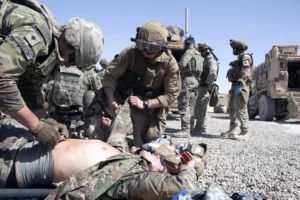
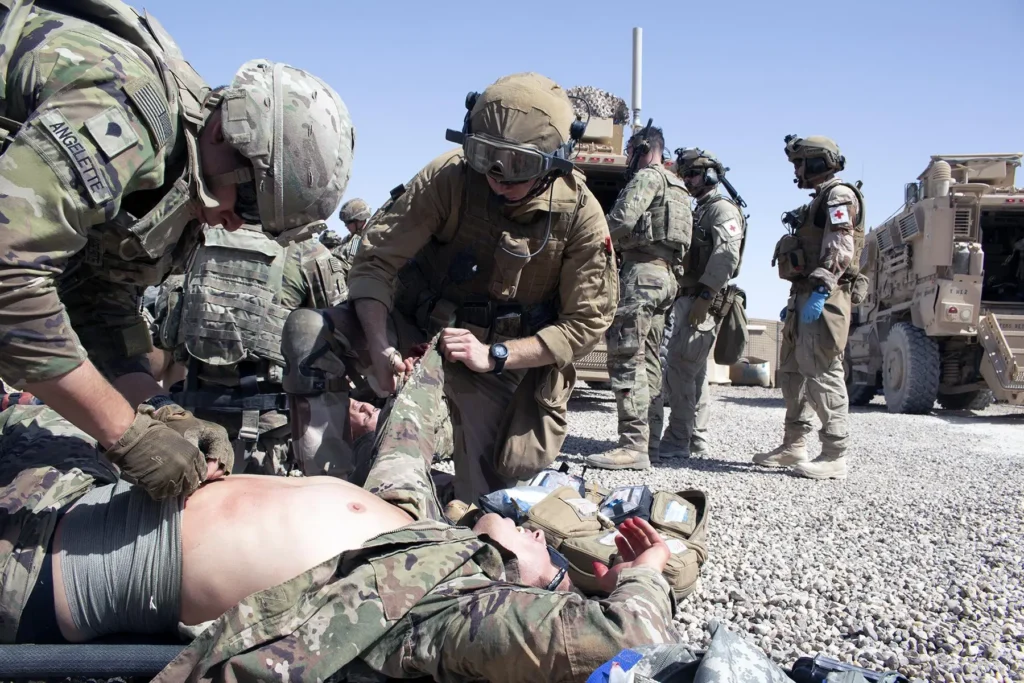
On a serene Saturday afternoon, thousands of miles from conflict, soldiers with the California Air National Guard are scattered among stations, hunched over a buddy. Some apply tourniquets. Others practice life-saving skills, checking for breathing, tilting chins to clear airways, searching for blood loss and hidden wounds.
This is how they learn to keep a soldier alive.
“They’re getting ready to deploy,” said Dr. Dean Winslow, a professor of medicine at Stanford University and an instructor at the Tactical Combat Casualty Care classes.
“This is very real.”
Drone warfare requires new age of battlefield medicine
To help them prepare for what they may encounter in the war with Iran, an update was added to the standard curriculum. Its title: Modern Warfare Concepts, POV Unmanned Aircraft System Explosives. Its focus: the risk of air attack and the importance of high-quality burn care.
As the U.S. confronts a changed character of combat, the trauma training for the 50 airmen at Moffett Federal Airfield, about 35 miles south of San Francisco, is urgent and essential. But is it enough?
Several new trends are driving concerns that military medical care needs to adapt to drone warfare, a defining feature of 21st-century conflicts.
“With injuries, it’s a new world now,” Winslow told The War Horse.

Wars have been inflicting explosive wounds ever since China’s early Ming Dynasty used “fire-weapons,” including a cast-iron grade bomb with gunpowder, in the 14th century. Sky-borne casualties are nothing new — Nazi Germany inflicted V-1 flying bombs on London residents during World War II. Improvised explosive devices were responsible for a surge of explosive injuries in Iraq and Afghanistan, causing 74.4% of casualties; only 19.9% of casualties were caused by gunshot wounds.
But an analysis of injuries in Ukraine shows that drone-delivered explosives are more destructive and lead to a wider range and higher severity of traumatic injury, according to research by a team led by the Uniformed Services University of the Health Sciences in Bethesda, Maryland. The drones Russia has been launching on Ukraine are similar to the weapons used by Iran.
Ukrainian soldiers are suffering from a far higher range and severity of devastating wounds than U.S. troops in Iraq and Afghanistan, researchers found. The high-energy explosives, deployed in swarms, have the potential to create large clusters of casualties in relatively short periods of time.
The signature wound of the Russian drones is limb amputation, followed by multiple-limb injuries and severe burns. Detonating at close range, a drone can inflict a complicated constellation of upper-body, neck and head injuries, according to a report by the aid group MedGlobal.

“Drone warfare has drastically changed the complexity of the traumatized patient that we see,” said Dr. Michael Samotowka, a volunteer trauma surgeon with MedGlobal who frequently travels to Ukraine to treat soldiers injured by Russian drones.
“It has drastically changed the volume of injuries that require surgical intervention,” he told The War Horse. “It’s changed our whole mentality.”
Mounting medical challenges
Drones also mean that we can no longer rely on an old axiom of combat: Distance from the front is protective, and the place for life-saving care. Small and cheap, drones can fly for miles, linger in the air for hours and descend in swarms, evading air defenses.
If the skies aren’t safe to evacuate injured soldiers, prolonged casualty care will become the collective effort by close combat forces at the brigade-and-below levels, according to research led by Army trauma surgeon Col. Jennifer Gurney, chief of the Joint Trauma System at the Department of Defense’s Center of Excellence for Trauma.
The new threat also comes at a precarious time: The U.S. Department of Defense has downsized its hospitals, so military physicians aren’t getting enough experience with trauma patients to be ready for major casualties.
“Because Army and Navy medical personnel are not consistently assigned where they can sustain their wartime readiness skills, they may not provide high-quality, point-of-injury care to service members during deployments,” concluded a 2025 Department of Defense Inspector General report.

Iran most commonly uses a drone called the Shahed 136, according to the munitions tracking project Open Source Munitions Portal. Preprogrammed to fly up to 1,200 miles and carry warheads guided by a satellite navigation system, it can target embassies, hotels and other places where American troops are dispersed.
Shortly after the U.S. and Israel launched their surprise air assault to start the war, an Iranian drone strike on March 1 triggered an explosion in Kuwait at a U.S supply and logistics unit that killed six U.S. service members, injured about 30 others and set off a fire and frantic search for survivors in the rubble.
The unit had relocated to the civilian Port of Shuaiba from U.S. Army base Camp Arifjan in an effort to evade incoming strikes from Tehran. “They were dispersing because they were in fear that the base they were on was going to get attacked, and they felt it was safer in smaller groups in separated places,” Joey Amor — the husband of Sgt. 1st Class Nicole Amor, who died in the attack — told The Associated Press.
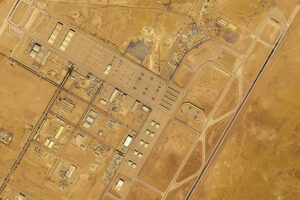
It wasn’t the only drone attack to injure U.S. forces. About 29 drones and six ballistic missiles were blamed for a March 27 assault at Saudi Arabia’s Prince Sultan air base that injured at least 15 U.S. troops, including five seriously, according to The Associated Press.
That was one of the most significant breaches of U.S. air defenses since the conflict started. With President Trump threatening a major escalation of attacks, Iran and the U.S. on Tuesday agreed to a two-week ceasefire. As of March 31, at least 348 U.S. military personnel had been wounded, reported U.S. Central Command’s spokesperson Navy Capt. Tim Hawkins, but reports are surfacing about whether this is an undercount.
Iraq and Afghanistan vs. Ukraine
Military combat care evolved to meet the needs of the Iraq and Afghanistan theaters. But this support — an agile and efficient network that quickly stabilized, treated and evacuated wounded service members — was based on relatively light patient loads in places where U.S. forces could safely evacuate injured service members to higher echelons of care.

In Iraq and Afghanistan, wounded soldiers and Marines could be evacuated from the field to an operating room within an hour, said Dan Elinoff, a combat medic in Iraq and Afghanistan and a former senior defense analyst at the RAND Corporation. That helped reduce the case fatality rate from 36% in Vietnam to 10% in Iraq and Afghanistan — a saving of an estimated 1,000 lives.
But when drones are overhead, evacuation can be delayed. Surgical treatment within “the golden hour” — the critical 60-minute window when most lives are saved or lost — will become a goal, not an expectation.
“The main issue that I can see for drone warfare, compared to IEDs, is a real compromise of ‘the golden hour,’” Elinoff told The War Horse. In previous wars, “your main threat was on the front line. The rear area is a lot more secure. You can get people back there, and you can probably keep them a lot safer.
“With the abundance of drones, it’s much easier to hit those rear areas,” said Elinoff. “Your evacuation routes are a lot more compromised.”
In Ukraine, drone warfare has demanded a dramatic shift toward a more decentralized model of care, bringing more advanced care closer to hard-to-reach people on the front lines.
This decentralized model echoes patterns of treatment created in Syria and Yemen, where air bombardment and targeting of health sites forced medical care to move underground, onto mobile platforms or across dispersed community sites, according to the MedGlobal report.
Anticipating that it may take two to three days to evacuate an injured soldier in future conflicts, Fort Benning launched in 2022 a pilot Delayed Evacuation Casualty Management Course to train medics how to provide advanced care on the front lines.

The type of injuries may shift. In Iraq and Afghanistan between 50% and 60% of deaths and injuries were caused by roadside improvised explosive devices, according to the Pentagon’s Defense Manpower Data Center. Because these devices often exploded under vehicles, the lower torso and abdomen were common sites of wounds, particularly by blasts that forced damage upward.
Drones, by contrast, cause significant damage both on the ground and overhead. Data from Ukraine shows that they frequently attack from above, targeting the top of buildings, tanks and trucks. Or they explode in the air, showering metal fragments. Some precision-guided drones enter buildings. As a result, the most frequent injuries in Ukrainian soldiers occur in the head and neck, followed by lower extremities, upper extremities and chest and upper back.
Drone injuries also are typically more complex. One study found that nearly half of Ukrainian casualties involved “multisite trauma,” involving more than two regions of the body from blasts, high-temperature burns from thermobaric and incendiary munitions and traumatic brain injuries. About one in five had injuries in three or more body regions.
A drone “either showers down at a high energy, in small fragments, head down to toes, or it drops in front of the soldier and it blows up,” said Samotowka.
“If there’s 100 drones flying around you, looking for you, you can’t be evacuated.”
Too few trauma experts, too little practice
In future U.S. conflicts, even if evacuation is successful, there is an insufficient supply of highly skilled military surgeons and other experts to meet the demand.
That’s because after every war, the military loses resources and expertise, said Rear Adm. Dr. David Lane, a former commanding officer of Naval Hospital Camp Lejeune and former director of Walter Reed National Military Medical Center.
“Budget wonks in both Republican and Democratic administrations always look for a so-called peace dividend whenever we scale back from major combat operations,” he told The War Horse.
“During peacetime, there is a ying and a yang between the efficiency needed to run military hospitals and clinics on par with the best of the best civilian health care organizations,” he said. “Staying ready for combat trauma and diseases and nonbattle injuries requires time away [from military treatment facilities], disrupts continuity, and adds to the cost of care.”

In recent years, the Army Medical Corps’ rate of recruitment has not been able to keep up with the pace of separations, according to a RAND Corporation report. And retention is down. So positions at military treatment facilities and other units go empty.
At military hospitals, there is less exposure to complex trauma, said Elinoff. On bases, “people are pretty young and healthy. … It’s really hard to keep those skill sets up when you’re not seeing a lot.”
Opportunities for hands-on work are limited. The Army and Navy do not effectively assign medical personnel to locations where they could maintain their required wartime medical readiness skills, the Department of Defense Inspector General found.
It’s too hard and time-consuming to get military health care providers credentialed and integrated into community settings, Elinoff said. While several of the nation’s top trauma hospitals — including the University of Maryland and the University of Cincinnati — have partnered with the military to share their trauma cases, the rotations at trauma centers tend to be too brief.
Even at a busy civilian hospital, there are relatively few trauma patients. That’s because seat belts, air bags, smoke alarms and flame-retardant children’s sleepwear have reduced the number of severe injuries that require complex life-saving surgery. Gunshot injuries are increasing, but they typically involve one part of the body, not general trauma, said doctors.
And trauma patients are increasingly unlikely to be rushed to the operating table. Due to high-tech innovations in interventional radiology, for example, damaged blood vessels can be sealed to stop internal bleeding.
Many young surgeons may graduate after operating on only one or two liver injuries, said Samotowka.
Practice is essential in medicine, said Stefani Diedrich, a retired U.S. Air Force colonel who served as an anesthesiologist for 24 years with deployments to Afghanistan and Niger.
“Any procedural skill needs to be practiced regularly or else it is lost,” she said. “Doing knee arthroscopy does not prepare you for a traumatic amputation. Doing a robotic hernia repair does not prepare you for an exploratory laparotomy for trauma.”
“You can’t ‘refresh’ trauma surgery skills. … You need to do it on a regular basis to not suck,” she said.
Stanford’s Winslow agreed. As the White House considers its next steps in the ongoing tensions with Iran, with thousands of additional U.S. troops heading to the Middle East theater, the challenge is no longer theoretical. There are now 50,000 American troops in the Middle East.
If there is a huge operation, Winslow said, “there’s no way that the active duty surgeons, or at least the majority of them, will have the recency of experience with handling major trauma.”
This War Horse story was edited by Mike Frankel, fact-checked by Jess Rohan and copy-edited by Mitchell Hansen-Dewar. Hrisanthi Pickett wrote the headlines.
This article first appeared on The War Horse and is republished here under a Creative Commons Attribution-NoDerivatives 4.0 International License.