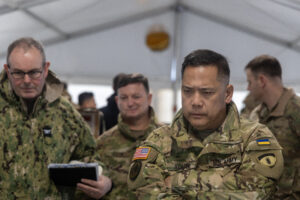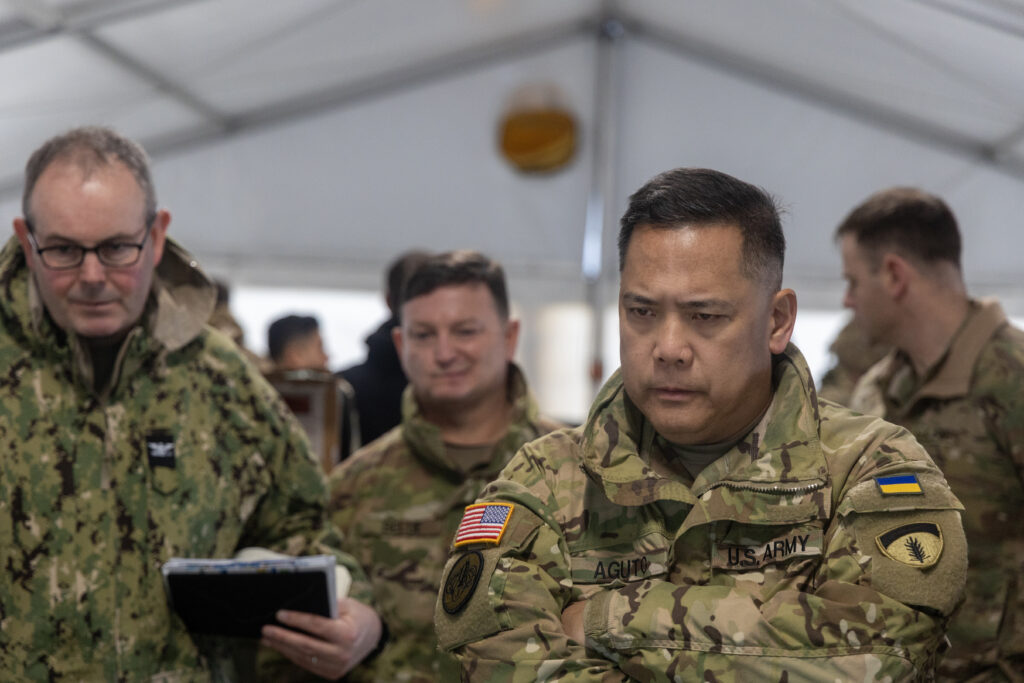
The two-star head of the command responsible for coordinating support for Ukraine left a tube of classified maps behind on a train in Europe, losing control of the sensitive material for 24 hours, a new report from the Department of Defense Inspector General’s office has found.
Then-Army Maj. Gen. Antonio Aguto, now retired, was also found to have sustained a concussion following a night of drinking to intoxication at a social event in Kiev, leading to incoherence and confusion in a briefing the next day.
The report, released March 12, covers a period in April and May 2024 in which Aguto was commander of the Wiesbaden, Germany-based Security Assistance Group-Ukraine. Aguto relinquished command of the group in August 2024, having presided over its activation in 2022. He retired the same month.
Established with about 300 personnel, SAG-U was formed as a headquarters element “to build on the work of the 18th Airborne Corps, who originally deployed to Europe to reinforce NATO’s eastern flank and whose mission latter evolved to include coordinating the training and equipping of the Armed Forces of Ukraine,” according to an announcement at its founding.
The investigation, which was based on anonymous whistleblower reports and also included allegations of a “toxic” environment at SAG-U headquarters, provided a rare inside perspective on working conditions and morale at the small logistics support element. The investigation did not find Aguto personally responsible for the unit’s problems, though.
According to the investigation, which was based on interviews with Aguto and 33 other witnesses, along with extensive document reviews, the classified materials breach happened April 4, 2024, on a return trip from Ukraine to Germany on a chartered train with a Ukrainian crew.
Aguto had brought with him to Ukraine a set of maps classified Secret, hand-carried in a cylindrical tube due to their size. While a witness reported seeing a noncommissioned officer in the travel party carry the map tube onto the train, nobody saw it being taken off. Aguto would only be notified by his executive officer that the map tube was missing after he had returned to headquarters in Wiesbaden, according to the investigation; it was found on the train the next day and returned, apparently untouched, via staff with U.S. Embassy Ukraine.
While classified information is supposed to be transported by courier on trips such as this, no courier order was issued, the investigation found.
Aguto told investigators he took responsibility for the temporary loss of the maps as the “senior guy,” despite not being the one designated to physically carry materials on and off the train.
In the military, mishandling of classified information can carry with it severe penalties, particularly when the violations are intentional.
The subject was pushed into the national spotlight last May, when a signal group chat including Defense Secretary Pete Hegseth and then-National Security Council Director Michael Waltz unintentionally shared sensitive attack plans with journalist Jeffrey Goldberg of The Atlantic.
While Hegseth said the disclosures included “no classified information,” a DoD IG report found some of the information matched that previously classified as Secret.
The IG recommended that the Secretary of the Army refer the matter of the documents’ improper transport by Aguto to the U.S. European Command Special Security Office.
The night of drinking addressed in the report took place May 13, 2024, during a nine-day trip to Ukraine. During a six-hour dinner in Kiev described as a military engagement, a witness reported that Aguto drank approximately two 500 ml bottles of chacha, a Georgian brandy containing 40-50% alcohol.
Witnesses reported Aguto as drunk, and he told investigators he was “some level of intoxicated” following the dinner.
During a meeting in Aguto’s room following the dinner, two witnesses reported seeing him fall backward and strike the back of his head against a wall. In the morning, according to the report, he also had a noticeable mark on his forehead.
As he met staff in the hotel lobby ahead of a morning meeting with then-Secretary of State Anthony Blinken, witnesses reported Aguto acting lethargic and “not himself,” and staff said they suggested he cancel the meeting.
En route to the U.S. Embassy and running late, Aguto fell again, hitting his jaw on the concrete and tearing his jacket.
Aguto showed up to the meeting looking “completely disheveled” and “out of it,” according to the regional security officer. The U.S. ambassador to Ukraine reported worrying that Aguto had been drugged, according to the IG, and others reported him slurring words and acting “cognitively diminished.” He was later taken to a local hospital and diagnosed with a concussion.
Investigators found Aguto’s falls had been a result of “overindulgence” in alcohol, saying he should have considered the effects before drinking so much and did not receive a proper waiver to consume more than the two authorized alcoholic beverages.
Aguto disagreed, saying he “acted in good faith” and had received verbal permission from Gen. Darryl Williams, commander of U.S. Army Europe, to drink at the dinner in light of the “cultural significance” of drinking at such events.
While the IG did not substantiate further allegations that Aguto “belittled” staff and created a toxic work environment, witnesses responding to a climate survey reported grim work conditions that tanked morale. Living spaces, containerized units or cubicle-like spaces in an open warehouse, had little privacy and no Wi-Fi, unit members reported.
“The living spaces were described as prison-like, with living conditions and food ‘[w]orse than Iraq and Afghanistan and even Syria,’” the investigation stated. “The base dining facility had limited food choices and did not operate in the evenings or on weekends when many SAG-U members worked, and the quality was substandard and unhealthy.”
Brutal operational tempo and long work hours also contributed to burnout, surveys found.
“The nature of SAG-U’s work in an active war, plus specific higher echelon briefing requirements, coupled with the Ukrainian partner’s demands for rapid and detailed information output, contributed to MG Aguto’s demanding leadership style,” investigators determined. “MG Aguto’s direct and stern communication style was not well received by some subordinates subject to his critiques, especially members from other Military Services.”
Attempts by Military Times to reach Aguto for comment were not immediately successful.
SAG-U, now commanded by Lt. Gen. Curtis Buzzard, continues to coordinate security force assistance to Ukraine.