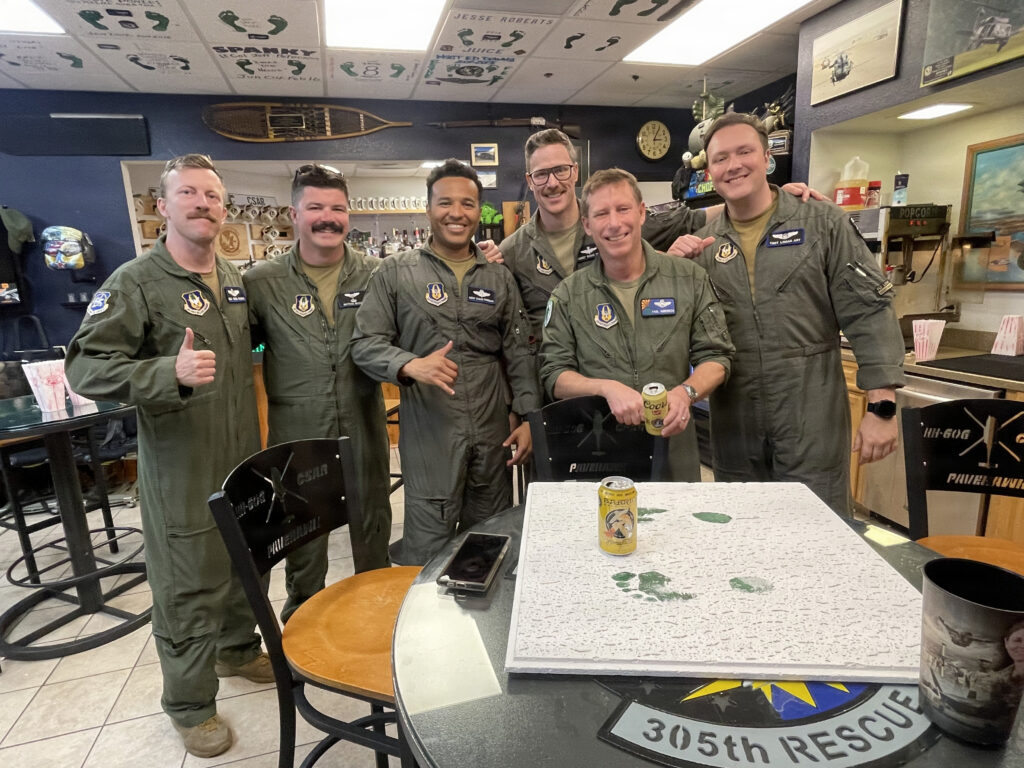
More than 36 years and 6,000 flight hours later, U.S. Air Force Reserve Lt. Col. Paul Anderson concluded his career this month with record-setting flying hours.
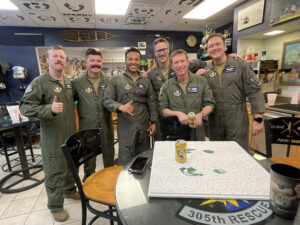
Anderson, assigned to the 305th Rescue Squadron at Davis-Monthan Air Force Base, Arizona, is ending his service after achieving the feat of being the longest-flying helicopter pilot across active duty, Reserve and Guard components, the Air Force confirmed.
The flying hours he notched were spent in the HH-60G Pave Hawk and the HH-60W Jolly Green II, per an Air Force release. He reached 1,000 more hours than the helicopter pilot with the second-most hours.
Anderson’s Air Force career began in 1990 as a maintenance officer in Indiana and Alaska, the release says. A few years later, he was selected to attend pilot training, where he made a “spur-of-the-moment decision” that would “define the next three decades of his life.”
“The flight commander came up and offered a helicopter slot,” Anderson said in the release. “I thought about it for a couple seconds and said, ‘I’ll take it.’”
He attended helicopter training in Fort Rucker, Alabama, according to the release, and graduated in 1995. After spending time at locations like Kadena Air Base, Japan, and Nellis Air Force Base, Nevada, Anderson transferred to the Reserve and joined the 305th Rescue Squadron in 2002.
The primary mission of the HH-60s — the helicopter Anderson accumulated his flying hours in — is combat search and rescue, the statement reads, meaning it is meant to recover personnel from hostile or denied territory. The release says he deployed to Afghanistan about six times to retrieve injured Army and Marine personnel for medical evacuation.
The release notes that the 305th Rescue Squadron has a history of “significant rescues,” like hurricane relief, as well as combat operations in Afghanistan and Iraq.

The most notable operation for Anderson is what he described in the release as the “Wild West”: performing citizen rescue operations in response to Hurricane Katrina.
He and his crew operated one of the hundreds of aircraft flying over New Orleans after the August 2005 storm caused catastrophic flooding. He estimated that in just one week, his team alone rescued more than 100 people.
“We were landing on rooftops and freeways and parks,” Anderson said in the release. “You would pick up a group of people, maybe a whole family, off a rooftop, and we would take them to the airport … drop them off, take off and go grab somebody else. Just go find somebody and help them.”
To Anderson, the flying hours were never the goal, but instead, a result of never saying no. He added that he’s “never not gone on a deployment.”
As he retires from the Reserve, Anderson will transition to being a Functional Check Flight pilot, ensuring that the HH-60W is safe and flight-ready after maintenance, per the Air Force release.
“I know I don’t deserve the career that I’ve had because it’s honestly been great,” Anderson said. “When I was that guy in college that wanted to be an Air Force pilot, I never thought it would be as great as it has been.”