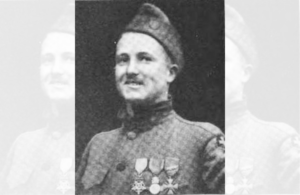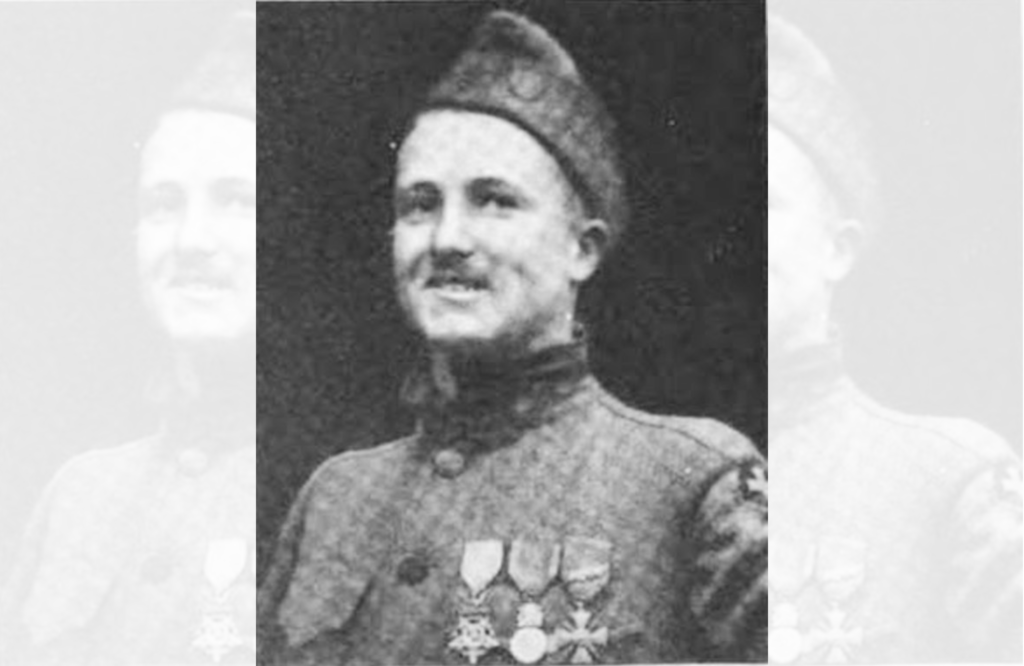
War has a way of changing the lives of its participants. Sometimes, it puts the main actor through a moment of decision that leads to an extraordinary feat. In the case of Ralyn Hill, it involved rushing where the average soldier would fear to tread, simply to retrieve a complete stranger from the jaws of death.
Hill was born in Lindenwood, Illinois, on May 6, 1899. After the United States declared war against Germany on April 6, 1917, he enlisted in the Illinois National Guard and after training shipped out with Company H, 129th Infantry Regiment, 33rd “Prairie” Division.
Once in France, the division underwent a temporary break. Although General John J. Pershing insisted that the American Expeditionary Forces be held together as entity, he and the British command were persuaded by Lt. Gen. John Monash, commander of I Australian Corps, to lend two elements for his assault on Hamel, Somme, France. Much, no doubt to Hill’s and his comrades’ chagrin, the 130nd and 131st had the honor of having their combat debut alongside the Aussies on July 4 — an added touch of timing deliberately chosen by Monash. The result was a swift victory that demonstrated Monash’s brilliant use of combined arms and established a working relationship between Yank and Digger that has lasted more than a century.
The 131st Infantry went on to play a distinguished role alongside the Australians at Chipilly Ridge and Amiens on Aug. 9. Then, as promised to Pershing, on Aug. 23 the 33rd Division was reunited and sent to the Toul sector. Within the division, the 65th Infantry Brigade was organized around the 129th and 130th Infantry Regiments and the 124th Machine Gun Battalion.
After successfully concluding its first major offensive at St. Mihiel on Sept. 18, 1918, the AEF launched a more ambitious push into the Argonne Forest on Sept. 26. There, facing the Meuse River and facing thickly and forested terrain beyond, the Americans encountered their first serious opposition — the German Fifth Army. During the grueling six-week campaign that followed, well-entrenched German forces inflicted heavy casualties on a succession of AEF divisions.
On Oct. 7 the 129th Infantry was fighting around Dannevoux Hill, now a corporal, was observing the area when circumstances called him to extraordinary action, as summed up in his citation:
“Seeing a French biplane fall out of control on the enemy side of the Meuse with its pilot injured, Cpl. Hill voluntarily dashed across the footbridge to the side of the wounded man and, taking him on his back, started back to his lines. During the entire exploit he was subjected to murderous fire of enemy machine guns and artillery, but he successfully accomplished his mission and brought his many to a place of safety, a distance of several hundred yards.”
Hill went on to survive the war and on April 22, 1919, at Ettelbruck, Luxembourg, he stood before Gen. Pershing to receive the Medal of Honor.
Although there is no doubting Hill’s courageous deed, events surrounding it suggest some discrepancies. First, the “French” airplane was made in France, but French records for Oct. 7 indicate no losses. That morning, however, as the 103rd Aero Squadron, U.S. Army Air Service, was returning from a mission, it lost contact with one of its French-built Spad XIII fighters, last seen at about 11 a.m. and declared “missing in action” as of 12:30.
The pilot, 2nd Lt. Wellford MacFadden Jr., was identified and buried two miles west of Brieulles, opposite the 4th Division. His grave was later rediscovered by Capt. Friedrich Wilhelm Zinn, a former observer in French escadrille Sop.24 and pioneer in accounting for USAS losses under the principle of “leave no man behind.”
What all this information, allowing for inconsistencies, suggests that MacFadden had probably fallen afoul of German ground fire (the German fighters made no claims that day), had crashed in German lines and was subsequently recovered by Hill. MacFadden died shortly afterward from his injuries, which in no way discredits Hill’s effort to bring him back, dead or alive.
After the war, Hill made a career of law enforcement, as a sergeant deputy sheriff in Oregon, Illinois, and an officer in Abilene, Kansas. He married Iva Fern Rock and had three daughters: Pauline Murphy, Shirley J. Patterson and Mary Ellen Reynolds. Ralyn M. Hill died on March 25, 1977 and was buried in Abilene.