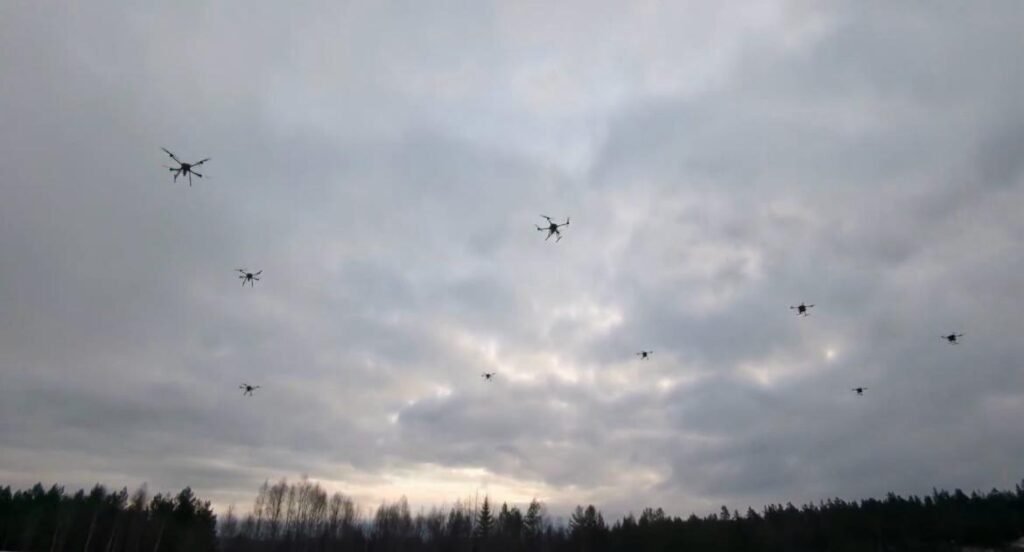
The U.S. Air Force is looking to turn its cargo planes into launch platforms for drone swarms.
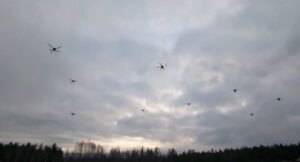
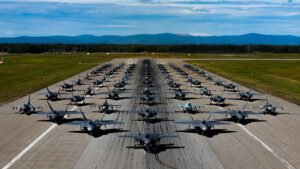
Or more specifically, the service would like transport aircraft and their retinue of drones to deploy to Air Force bases. Once there, this swarm of AI-controlled drones would autonomously defend the bases — and any aircraft parked there — from attack.
The goal is to transform cargo planes into “adaptive, force-multiplying launch platforms” that provide “a rapidly deployable swarm for base security,” according to an Air Force Small Business Innovation Research solicitation. The deadline is Oct. 21.
The Air Force is looking for a 3-for-1 deal. One mission is to provide transport aircraft with onboard intelligence, surveillance and reconnaissance capabilities by enabling them to become high-altitude drone motherships, as the Defense Advanced Research Projects Agency demonstrated in 2021 when a C-130 recovered an X-61 Gremlin in mid-air.

A footnote in the SBIR also cites discussion by Air Mobility Command of using KC-135 tankers as launch platforms.
Another mission is “self-protection for Mobility Air Forces operating in contested airspace.” Such a capability would have been welcome in the Iran war, during which Iranian strikes destroyed or damaged American tankers and airborne warning and control system aircraft parked at Persian Gulf airbases.
Meanwhile, drone swarms would protect forward bases from which the transports and other aircraft operate.
Transport planes can be “significantly augmented with enhanced organic self-protection and intelligence, surveillance, and reconnaissance capabilities to maintain operational overmatch,” explained the SBIR. “Similarly, forward operating bases can bolster their security posture by leveraging rapidly deployable, autonomous perimeter defense networks.”
In a sign of how far drone and AI technology has advanced, the project is skipping the customary Phase I of an SBIR and going straight to Phase II.
“The fundamental scientific and technical merit of coordinating multiple uncrewed aerial systems via artificial intelligence has already been established by the private sector,” the Air Force noted.
Phase II involves contractors demonstrating how cargo planes can deploy drone swarms “at operational altitudes to simulate operational Mobility Air Forces scenarios.” As for the drones, companies should show “the swarm’s ability to autonomously monitor and defend a designated perimeter using onboard visual and thermal sensors.”
The Air Force wants the same AI drone software to handle both missions. This means “the artificial intelligence software should be adapted to seamlessly transition from aerial deployment into a coordinated flight pattern and autonomously execute a perimeter defense monitoring route.”
Another key is keeping the drones from being hacked. The Air Force is looking for “secure, encrypted military communications, replacing readily available data links to ensure secure command and control that aligns with Department of the Air Force standards.”
The SBIR also offers potential Phase III dual-use applications, including domestic missions by the National Guard.
“By rapidly deploying a high-altitude drone swarm from mobility launch platforms, rescue units gain an instant, wide-area sensor net to expedite the location of survivors during natural disasters, while ground units can deploy the swarm for persistent, autonomous border surveillance,” the Air Force suggested.
Other potential uses include National Oceanic and Atmospheric Administration drone swarms flying into hurricanes.
Commercially, the ruggedized, secure swarm capability could be expanded for advanced disaster response, large-scale search-and-rescue, and commercial aviation monitoring, the Air Force said.