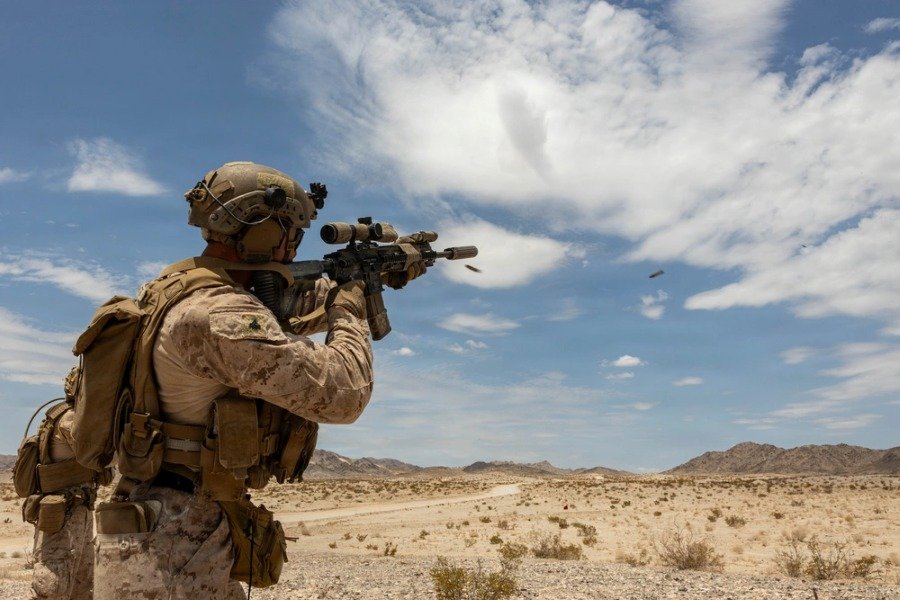
Last month, the Marine Corps introduced new service-level training to teach Marines how to counter small combat drones with weapons currently available in their arsenal.
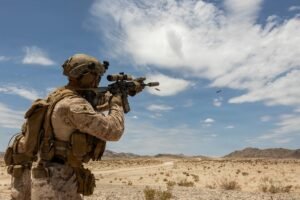
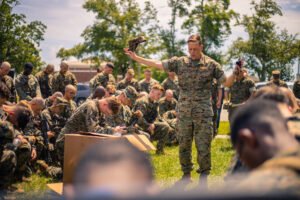
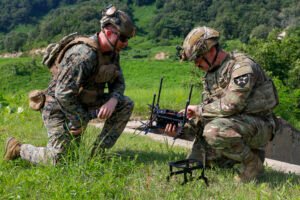
The training commenced with a three-day event at Twentynine Palms, California, where Marines from the 1st and 2nd Marine Divisions learned how to shoot down small unmanned aerial systems, or sUASs, with rifles, shotguns and grenade launchers, according to a recent release.
Capt. Faith Richardson, a platoon commander with the Tactical Training and Exercise Control Group, said in the release that they aimed to give Marines “a realistic look at the threat.”
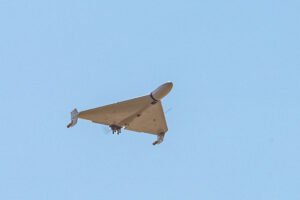
For the exercise, TTECG created counter-sUAS lanes where Marines engaged simulated enemy drones from distances as close as 20 meters, or around 65 feet. Controlled by members of TTECG, nicknamed “Coyotes,” the drones reach speeds at over 90 miles per hour.
“The intent of the C-sUAS lanes was to build the confidence of our Marines to target sUAS and complete the mission,” Richardson added.
Inside the lane, Marines practiced using an assortment of weapons, including the M27 Infantry Automatic Rifle, the M1014 shotgun, and M32A1 and M320 grenade launchers as well as electronic anti-drone weapons.
In addition to the live-fire training, the event included house clearing and patrol exercises, which tested and evaluated Marines on their ability to deny, detect and defeat sUAS.
Richardson explained that by the end, participants developed the basic skillset to apply the C-sUAS mindset to all subsequent service-level training events.
While the U.S. military has long used large aircraft drones in combat, it has rapidly accelerated the use and experimentation of small commercial drones over the past couple of years.
In December 2025, the Pentagon launched the Drone Dominance program to invest $1.1 billion into the U.S. drone market. The goal is increasing the quality of the technology while decreasing price per unit.
The program was largely influenced by the war in Ukraine, where drones have become a dominating force on the battlefield. Combatants have used inexpensive commercial drones to destroy billions of dollars worth of Russian equipment, and 90% of Russian casualties are from drone attacks.
Adopting the spirit of Drone Dominance, the Marine Corps has been quickly developing its own drone capabilities.
In the past month, the service established the Marine Corps Robotics Integration Group, or MCRIG. The group serves to integrate, standardize and institutionalize training for sUASs and C-sUASs across the total force.
The service also began stockpiling anti-drone ammo, which Marines can load into an M4 or M27 without any modification. However, unlike standard 5.56mm ammo, the anti-drone’s projectile fragments as it flies down range, so it functions similarly to a shot shell.
For intercepting medium to large attack drones, the Marine Corps inked a deal with Allen Control Systems for the Bullfrog M240, which it plans to use to aid air defense. The AI-enabled machine gun is designed to detect, track and automatically fire at aerial threats.
Moving forward, the Marine Corps said it will continue the service level training at Twentynine Palms to ensure Marines have the basic skillset to operate in areas where sUAS may be present. In turn, those who complete the training can share it with their home units.