HONOLULU — In an effort to mitigate logistical issues that accompany large-scale combat operations, the U.S. Army is working to better integrate veterinarians into combat care.
To better prepare for the possibility of a large injury rate in a future Indo-Pacific fight, combat medical teams are working on ways to utilize human and animal health at the same time, given the similar anatomies between humans and canines, as demonstrated by the 18th Theater Medical Command at the 2026 Land Forces of the Pacific Symposium and Exposition in Hawaii.
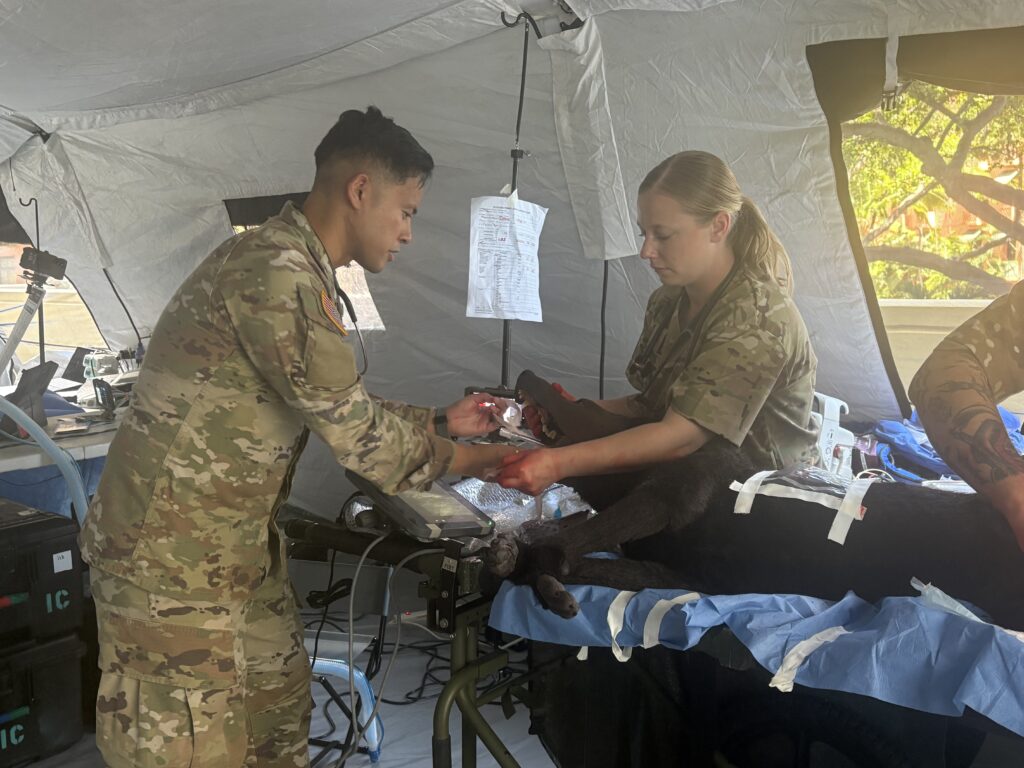
The unit, based at Fort Shafter, Hawaii, showcased a mock Forward Resuscitative Surgical Detachment tent to display their high-fidelity canine model, which is an anatomically accurate representation of a canine meant for veterinary training, and how the initial stages of triage are the same for canines and humans.
“The only difference is there’s some anatomical differences between us and a dog,” Capt. John Hutchison, a veterinarian with the Oahu Veterinary Network, said during the demonstration.
“But the principles are identical, and then all the equipment that you’re seeing is all the human equipment from our partners and all the medications that they’re using too are all the same medications, with dosaging just being a little bit different,” Hutchison continued.

Hutchison said the initial stage of isolation is the same between a canine and a human, and they undergo the same trauma assessment, called a MARCH sequence. He said that the medics address hemorrhaging as they look to get an airway established and for any signs of respiratory compromise, shock, hypothermia or head trauma.
With large-scale combat operations, there are logistical challenges to account for, such as manpower issues and contested environments.
As veterinarians and human medics “deliberately” operate and train alongside one another, they are increasing their survivability and preserving combat manpower, which provides a more resilient forward medical capability, Hutchison said.
“Here we’ve got veterinary staff, but it could be human medics working on canine patients or it could be veterinarians even helping in the [operating room] on a human patient because the principles are all the same,” Hutchison said.

The crew also displayed the Battlefield Assisted Trauma Distribution Observation Kit, or BATDOK system, that is used by the team to ensure a streamlined care process. The software models an electronic medical record system, instead of the previous paper model.
In the case that a veterinarian isn’t there, the system contains various guides that can be used by combat medics or handlers unfamiliar with medical dosing.
“It makes it a lot easier, so you can identify your point of injury, what time you gave your interventions, what kind of intervention you gave it to them, so it really organizes a lot better, makes it easy to kind of keep track of all those patients,” said Maj. Luigi Topacio, a Veterinary Corps officer at Joint Base Pearl Harbor-Hickam, Hawaii.
Since a cut suite OR would use the same technology used for military working dogs and human patients, whoever is providing the care can use a QR code to locate or create an electronic medical record for the patient to document their care as they move forward since it automatically transfers it to a record-keeping system, Maj. Tim Fogarty, a certified registered nurse anesthetist with the 18th TMC, said during the demonstration.
Lt. Col. Lauren Hamlin, commander of Veterinary Readiness Activity, Hawaii who assisted in the demonstration, told Military Times on Tuesday that in low-resource or prolonged care environments, veterinarians bring a wide-range of expertise that assists combat care, such as surgical, emergency, anesthesia, trauma and public health skills.
“Side-by-side training with human medical teams builds shared skills in triage, anesthesia, surgical support, resuscitation, logistics and evacuation while increasing overall medical capacity across the force,” Hamlin said.