At the Department of Agriculture’s research division, everyone knows there’s one word they should never say, according to Ethan Roberts. “The forbidden C-word” — climate.
Roberts, union president at the National Center for Agricultural Utilization Research in Peoria, Illinois, has worked for the federal government for nearly a decade. In that time, the physical science technician has weathered several political administrations, including President Donald Trump’s first term. None compare to what’s happening now.
The sweeping transformation became apparent last March, after a memo from upper management at the USDA Agricultural Research Service instructed staffers to avoid submitting agreements and other contracts that used any of 100-plus newly banned words and phrases. Roughly a third directly related to climate change, including “global warming,” “climate science,” and “carbon sequestration.”
Roberts met with his union to figure out how to respond to the memo. They concluded that the best course of action was just to avoid the terms and try to get their research published by working around them. Throughout the federal agency, “climate change” was swapped for softer synonyms: “elevated temperatures,” “soil health,” and “extreme weather.”
It’s part of a bigger trend. Across federal agencies and academic institutions, scientists are avoiding words they once used without hesitation. When Trump took office last year — calling coal “clean” and “beautiful” while deriding plans to tackle climate change as a “green scam” — a so-called “climate hushing” took hold of the United States, as businesses, politicians, and even the news media got quieter about global warming. There’s a long list of supposedly “woke” words that agencies have been discouraged from using, many tied to climate change or diversity, equity, and inclusion initiatives.
The language changes were accompanied by larger shifts in how the federal government operates. Elon Musk’s Department of Government Efficiency, known as DOGE, laid off hundreds of thousands of federal workers last year. The Trump administration also slashed spending on science, cutting tens of billions of dollars in grants for projects related to the environment and public lands. Researchers are adapting to the new landscape, with some finding creative ways to continue their climate research, from changing their wording to seeking out different sources of funding.
For federal researchers studying, say, the interplay between weather patterns and soybean diseases, the key is to reframe studies so they don’t clash with the Trump administration’s politics. “Instead of making it about the climate, you would instead just make it about the disease itself, and be like, ‘This disease does these things under these conditions,’ rather than ‘These conditions cause this disease to do this,’” Roberts added. “It’s just changing the focus.”
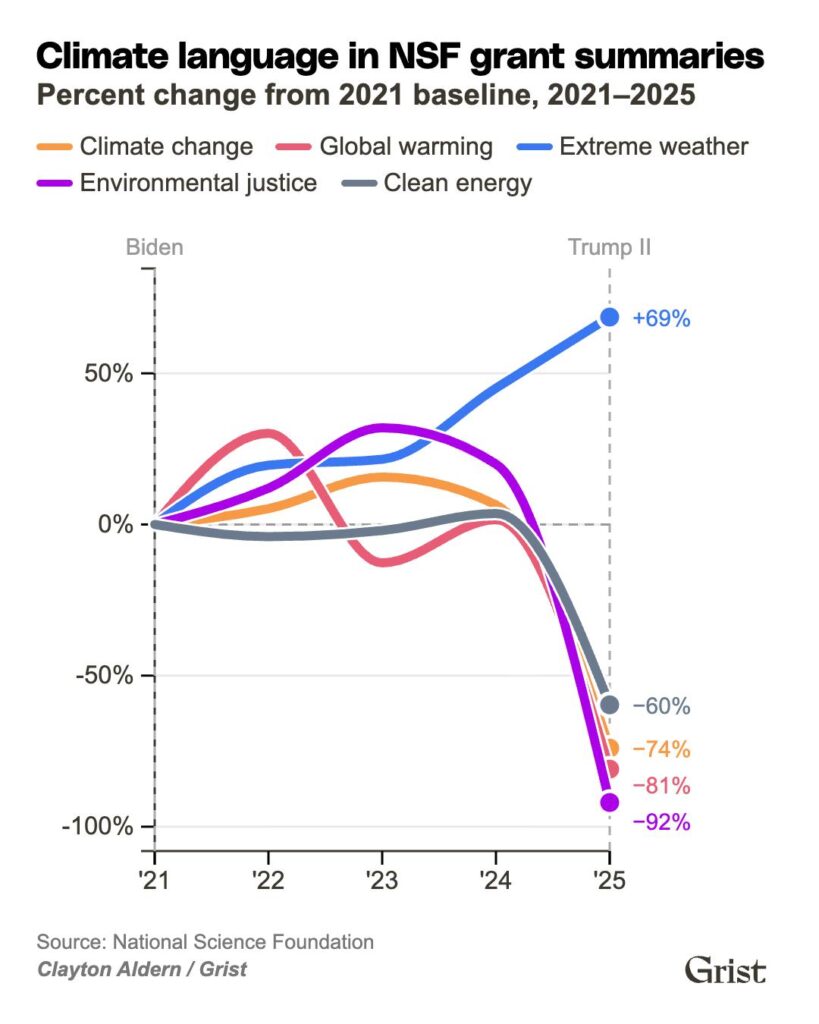
You can see how federally funded research has changed by looking at the grants approved by the National Science Foundation, or NSF, an agency that provides roughly a quarter of the U.S. government’s funding to universities. Grist’s analysis found that the number of NSF grants whose titles or abstracts mentioned “climate change” fell from 889 in 2023 to 148 last year, a 77 percent plunge. Part of that’s a result of NSF staffers approving fewer grants related to climate change under Trump. But researchers self-censoring by omitting the phrase in their proposals also appears to play a role, evidenced by the corresponding rise of “extreme weather” — a synonym that gets around the politicized language.
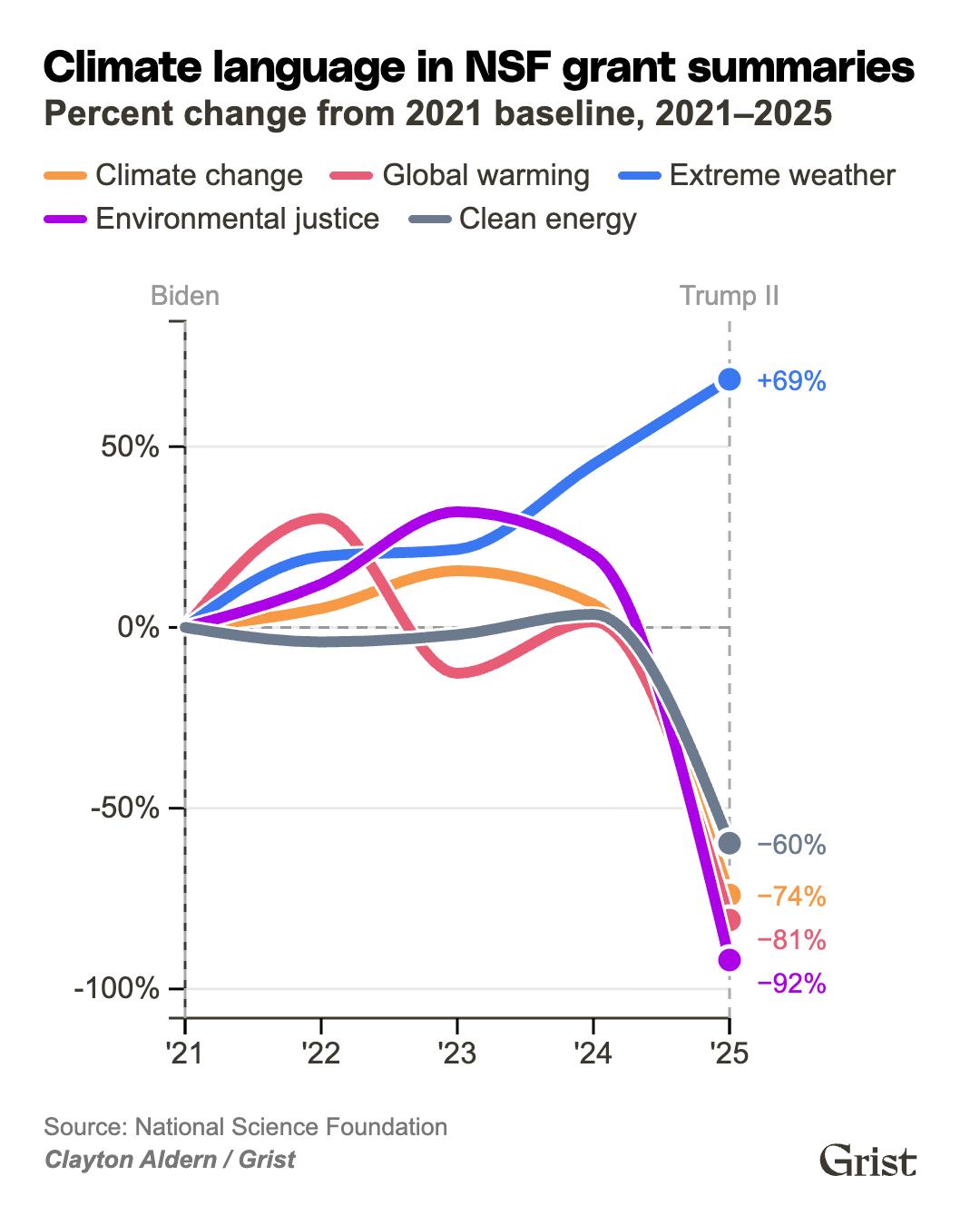
Climate language in NSF grant summaries
Percent change from 2021 baseline, 2021–2025
Click to show or hide lines
Climate change
Global warming
Extreme weather
Environmental justice
Clean energy