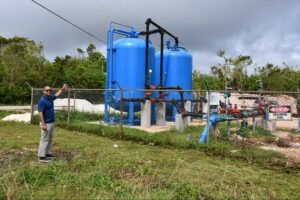
Across tribal nations, hosting a convening with dinner and a tour of an ambitious new project is a familiar scene. But for David Harper, a member of the Colorado River Indian Tribes and CEO of the newly created tribal energy financing organization Huurav, a recent gathering felt different. Last week, at the Bluewater Resort and Casino on the Colorado River Indian Tribes reservation in western Arizona, Huurav met with tribal leaders, investors, and farmers to kick off the tribe’s first agrivoltaics project: a practice that allows for growing crops beneath solar panels.
The project marks a significant breakthrough for the tribe and the broader tribal clean energy landscape, arriving on the heels of a devastating blow to federal support. In October of last year, the passage of President Donald Trump’s tax bill, colloquially known as the “One Big Beautiful Bill Act,” stripped roughly $1.5 billion in federal funding earmarked for tribal renewable energy and climate resilience projects.
“Were we surprised by the claw back? No, they’ve done it before,” said Huurav’s Harper. “Have they reneged on their promise of our treaties? Yes, of course. So does that immobilize us and not be able to survive? No, what it does is it helps us, it makes us create a better pathway for ourselves.”
With nearly 1,600 projects by tribal governments and Native entities losing some or all of their federal funding, tribes have been forced to get creative. To keep clean energy projects alive, tribes are turning to philanthropy, low-interest loans, and nonprofits to bridge the massive financial gap.
The Biden-era Inflation Reduction Act of 2022 represented a historic investment in tribes and renewables, but experts and tribal leaders felt it was still insufficient to address historic inequities in Indian Country. “Given the role that the federal government itself played in generating these investment needs through things like land theft, disinvestment, [and] cultural destruction in Indian Country, a one-time infusion of cash isn’t enough,” said Robert Maxim, a member of the Mashpee Wampanoag Tribe and Brookings fellow who recently co-authored a report on the One Big Beautiful Bill Act’s impact. Maxim emphasized that federal funding for Indian Country is a fundamental part of trust and treaty obligations.
“Things like a clean environment, adequate energy to supply homes, basic investments in electricity, and the ability to do all that without higher levels of pollution and environmental degradation than the U.S population as a whole are all key to that trust and treaty relationship,” said Maxim.
To fill the void, nonprofits like the Alliance for Tribal Clean Energy are stepping in. Through its Indigenous Power and Light Fund, backed by philanthropic partners like the MacArthur Foundation, the Alliance serves as a critical lifeline. Huurav is taking a lead role as well, drawing on its expertise gained through its participation in the inaugural cohort of the Agrivoltaics Growth through Resilience and Innovation program, run by the National Laboratory of the Rockies and the Farmland Trust, a conservation-focused agriculture nonprofit.
While commercial lenders are difficult to find across tribal nations, community financial development institutions, known as CFDIs, are meant to bridge that gap by offering funding to Native-led organizations and tribes seeking to invest in renewables on tribal land.
A recent survey found that more than half of Native-operated CFDIs, financial institutions that provide credit to underserved populations, cite lack of funding as one of their biggest challenges, and that financial barrier compounds existing energy inequalities. A 2023 Department of Energy report revealed that tribal households face an energy burden 28 percent higher than the national average. In the Southwest, for example, the Hopi Tribe and Navajo Nation have the highest rates of unelectrified homes and often rely on coal or propane for heat. Many tribes lack reliable transmission lines, leaving them vulnerable to extreme weather events, like floods and wildfires, fueled by climate change.
Despite these obstacles, Indigenous communities are pushing forward by courting sustainable investors to achieve energy independence and lower utility costs. On the Hawaiian island of Molokai, for instance, Native Hawaiians are leveraging profitable renewable energy projects to reduce exorbitant utility bills while simultaneously advancing their landback initiatives. “They’re making the case that they can get investors to invest in their landback projects,” said Kyle Whyte, Citizen Potawatomi Nation and University of Michigan professor of environmental justice. “One of the ways that they’ll be able to succeed in governing that land is through profitable renewable energy projects that would reduce people’s utility costs.”
However, some tribes have turned away from solar and wind altogether, opting instead to pursue active federal grants aligned with the Trump administration’s agenda to expand domestic energy. This includes tapping into almost $172 million in Department of Energy geothermal funding or seeking transmission upgrades backed by a $1.6 billion federal loan guarantee.
Ultimately, the push for clean energy is about self-determination and resilience. As David Harper of Huurav puts it: “We don’t trust the federal government, but we have to work with them to understand that we have to continue in our process of survival and self-sustainability.”
This story was originally published by Grist with the headline The feds pulled $1.5B from tribal clean energy. Tribes are finding another way. on Mar 10, 2026.